Renaissance of 'little lobsters'
 |
|
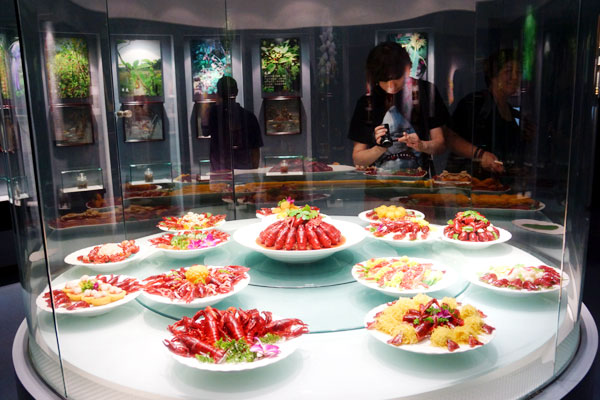
A crayfish feast on display at the Xuyi Crayfish Museum. Photos by Ye Jun / China Daily |
 |
|
Xuyi has more than 13,340 hectares of crayfish farms. |
They are called crayfish, crawfish or yabbies, depending on where you come from, but in China they are celebrated as "little lobsters" and enjoyed across half the country. Ye Jun looks at the popular delicacy.
It is mid-June, and there are 10,000 eager diners gathered around a huge city square at the foot of Duliang Mountain in Xuyi, Jiangsu province. They are there to eat crayfish, the petite crustaceans that the Chinese call "little lobsters" or xiaolongxia.
At Xuyi, it is the start of the annual crayfish festival, which will last until the end of June. It has been held every year since 2000, and it is the residents' way of celebrating a produce that gives much of the population a steady income.
They have found fame as well as fortune. In 2008, 15,600 people seated around 2,380 tables consumed huge amounts of crayfish in the festival square, and created a Guinness world record.
The crayfish festival is very much like Spring Festival for local farmers and residents, and everyone from around Xuyi will come into the city specially to eat crayfish.
"Little lobsters" have become a major source of revenue here. Twenty percent of the average income, which is about 2,000 yuan ($326) a year, comes from crayfish farming and its supporting industries.
With a population of 780,000, more than 100,000 Xuyi residents are involved in the production and preparation of crayfish, with a turnover of more than 2 billion yuan ($330 million) per year.
The success of the crayfish industry in Xuyi has much to do with the invention of shisanxiang, "13 fragrant spices", a combination of herbs that are used to cook the crayfish, much like the lobster boil mix in the West.
Shisanxiang includes spices such as cinnamon, star anise, dried tangerine peel, Sichuan pepper, galangal and fennel among others. These spices are normally used in Chinese cuisine to flavor meat, and they are supposed to warm the stomach, countering the "chill" of seafood.
The flavors also whet the appetite, making diners want more.
The special cooking method, along with the spice mix recipe, has made crayfish chefs from Xuyi very popular exports to other parts of China, and the city has pressed this advantage by building training centers - both for farmers, and chefs.
Xuyi farms crayfish on a large scale, with more than 13,340 hectares of crayfish ponds. It is also helping authorities set up national benchmarks for crayfish farming. A traceable system is being implemented so consumers can find out where the crayfish they are eating comes from, and when they were harvested.
"At the farm ponds we do not need use any pesticide," says Lu Wei, general manager of River Red, a crayfish farm in Xuyi that produces 250,000 kilograms of crayfish. "That's because the crayfish has a strong constitution, and can resist natural calamity."
"Crayfish have strong survival instincts and can live in poor conditions in small ponds. That gives rise to the misconception that crayfish live in unsanitary environments," says Liu Guoxing, assistant researcher of Freshwater Fisheries Research Institute of Jiangsu province.
"But only farmed crayfish that grow in clean water get big enough for the market."
Liu manages a research center at River Red farm. Many big crayfish farms in Xuyi cooperate with professional research institutes like Liu's in Jiangsu.
|
|
|