Hong Kong steps up on RMB internationalization
Updated: 2013-11-22 07:19
By Wong Joon San(HK Edition)
|
|||||||


Hong Kong has become the largest offshore renminbi (RMB) financing center and will play a key role in promoting its use globally, Chief Executive Leung Chun-ying said at the China Daily Asia Leadership Roundtable Forum on Tuesday.
In his keynote address at the public forum, Financial Development in China & Implications for the Global Economy, Leung said with increased market participants in offshore RMB business, there were more RMB-denominated investment products coming on stream, including deliverable RMB currency futures, offshore RMB stocks, A-share exchange-traded funds (ETF) warrants and offshore RMB Bond Index ETFs.
"These are encouraging developments to promote the use of the RMB as an investment currency," he said. "And because Hong Kong is also an international financial center, it is our mission to promote the use of RMB around the world."
This week, Hong Kong's Financial Secretary John Tsang was in Europe to discuss, among other things, ways for Hong Kong to co-operate more closely with the financial centers of London and Paris.
The special panel discussion on "Financial Development in China and Implications for the Global Economy" was organized by China Daily together with the Pacific Trade and Development Conference (PAFTAD) and Hong Kong Institute for Monetary Research (HKIMR).
As the forum's co-chair, Zhou Li, Publisher & Editor-in-Chief of China Daily Asia Pacific, said: "This high-level discussion provided more insights on the communique issued after the Third Plenary Session of the 18th CPC Central Committee, which pledges to speed up the building of China's market system."
Professor Edward KY Chen, the forum's other co-chair, who is also the chairman of the council of advisers of the Hong Kong Institute for Monetary Research, said he believed that Hong Kong has its own role to play in driving forward the growth of the world's second largest economy - China. "Hong Kong has contributed greatly to the banking and research in RMB internationalization," he said.
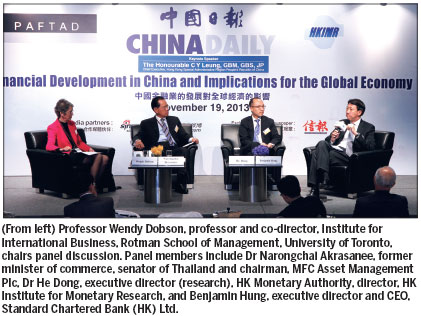
Commenting on capital account liberalization and interest rate deregulation, Standard Chartered Bank (Hong Kong) executive director and Chief Executive officer Benjamin Hung, said: "If I were to guess what is on Beijing's mind, two words come to my mind. Hurry (up) slowly. Obviously they would like this (capital account liberalization) to be fast, but they also want it to be ready. A lot of what is happening in Hong Kong shows that the mainland is using Hong Kong both as an experimental ground as well as a firewall."
Hung spoke during the panel discussion on "Financial Development in China and Implications for the Global Economy" moderated by Professor Wendy Dobson from the Institute for International Business, University of Toronto's Rotman School of Management.
Regarding the same issue of capital account liberalization, He Dong, executive director (research) at Hong Kong Monetary Authority, said: "My view is that capital account convertibility of the RMB should be considered as a spectrum it is not a 'black and white' picture, we have a spectrum of different shades of colors."
"As the Chinese leaders have said they will accelerate the pace of RMB convertibility at some stage, so it maybe sooner than you think, and the RMB will be basically convertible for most transactions," said He.
A third panel speaker Narongchai Akrasanee, the former Minister of Commerce and Senator of Thailand, who is also chairman of the MFC Asset Management Plc, said: "The RMB will be another important anchor (in the basket of international currencies) and continue to operate as such (alongside the US dollar)."
Investment restrictions
Turning to the investment restrictions of RQFII funds, Leung said they have also been relaxed to allow pilot institutions to choose their preferred investment portfolios in accordance with market conditions.
"These measures will enable more market participants in Hong Kong to engage in RMB product origination, further facilitating the cross-boundary use and healthy circulation of RMB."
Leung said all this presents huge new opportunities for international trade as well as investment with Chinese mainland. "It is also a trend that Hong Kong has long been preparing for."
"Our city serves as the premier international gateway for trade and investment into and out of the mainland. Nowhere has more experience in doing business on the mainland than Hong Kong. We have the right government-to-government, business-to-business and people-to-people links to connect foreign firms to the opportunities just across our boundary," Leung commented.
"This is what makes Hong Kong the Chief Knowledge Officer, or CKO, for China. Today, this knowledge extends beyond trade and services expertise to include financial and investment developments," he said.
On this note, Leung said Hong Kong naturally expected more competition for offshore RMB business from financial centers around the world. Hong Kong, he said, has always welcomed competition as a driver for growth and progress.
"RMB business is no exception. We look forward to a more liberalized environment and more players in the market. This will help to boost collective efforts to expand the range and quantity of RMB business globally," Leung stressed.
Unique clearing platform
Leung said in terms of financial infrastructure, Hong Kong has developed a unique, highly efficient and reliable RMB clearing platform - the Renminbi Real Time Gross Settlement (RTGS) system.
"The system facilitates banks from around the world to make RMB payments efficiently and with minimal risk. In the second quarter of this year, the average daily turnover handled by the RTGS system in Hong Kong exceeded 400 billion yuan. That is a vast amount of capital being transacted through the system every day in Hong Kong," Leung explains.
"We have also extended the operating hours of the RMB RTGS system until 5.30pm Central European time to meet the needs of banks in Europe," Leung says.
As at the end of September, a total of 211 banks participated in Hong Kong's RMB clearing platform, including 186 branches and subsidiaries of foreign banks and overseas arms of Chinese banks.
All this represents an unparalleled global payment network capable of handling RMB transactions for different parts of the world, as well as among the various offshore markets and onshore markets in mainland China, Leung says.
In another development, Leung points out that the RMB has emerged as an international reserve currency. In June this year, the city's Treasury Markets Association launched the CNH Hong Kong Interbank Offered Rate fixing, or CNH Hibor. It facilitates the pricing of RMB loan facilities and various offshore RMB interest rate derivatives. This is important for market participants to manage their risks and improve market-wide liquidity.
Contact the writer at joonsan@chinadailyhk.com
China Daily
|
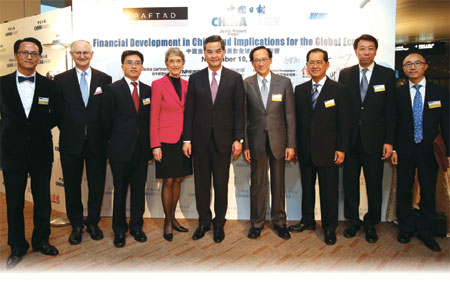
VIPs pose for group photograph at the roundtable event, together with Chief Executive of the HKSAR Leung Chun-ying (fifth from left). Edmond Tang, Parker Zheng / China Daily |

(HK Edition 11/22/2013 page4)