Press freedom also means press responsibilities
Updated: 2014-02-19 06:59
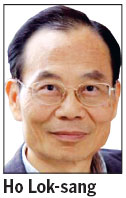
By Ho Lok-Sang(HK Edition)
|
|||||||


The sudden dismissal of the former Commercial Radio host Li Wai-Ling has caused a stir, because some people believe it was a violation of press freedom. The public concern is justified, because freedom of the press is fundamental to effective public governance, and as the recent experience in Japan under Shinzo Abe and Turkey under Recep Tayyip Erdogan show, political intervention is often a reality - even in supposedly democratic countries.
A spokesman for Commercial Radio says that there is a lack of trust between Li and the radio that made it impossible for them to work together. Li counters that her style and behavior have not really changed over the years, and she cannot understand why the radio terminated her contract so suddenly. I cannot comment on who is right or wrong in this case, but I would like to discuss what press freedom really is.
First of all, having press freedom does not mean that the media can act in an unprofessional and irresponsible manner. Even the Nordic countries which are well regarded in terms of press freedom require their media to comply with a Code of Ethics. For example, in Norway, ranked No 3 in the Freedom of the Press Index according to Reporters Without Borders, there is an official ethical code for the press. This applies to the printed press, radio, television, as well as online publications. The Norwegian Press Complaints Commission is the enforcer. A selection from the key items on the code includes:
(i) Reporters should be able to identify the source of information, while protecting the informant by not divulging the name of the source;
(ii) Reporters should ensure the accuracy of information and quotes;
(iii) Change of a given statement from higher authorities or management should be limited to the correction of factual errors;
(iv) Reporters should respect a person's character and identity, privacy, ethnicity, nationality or belief, and avoid using terms that might be stigmatizing;
(v) Factual information and commentaries should be clearly distinguished;
(vi) Be sensitive to the way reports of accidents and crime may affect victims and their families and avoid identifying victims or missing persons unless the next of kin have been informed. Be considerate to people suffering from grief or other troubles;
(vii) Be cautious when reporting on suicide and suicide attempts. Avoid descriptions of the method or other conditions that might trigger more suicides.
Unfortunately, Hong Kong's press routinely ignores these principles. Shih Wing-ching, the noted entrepreneur and philanthropist, in one of his columns in AM730, said people in Hong Kong today are reluctant to accept interviews by reporters. He wrote: "As soon as the subject of press invitations for interviews was raised, everyone was indignant, warning, 'You will regret it. You will discover that the reporters are taking advantage of you to make a point. They all wanted you to confirm their views rather than report your views. In the event your views differ from theirs, they would attack you, make fun of you. They would trap you by raising hypothetical questions.' A scholar who received an interview from a high-end media reporter was surprised to find that what came out was not really a report based on the interview, but an article based on the reporter's perception of him based on earlier reports."
A sample of commentaries from Hong Kong's newspapers readily shows how abusive Hong Kong's commentators often are. What is the sense in calling the Chief Executive Leung Chun-ying "Lang Ying" (Wolf Ying) or "Distorted Thinking"(similar to "CY" in Cantonese pronunciation) when the commentator has the freedom to criticize policies he finds problematic? Why are commentators so prone to second guess other people's intentions? Many of these commentaries would be unacceptable under Norway's code of ethics for the media. If the management refuses to publish an article that violates professional ethics, it is not interfering with press freedom.
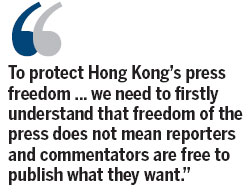
To protect Hong Kong's press freedom, therefore, we need to understand that freedom of the press does not mean reporters and commentators are free to publish what they want. News reports are supposed to be news reports, and reporters must not try to lead readers to their points of view. Commentaries based on different ideologies and arguments of course should be allowed, the bottom line being that they should genuinely reflect the views of the commentators and should be based on facts and arguments. Personal attacks and abusive language cannot be equated with satire.
I believe that a translation of Hong Kong's newspapers would shock many journalists in the West, including the Nordic countries. Requiring journalists to abide by a code of ethics is consistent with press freedom, and indeed the beginning of the Hong Kong's press regaining its credibility.
The author is director of the Center for Public Policy Studies at Lingnan University.
(HK Edition 02/19/2014 page1)