'International standards' of nomination don't exist
Updated: 2014-08-22 05:40
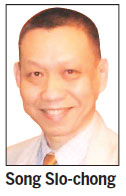
By Song Sio-Chong(HK Edition)
|
|||||||


A day before meeting central government officials in Shenzhen to discuss constitutional reform for the SAR on Thursday, 26 opposition lawmakers signed a joint declaration vowing to veto any proposals for political reform which failed to meet "international standards".
To those who study international law, such a demand is illogical and could even be construed as blackmail. This is because there are no international or universal standards governing universal suffrage. For example, the US president is elected by 538 members of Electorate College; the prime minister of the United Kingdom is selected from the ruling party. Such a person in Britain is selected either by parliamentary members of the Conservative Party or individual members of the Labor Party. The French president is elected by all registered voters. If an "international standard" did exist, these three democratic nations would surely have adopted it. As they have different election and selection mechanisms, it shows there is no such standard.
The same logic can be applied to the nomination of candidates. US presidential candidates are chosen at national conferences of the Republican and Democratic parties. But no such national conferences are held in the UK.
This is because the leaders of all parties contesting a UK general election are de-facto candidates for election as prime minister under the aegis of their party; these leaders are chosen by leadership contests within their parties - parliamentary, and general.
In France presidential candidates are nominated by 400 members among a poll of 50,000 people chosen as nominating agents. These make up less than 1 percent of the French population. Therefore, different national standards demonstrate that there is no international standard.
Hong Kong's opposition politicians may argue that there is more than one international standard - however, they do not say how many there are or which one they would prefer. As far as I know there are more than a hundred standards concerning the qualification, nomination and election of heads of states and heads of national governments, not to mention regional leaders.
As such, standards are so varied they should be called national or domestic standards. Again this shows it is a misnomer to talk of international standards.
Even though there are common principles in international law which are observed, the signatories of such laws, if any, are individual sovereign nations. How these international laws are applied depends on central authorities of individual sovereign nations. It also depends on their international obligations. It is not dictated to them by members of regional institutions - which in the case of Hong Kong would be the opposition in the Legislative Council.
There are thousands of different standards of domestic legislation at both national and regional level. It is interesting to note all these have two things in common:
One is the requirement that heads of the state or region, or heads of government at national and regional levels must be patriotic. They are required to be loyal to their constitutions and their countries - without exception. Hong Kong's opposition demand adherence to international standards (which do not exist) yet is reluctant to implement any universal understanding of patriotism.
Another thing they all have in common is that all nations confer voting rights to citizens instead of to permanent residents. But the Hong Kong SAR Basic Law gives these rights to permanent residents. Chinese citizens who do not have permanent resident status cannot register as voters. Again, Hong Kong's opposition does not want to include all local Chinese citizens as voters - despite demanding the implementation of international standards.
The opposition also rejects the common practice of international standards of patriotism. They want to adopt some local interpretations of international standards. Their intention is to veto anything they do not like without reason because it might still have some ideological appeal to their supporters.
This will only hinder and jeopardize Hong Kong's democratic process. One aspect of the current political reform process is the need to amend the present voting mechanism of CE candidates by 1200 members of the Election Committee. The aim is to achieve the direct election by all 3.5 million registered voters. This will be a dramatic leap forward for democracy in Hong Kong in 2017.
To overcome these problems, I suggest the National People's Congress Standing Committee (NPCSC) divide the whole CE political reform package into two parts. The first should deal with the amendment of Annex I of the Basic Law and the revision of local legislation. The second would comprise those amendments capable of being directly implemented into local legislation.
I also believe the direct election of the CE (by 3.5 million voters) should be outlined in Annex I of the Basic Law. A detailed election mechanism should also be written into the CE Election Ordinance. As for implementation of Article 45 of the Basic Law regarding the meaning of the terms such as "broadly representative" and "by democratic procedure", and also issues of patriotism, these are all matters of interpretation. The NPCSC can interpret them as it sees fit.
The author is a HK veteran commentator and professor at the Research Center of Hong Kong and Macao Basic Law, Shenzhen University.
(HK Edition 08/22/2014 page9)