HK should try hard to net dotcom firms
Updated: 2014-10-10 05:20
By Emma Dai in Hong Kong(HK Edition)
|
|||||||


In the light of Alibaba Group Holding Ltd's mega listing in New York, Hong Kong's equity market still has chance to lure Internet companies for initial public offerings (IPOs), although more efforts are needed, a market expert from auditing giant Ernst & Young said.
"It's a pity that Hong Kong has missed out on Alibaba. With or without it, a market would be different," Ringo Choi, Asia-Pacific IPO leader of Ernst & Young LLP, told China Daily. "But, apart from e-commerce, the sector generates all kinds of businesses, such as mobile payment firms and logistics services. We still have plenty of chances to float them in Hong Kong," he said.
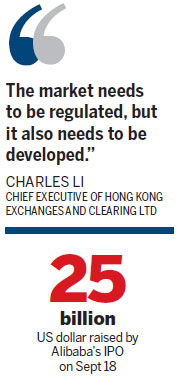
With Alibaba's $25-billion debut- the world's largest IPO on record, launched on Sept 18 - two of the three mainland Internet giants, Baidu, Alibaba and Tencent, have finally landed in the US. Several other popular mainland websites like JD.com, Alibaba's competitor, and Weibo.com, the mainland version of Twitter, also got listed on Nasdaq earlier this year.
By comparison, the Hong Kong capital market's disadvantage in the battle to lure dotcom firms has become more obvious. "Although Internet companies can get a similar price-to-earning (PE) ratio for IPOs in Hong Kong as they would have in the US, the latter is still much preferred by mainland Internet firms seeking a listing. That's because in the secondary market, American investors are much more enthusiastic about dotcom firms," Choi said.
To change the mindset that the US is the prime share floating location for Internet firms, Hong Kong needs to be more flexible with its regulations, and offer more favorable conditions, Choi argued, referring to weighted voting rights.
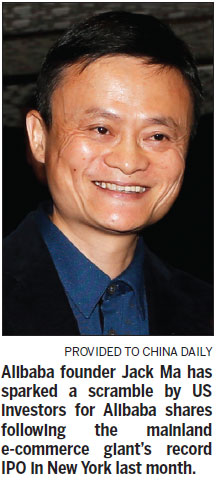
As a governance structure empowering certain persons to control a company regardless of their shareholding, weighted voting rights was reportedly the last straw in Alibaba's decision to skip Hong Kong. The city's existing listing rules do not allow any company to go public with such a structure. However, Jack Ma, founder and spiritual leader of the e-commerce powerhouse, only holds less than 7 percent of the company's stake.
"The money-burning nature of the Internet sector dictates that core members of the management are not always the major shareholder. Dotcom firms have to continuously get capital injections, especially before they become large enough to dominate, or they would never make it. By then, founders' shareholding would have long been diluted. Yet, the company would not be the same without them at the helm," Choi said.
"It's not right to change the rules for just one company. But allowing weighted voting rights will help Hong Kong attract a whole range of Internet firms. I believe it would be worth the effort," he said.
Hong Kong Exchanges and Clearing Ltd (HKEx) published a concept paper on Aug 29, seeking market opinions on weighted voting rights. According to the document, 102 mainland firms had listed in the US instead of Hong Kong as of the end of May. Nearly one third of them, or 29 percent, have a weighted voting right structure and "this is becoming increasingly common". More importantly, the paper said, "this one third represents 70 percent of the market capitalization of all US-listed mainland companies".
After publishing at least four blogs on the topic, HKEx Chief Executive Charles Li said in his Aug 31 post: "The paper is designed to promote a focused and coherent discussion on the concept of a weighted voting rights structure in Hong Kong and determine whether our adherence to 'one share, one vote' should be universally required or whether we could accommodate more flexibility under appropriate circumstances. The market needs to be regulated, but it also needs to be developed".
"'One share, one vote' is so deeply rooted in Hong Kong that many people take it as a principle. However, even with it, major shareholders still enjoy an advantage over small shareholders. It's not equal anyway," said Choi.
"I believe we can find a way to have weighted voting rights in Hong Kong and have small shareholders under the wing of regulations as well," he added. "We are always the financial market on the front and we should keep exploring."
emmadai@chinadailyhk.com
(HK Edition 10/10/2014 page8)