Unearthing homegrown literature
Updated: 2016-03-14 07:32
By Wang Yuke in Hong Kong(HK Edition)
|
|||||||


|
Professor Chan Kwok-kou, dean of the Faculty of Humanities at the Hong Kong Institute of Education. |

Most local youth have no inkling about the history and landscape of Hong Kong literature, which is a great pity, said Professor Chan Kwok-kou, dean of the Faculty of Humanities at the Hong Kong Institute of Education (HKIEd). Keen to redress the situation, Chan has taken it upon himself to foster greater awareness about Hong Kong literature among the public, particularly the younger generations.
"I once asked some young people to name a few Hong Kong writers. They couldn't give me an answer. They are familiar with Bai Xianyong, Yu Guangzhong, or Chinese classic poet Du Fu but not Hong Kong writers," says Chan. He asserts that the city is not short of talented writers who have produced literary works of high quality. Many of these works have gained huge popularity outside Hong Kong, like in Taiwan and the Chinese mainland, but remain ignored in Hong Kong.
Even more ironically, Hong Kong people sometimes take certain local writers to be Taiwanese because they shot to fame in Taiwan or elsewhere. For example, Xi Xi, a Hong Kong fiction writer and poet, has once been mistaken by many as a Taiwanese because that's where she began to get noticed.
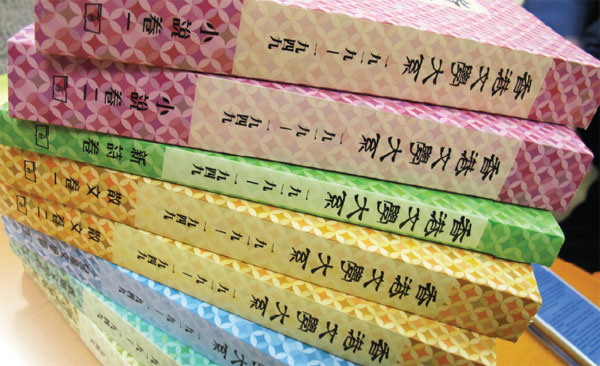
In the past six years, Professor Chan worked with a team of academics and they compiled an anthology of Hong Kong literature, Compendium of Hong Kong Literature 1919-1949. This 12-volume set covers major works in Chinese that went into print during that 30-year period. Poetry, prose, drama, fiction, criticism and other genres are featured in the collection. Classical-style literature finds a place as well.
"We create this big volume of a compendium with an intention to offer local people a glimpse into the literature scene in early Hong Kong and how it was influenced by metropolitan culture," says Chan. The publication has drawn much attention from Taiwan and the Chinese mainland.
Chan says there is no public policy in Hong Kong that specifically focuses on promoting local literary culture. He says the funding for compiling and producing the compendium was provided mainly by private donation and individual editors' own research grants. The Hong Kong Arts Development Council also sponsors the project enthusiastically.
Chan asserts that the Chinese history and language education modules followed in Hong Kong do not expose students to Chinese literature from a broad perspective. He says it is not mandatory to study history in secondary schools. Students who opt for history either study Chinese history or World history but rarely both.
Not long after took up the position of founding Dean of the Faculty of Humanities, Chan developed a new BA in Language Studies program which aims to cultivate Chinese-major students with a sense of global awareness, and English-major students with knowledge of Chinese culture. Chan thinks it is very important to learn Chinese and English at the same time, in a bicultural and trilingual way. Chinese and English should be equally emphasized in Hong Kong, given the city's unique bicultural environment.
In their 2015-2016 term, HKIEd launched a new program, Bachelor of Education (BEd) in History. BEd in Chinese History will follow next year. These programmes are designed with a particular consideration of Hong Kong's cultural and linguistic environment. Chan believes the retitling of HKIEd as a university makes it easier for graduates of Chinese history and Chinese literature to get teaching job in local schools. In the long term, it would motivate young people in Hong Kong to study their own literature and culture.
"Literature is regarded by some as remote and irrelevant to our daily lives. But aside from being an area of knowledge, literature is also a vehicle that connects us to the world," notes Chan.
Chan says that in times of globalization it is necessary to understand the world through one's own cultural identity. It's a way of broadening one's horizons and expanding one's mind. Books play a pivotal role in channeling us into the world because by reading books "we can connect ourselves to the outside world and understand our society better" says Chan.
Apart from that, Chan notes, books lead us into an imaginative world. Literature of all forms can open up a world which is inaccessible in reality. In Chan's words, only books could make the impossible possible.
jenny@chinadaliyhk.com
|
Compendium of Hong Kong Literature 1919-49. |
(HK Edition 03/14/2016 page1)