Can franchising help US fast-food giant regain its footing globally?
Updated: 2016-07-19 07:21
By Luo Weiteng in Hong Kong(HK Edition)
|
|||||||


|
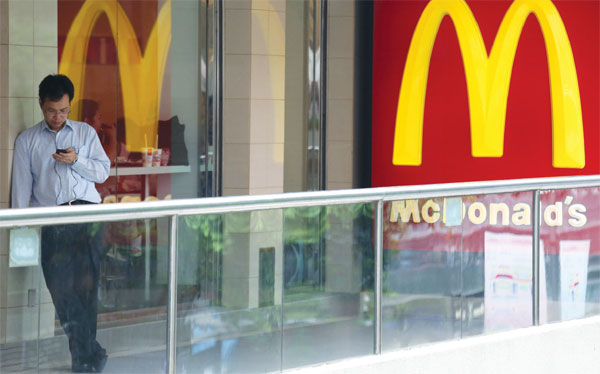
A man checks his smartphone outside a McDonald's store in Hong Kong. Touted as a gold mine for McDonald's for many years, the Chinese mainland and Hong Kong have seen a 75-percent surge in the number of McDonald's outlets, with operating margins having almost doubled from 2005 to 2010. Parker Zheng / China Daily |
Will the McDonald's hamburger and the traditional, famous Peking roast duck make a good match?
The options are open as the US fast-food giant is contemplating a more localized recipe for its business on the Chinese mainland and in Hong Kong.
McDonald's is seeking franchised partners, who might know the Chinese market a little better to do the cooking, at an auction that could fetch up to $3 billion.
A fresh bout of market speculation was ignited over possible correlation between the surprise resignations of four top executives at Quanjude - China's time-honored brand for Peking roast duck that was established in 1864 - and the group's bidding for McDonald's 20-year mass franchise rights on the mainland and in the SAR.
The management reshuffle at the State-owned Peking duck restaurant chain, involving its chairman, general manager, board secretary and a board member, came as McDonald's narrowed down a shortlist of bidders at the second round of bidding in early July.
The shortlist includes Nanjing-based conglomerate Sanpower Group, which bought an 89-percent stake in 167-year-old UK department store House of Fraser in 2014, and confirmed a joint bid with Beijing Tourism Group at McDonald's first-round bidding in June.
However, it's not immediately clear whether Beijing Tourism Group - Quanjude's largest shareholder with a 42.67-percent stake - was among the shortlisted bidders in the second round.
Shenzhen-listed Quanjude told the Shenzhen Stock Exchange last Tuesday that the resignations by some of its directors and senior managers were a "normal personnel reshuffle".
A spokesman for the chain told China Daily that the resignations and management changes had nothing to do with the McDonald's bidding, dismissing market speculation that a new management team with richer acquisition-and-merger experience would give it more leverage in McDonald's franchise deal.
Sanpower Group and Beijing Tourism Group were not immediately available for comment. "As no decision has yet been made, it would be premature to speculate further," McDonald's said in a email reply to China Daily.
"We may not expect Peking duck burgers on McDonald's recipe, but it's definitely more of a joke. Basically, the introduction of franchised partners with more local relevance indicates that McDonald's menus in the Chinese market will become more localized to win back customers," said Li Zhiqi, chairman of China Brand Creative Team Co.
Impressing mainland consumers is no easy task as it used to be. The novelty of eating at a US fast-food restaurant has worn off, with the increasingly fickle and choosy customers favoring healthier and more upscale dining experience instead, and paying more attention to food security in the wake of a scandal over expired meat that had tarnished the image of a cluster of foreign fast-food brands, including McDonald's, in 2014. Not to mention the country's food-delivery platform makes the game really hard to play.
"Brand aging and flagging sales have become a big trend for foreign fast-food companies in China. They are struggling to bring in local franchised partners to reinvigorate growth and rejuvenate their brands," said Zhu Danpeng, a researcher at the China Brand Research Institute.
Unlike US and European markets, where 90 percent and 82 percent, respectively, of McDonald's outlets are franchised, only 35 percent of the group's over 2,200 outlets in China have been under local ownership since it began franchising its operations on the mainland in 2010.
In an attempt to fend off growing competition from domestic rivals and to revamp its public image in the aftermath of food-safety scandals, the US fast-food chain has stepped up reducing its direct business exposure in the region. It announced a plan in March this year to open up more than 1,500 restaurants on the Chinese mainland and in Hong Kong and South Korea over the next five years and, eventually, franchise 95 percent of its stores around the world.
The franchising business enables McDonald's not only to offload certain operational risks onto the franchisees, but also pull some capital out of the region to fortify its sales in other markets, Fielding Chen Shiyuan, Hong Kong-based Asia economist at Bloomberg Intelligence told China Daily.
Through franchising, McDonald's would get some 3 percent to 5 percent of annual sales as royalties, as well as the regular rent payments from franchisees, translating into a stable cash flow for its balance sheet.
As of last year, about 85 percent of McDonald's outlets around the world had been under local ownership, reaping profits of $7.28 billion in 2015 and dwarfing the $2.51 billion from the company-owned outlets.
The earnings gap between the franchised operations and company-owned outlets has widened in the past few years, with McDonald's profits from company-owned outlets having shrunk by nearly 30 percent from $3.46 billion in 2011, making local ownership a far more lucrative business model.
Touted as a gold mine for McDonald's for many years, the mainland and Hong Kong have seen a 75-percent surge in the number of McDonald's outlets, with operating margins having almost doubled from 2005 to 2010.
When McDonald's restructured its business with a turnaround plan last year, the Chinese mainland and Hong Kong, together with other seven markets, are categorized as "high-growth markets", contributing to roughly 24 percent of total revenue in 2015. However, the macro business climate that McDonald's faces in the region and worldwide is a lack of momentum and the loss of guests.
From 2011 to 2015, the chain's comparable store sales growth in "high-growth markets" (formerly the Asia Pacific, the Middle East, and Africa) had declined from 4.7 percent to 1.8 percent, with the growth in guest numbers turning from positive to negative.
The company's newly-appointed Chief Executive Officer Steve Easterbrook appears to be pinning high hopes on the China market, where he aims to open up to 250 restaurants by year-end - approximately a quarter of the total number of outlets set to open worldwide this year.
Compared with the mainland's roughly 5,000 KFC restaurants and 2,300 outlets for Taiwan-based fried chicken fast-food chain Dicos, McDonald's is on the trail to reach out to more cities across the Chinese mainland, on condition that it would not be bound hand and foot by the company-owned model any more, said Zhu .
But franchising may be only the very first step. As market researcher Euromonitor International estimates, the increasingly-saturated, fast-food market in China would see growth slow to 4 percent by 2019 - less than one-third of that a decade ago.
The murky prospects may force McDonald's to be more cautious over the selection of franchised partners. It wants to find the best match to help ward off domestic competition and gain ground in the market, said Li.
Yet, the concern is that some local bidders may have a history of merely buying foreign brands and not running them well, which may not make them live up to McDonald's expectations, he added.
"As the Chinese economy is slowing down, some domestic sectors are naturally experiencing the foreign capital exodus, and the fast-food sector may be one of them," said Chen.
"Domestic companies and funds with deep pockets, however, should not rush into filling the market gap. More thought should be placed on related market risks and their own business strategies before making any binding offer."
sophia@chinadailyhk.com
|
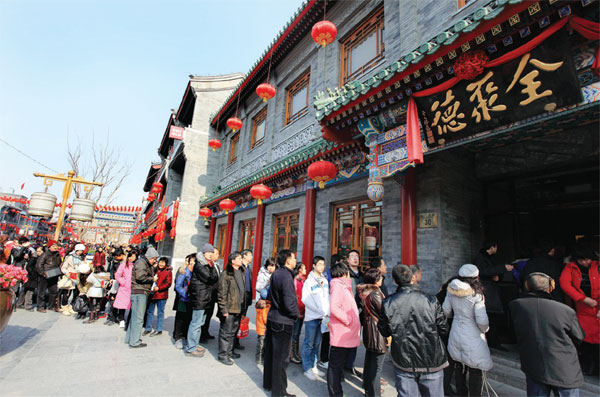
People wait in a long queue outside a Quanjude roast duck restaurant in Beijing. Beijing Tourism Group, a major shareholder of Quanjude, joined a bid in June for McDonald's mass franchise rights on the mainland and in Hong Kong. Asia News Photo |
(HK Edition 07/19/2016 page9)