SAR in the act as noose tightens on rich tax evaders
Updated: 2016-12-20 07:55
By Luo Weitengin Hong Kong(HK Edition)
|
|||||||


|
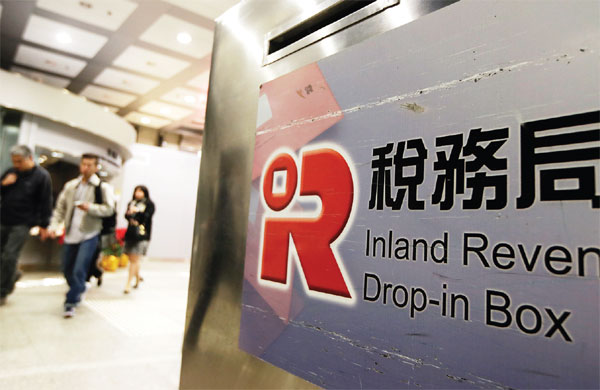
The Inland Revenue Department in Wan Chai is expected to receive the first batch of AEOI (Automatic Exchange of Information) returns filed by local financial institutions by May 2018, as the Common Reporting Standard (CRS) regime is well underway in Hong Kong. Roy Liu / China Daily |
A "game changing" tax transparency initiative poised to reshape the international tax landscape is on track in Hong Kong and worldwide, putting tax advisers and their clients on a tight schedule to lay out a viable solution.
The SAR became one of the 47 "second-wave adopters" of the Common Reporting Standard (CRS) regime for the Automatic Exchange of Information (AEOI) between participating jurisdictions in June this year.
The regime, issued by the Organisation for Economic Co-operation and Development (OECD) in July 2014, aims to combat tax evasion and profit shifting, with more than 100 jurisdictions, including major financial centers such as the British Virgin Islands, the Cayman Islands, Dubai, Singapore and Switzerland, committing themselves to complying with it.

Financial institutions in over 50 jurisdictions around the world, in particular, are already geared up to pass on information on their clients and accounts, collected since January this year, to their country of residence in 2017.
Likewise, the radical tax reform in Hong Kong is well underway as local financial institutions are required to start conducting due diligence procedures for all pre-existing and new financial accounts from early next year, paving the way for filing the first AEOI returns containing "reportable" information up to late 2017, to the Inland Revenue Department by May 2018.
"Basically, it's more of a big trend today where jurisdictions across the globe are joining hands to increase tax transparency and work out a standardized tax framework on a global scale," said Anthony Tam, chairman of the taxation faculty executive committee at the Hong Kong Institute of Certified Public Accountants. "As a world renowned financial center, Hong Kong is, of course, jumping on the bandwagon with its regional counterparts like the Chinese mainland and Singapore."
The city has long been playing an active role in clamping down on anti-money laundering activities to sharpen its edge as a well-established and well-regulated financial market. This time, it looks to stand at the vanguard of the fight against tax avoidance, Tam told China Daily.
There's little time to waste for tax advisers, as well as high-net-worth individuals, who may bear the brunt of the global tax policy tightening-up.
"CRS is indeed a watershed in the wealth management business with significant ramifications for high-net-worth families," said Lee Woon Shiu, Hong Kong-based head of wealth planning at Bank of Singapore.
"Similar to the US Foreign Account Tax Compliance Act and the European Savings Directive previously, it compels high-net-worth families to be fully tax compliant in all their financial affairs and also be more strategic in the deployment of their family human capital," Lee told China Daily in an email.
Interestingly, he doesn't think that the imminent introduction of CRS would make Hong Kong, whose simple and low-rate tax code has long underpinned its global competitiveness according to a study by CPA Australia, lose its allure to the wealthy as a once-popular "tax haven".
"Just the opposite, we see the sophisticated clients with more substantial wealth becoming more interested in establishing a permanent tax residence in Hong Kong, and increasing their business activities or even strategically establishing their permanent regional headquarters in the territory, apart from merely using the city as a private banking booking center," he said.

And the idea of immigrating to Hong Kong or other benign jurisdictions has been noted as being increasingly relished by rich people.
"However, it's crucial to distinguish between immigration for the purpose of acquiring a new tax residency in a tax-friendly jurisdiction, which may be useful from a CRS perspective, compared to immigration with the objective of acquiring a new passport or nationality, which may not be useful, given that the CRS is based primarily on tax residencies and not the nationalities of controlling parties."
All in all, Tam believed what's really true for the wealthy is the growing difficulty of hiding their wealth, those who may not always be on the government radar.
"With the tax authorities getting more power to monitor overseas accounts of citizens and track the finances of the wealthy, the global tax transparency is a sure thing," he said.
"It may take some time, but it won't be long. After all, 2018 is an implementation timeline set by the OECD," he noted.
In particular, the complex and stringent framework of tax rules would somehow get in the way of wealthy mainland people parking money in large sums out of the border via the red-hot Hong Kong insurance products.
"We do expect the Hong Kong insurance industry to tighten up its compliance regimes and ensure that all businesses with mainland clients are conducted in a manner compliant with the rule of law both in Hong Kong and on the Chinese mainland," Lee observed.
Yet, the individual income tax and foreign exchange control regimes have already been firmly entrenched as part of the legal framework of the world's second-largest economy.
The CRS regime, fitting in well with the nation's policymakers' determination, may merely strengthen the authorities' ability in enforcing the mainland's laws and ensure compliance by its tax residents, Lee added.
sophia@chinadailyhk.com
(HK Edition 12/20/2016 page9)