-
News >World

Japan's PM quits as poll ratings dive
2010-06-03 07:32
TOKYO - Embattled Japanese Prime Minister Yukio Hatoyama resigned on Wednesday to improve his party's chances in an election next month, after his popularity plunged over a broken campaign promise to move a US Marine base.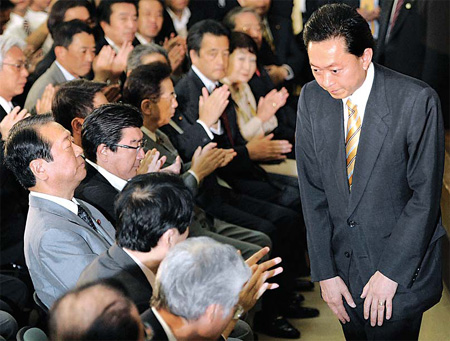
Japanese Prime Minister Yukio Hatoyama is applauded by DPJ lawmakers at the party’s general meeting in Tokyo on Wednesday after he said he would resign following a slide in polls that threatened his party’s chances in an election next month.[Agencies]Hatoyama, 63, announced the decision to quit with tears in his eyes at a press conference broadcast nationwide. He later defended his decision, saying that without public support, the government could not meet its goals.
"So I decided that my resignation would serve this country's interests," Hatoyama, who became the fourth leader in a row to leave office after a year or less, told reporters.Beijing praised Hatoyama for his efforts in promoting bilateral relations during his term.
Whatever changes take place in Japan's political arena, "China hopes to continue pushing forward strategic and mutually-beneficial relations between the two countries," Foreign Ministry spokesman Ma Zhaoxu said on Wednesday.
Sweeping into office just eight months ago by defeating the long-ruling conservative Liberal Democratic Party (LDP), Hatoyama, who heads the Democratic Party of Japan (DPJ), captured the imagination of many Japanese voters with his promises to bring change and transparency to government as the country grappled with economic stagnation and an aging population.
So when he failed to deliver on his pledge to move the Marine Air Station Futenma off the southern island of Okinawa, which hosts more than half the 47,000 US troops in Japan, his approval ratings rapidly sank, falling below 20 percent.
"He could not live up to the huge expectations," said Tetsuro Kato, professor of politics at Hitotsubashi University in Tokyo.
"The disappointment was also great," he added.
The DPJ's powerful No 2, Secretary General Ichiro Ozawa, also resigned.
DPJ lawmakers, especially upper house members whose current six-year terms will expire in July, have become increasingly dissatisfied with the party leadership, saying they would not be able to put up a strong fight in the election under Hatoyama as prime minister.
Besides Futenma, Hatoyama reneged on other promises such as cash payments for children to reverse an aging society, halving the money from the initial proposal; and abolishing tolls on highways, which has been postponed.
Hatoyama's coalition was dealt a blow over the weekend when the Social Democrats, a junior partner in the coalition, withdrew from the government after Hatoyama dismissed the party's leader, Mizuho Fuku-shima, from his Cabinet because she would not accept his decision on Futenma.
Experts: Policy toward China will not change much
Chinese experts said they believe Japan's China policy will not change much.
Japanese Finance Minister Naoto Kan emerged as a likely successor, signaling his intention to run for leadership of the DPJ at a party meeting to be held Friday.
"His attitude (toward Beijing) is unclear. But at least he is a DPJ member. The party elites have maintained good relations with China," said Feng Zhaokui, former deputy head of the Institute of Japan Studies at the Chinese Academy of Social Sciences.
One of the highlights of DPJ's policies is seeking a "more equal" relationship with the US and improving ties with East Asia, especially China.
But Feng did not exclude the possibility of Japan's new leader consolidating the alliance with Washington "partly to counteract China".
"For China and Japan, a key issue is how to build mutual trust," he said.
However, Chen Yan, an analyst on China-Japan relations, said the resignations of Hatoyama and Ozawa had dimmed the chances of a DPJ win.
He also said the DPJ "has done nothing except exerting greater pressure on China than the LDP on issues raging from the East China Sea to nuclear disarmament".
It is still unclear who will be picked in the jockeying of power among blocs of lawmakers in the DPJ. The pick will be Japan's next prime minister, because the party has the majority in the lower house that chooses the prime minister.
The DPJ and its partners can lose a majority in the chamber and still remain in power because they control the more powerful lower house. But it will make it more difficult for them to pass key legislation.
The once-powerful LDP remains in disarray after its crushing defeat last year.
Glance Japan's recent prime ministers
? Junichiro Koizumi's five-year term made him one of the longest-serving prime ministers. Koizumi stepped down in September 2006 on his own terms.
? Shinzo Abe was Koizumi's successor. Four of his Cabinet ministers resigned due to financial improprieties, and his agriculture minister committed suicide over a scandal. Abe resigned suddenly in September 2007, citing health problems.
? Yasuo Fukuda took office as a political veteran. He quit abruptly in September 2008, saying he was unable to break an impasse with opposition parties.
? Taro Aso was a long-serving politician who served in several Cabinet posts before becoming prime minister. His support suffered amid a deepening recession. Aso left office in September 2009 after his long-ruling Liberal Democratic Party was defeated soundly in lower house elections.
? Yukio Hatoyama's Democratic Party swept to power amid high hopes for political change, but his inability to keep a campaign promise to relocate a US Marine base off Okinawa sank his approval ratings.