Ready for the big leap
Industrial transformation is an inherent requirement for the economic development of the Pearl River Delta region
|
 |
The changing financial landscape in the last two years has brought with it several new challenges for the Pearl River Delta (PRD) region in China's Guangdong province.
The main challenge confronting the PRD is on how to transform its current economic growth and development pattern.
In the 30 years since China began its market reforms, the PRD has been the main economic engine and the epitome of China's manufacturing strength.
Backed by a slew of preferential policies and due to its proximity to neighbors like Hong Kong and Macao, the PRD has often been a flag bearer and catalyst for industrialization in China and also managed to attract several foreign companies.
Over the years, the region has seen the growth of private capital and the emergence of many successful Chinese entrepreneurs. Towns that are fully export-oriented and industrial clusters are commonplace in the PRD.
Lying on the east bank of the Pearl River are the cities of Dongguan, Shenzhen and Huizhou that have become the largest manufacturing hubs for electronic communication products.
On the west bank, the industry belt encompassing Zhuhai, Zhongshan, Shunde and Jiangmen are a hub for making household consumer durables, non-durables and hardware.
The Guangzhou, Foshan and Zhaoqing regions in the PRD are renown for their strength in producing electrical equipment, steel, cars, ships, petrochemicals and building materials. It is also a major base for car manufacturing and building materials.
Currently the PRD is confronted with several macroeconomic challenges in a fast-changing business environment amid uncertainties triggered by the global economic crisis.
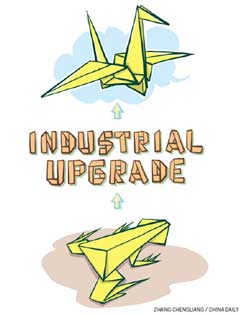
But for the PRD, industrial transformation still remains the foremost challenge.
Economic development can be divided into different stages based on per capita gross domestic product (GDP) and the changes in industrial structure.
In the initial stage of economic development, with the economic growth, the proportion of the secondary industry in the national economy will grow rapidly, and that of the first industry (mainly agriculture) will decrease. This is the first stage of economic development, that is, industrialization. Eventually the third industry (the service industry) will outweigh the second in output value and employment, becoming predominant.
The traditional agricultural society gradually develops into a modern industrialized society. Industrialization is the first leap for a country's economic development; the second leap happens when the third industry becomes the biggest part of the national economy.
It has taken the Pearl River Delta nearly 30 years to complete the first leap and now it is ready for the second.
Compared with countries and regions that are on the same GDP level, the proportion of the service industry in the delta is quite low. As a result, the growth of a modern service industry will surely be an important direction of the industrial transformation.
At the beginning of reform and opening-up, with a weak industrial foundation, the industrial development of the region started from the fields closely related with people's lives, including beverages, food and clothing.
In the 1990s, with incomes increasing and people's higher expectations for living conditions, families started to buy household durables such as home appliances and furniture, increasing the demand for decoration materials. This in turn sparked the development of the home appliance and building materials industry in Guangdong. Brands of home appliances in Guangdong were widely recognized in the country.
By the middle and late 1990s, the information industry had started to grow rapidly, including telecommunications, computers and cell phones. Companies such as Huawei Technologies Co Ltd and ZTE Corporation became well known.
At the turn of the century, cars started finding their way onto the market. The cooperation with Honda and Toyota accelerated the development of car industry. Guangzhou soon became an important domestic base for automobile manufacturing.
Compared with products on the international market, Guangdong products are still low end, which makes their added value far lower than their rivals.
The delta is going through a new leap from a resource- and labor-intensive economy to a capital-, technology- and knowledge-intensive economy, and from capitalizing the advantages of low-priced resources and labor to making good use of capital, technology and knowledge to achieve growth.
The ultimate aim should be to change the label "made in the Pearl River Delta" to "created in China," and placing these products in high-end markets overseas.
The author is director of the Center for Studies of Hong Kong, Macao and Pearl River Delta at Sun Yat-sen University.