


Bing aims to slay the Google giant
BELLEVUE, Washington - Microsoft's assault on Google in Internet search and search advertising may be the steepest competitive challenge in business today. It is certainly among the most costly: Microsoft spends at least $5 billion a year on the task, industry executives and analysts estimate.
As the overwhelming search leader, Google has advantages that reinforce one another. It has the most people typing in searches - billions a day - and that generates more data for Google's algorithms to mine to improve search results. All those users attract advertisers. And "Google" is synonymous with search, the habitual choice.
Microsoft's Bing search site, available in 40 languages, has steadily picked up traffic since its introduction two years ago, accounting for more than 14 percent of searches in the American market, according to comScore, a digital market research company. Add the searches that Microsoft handles for Yahoo, in a partnership begun in 2010, and Microsoft's search technology fields 30 percent of the total.
Microsoft's costs keep mounting. In the latest fiscal year, the online services divisionlost $2.56 billion. The unit's revenue rose 15 percent, to $2.53 billion, but the losses still exceeded revenue.
Investors are growing restless. In May, when David Einhorn, the hedge fund manager, called for Steven A. Ballmer, Microsoft's C.E.O., to be replaced, he pointed to the online unit as a weak spot.
Microsoft says it aims to make search smarter. Today's search, it says, primarily finds topics or noun phrases - a name, a city, a product and so on.
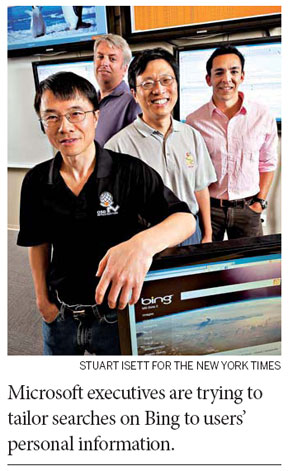
"It's all nouns," says Qi Lu, Microsoft's Chinese-born president of online services. "But the future of search is verbs."
Microsoft calls it "decision engine" instead of search engine.
New classes of information will help. Microsoft has a partnership with Facebook, including a feature for linking the "Like" tags of Facebook friends to search results in Bing. It might show that 15 Facebook friends "liked" a certain restaurant. It is a step, Mr. Lu says, in including trusted opinions in search - and not just the popular ones that conventional search does so well.
Location data offers another rich stream of information. The goal, Mr. Lu says, is that you will speak into your smartphone - "Dinner for two on Friday and movie" - and the software will connect to your personal data - your location, your dining and film preferences. It will then connect to dining and restaurant reservation apps, and movie reservation apps.
Then the engine will begin a dialogue: "Here's what is available. Where would you like to eat and when?"
In Bing, the decision-engine concept is evident in its ability to aggregate and present specific kinds of information in a search result. Microsoft has invested in travel services, for example. Type "flights to San Francisco" into Bing, and it searches all flights and predicts whether the fare is likely to rise or fall. That feature is based on technology from Farecast, a start-up that Microsoft bought for $115 million in 2008.
"What Microsoft is trying to do is present users with context and structure, more a map of the world of information instead of just ranking it," says Esther Dyson, a start-up investor and longtime technology analyst.
But Google is innovating as well. In April, it purchased ITA Software, which collects and organizes online data for airline flights. Last year, Google bought MetaWeb, which used a vast database to better decipher the meaning of search queries. And in 2008 it purchased Powerset, a specialist in so-called semantic search technology.
Bing is praised for improvements like its stylish home page.

Laura Desmond, C.E.O. of Starcom MediaVest, an ad strategy agency, says Microsoft's share of its corporate clients' click volume from search ads has grown from 14 percent to 24 percent in the last nine months.
Microsoft is not yet translating its search traffic into comparable ad dollars. Revenue per search from Yahoo traffic is far less than it was when Yahoo managed its own search ads.
But there may be an opening. Charlene Li, founder of the Altimeter Group, a tech research firm, calls herself a "huge Google user." Yet she says she now uses Bing for finding flights and sometimes restaurants.
"Microsoft's best hope is that it gets more and more people to migrate to Bing for specific tasks like travel," she says. "Then, if they like what they see, they may use Bing more broadly."
The New York Times
(China Daily 08/14/2011 page11)














