Revised criminal law will give suspects greater protection
|
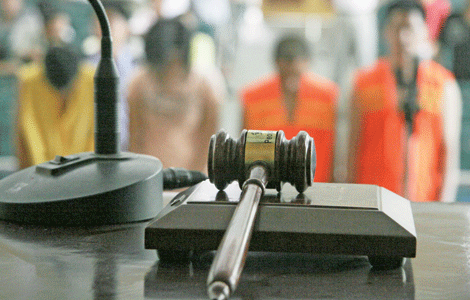 Deputies to the National People's Congress, the nation's top legislative body, will vote on a revised Criminal Procedure Law, which aims to further protect the rights of suspects in custody and prevent forced confessions. Li Yuanbo / for China Daily |
|
 Lang Sheng (left), deputy director of the Legislative Affairs Commission of the National People's Congress Standing Committee, and Li Shouwei, deputy director of the commission's office for criminal law, talk to the media in Beijing on Thursday. Feng Yongbin / China Daily |

Legislation set to be voted on by the NPC enshrines rights of those held in custody, Zhao Yinan reports in Beijing.
When Zhang Guoxi returned to his office from lunch one Thursday afternoon in July 2010, a team of anti-corruption investigators was already waiting for him.
What followed, according to court documents, was a month of interrogations that eventually resulted in the construction official admitting that he accepted 76,000 yuan ($12,000) in bribes.
When the case went to trial, however, judges deemed the confession inadmissible due to allegations it had been obtained illegally.
It was a landmark decision, and National People's Congress deputies are set to vote on a revised Criminal Procedure Law that is aimed at further protecting the rights of suspects in custody and preventing forced confessions.
Public security bureaus have relied heavily on self-incrimination to solve criminal cases, said Tian Wenchang, director of the All-China Lawyers Association's criminal committee.
"These changes (to the law) will, hopefully, reduce the risks during interrogations and improve the investigative tactics used by the police," he said.
A draft of the amended law was released to the public in September and received roughly 80,000 comments, either on e-mail or through the official website of the NPC, the country's top legislative body.
While most people acknowledged the progress being made, the media attention at home and abroad largely focused on several clauses that would have allowed police to detain suspects without informing families for up to six months.
In the version set to go before this year's plenary session of the NPC, almost all the controversial aspects appear to have been omitted.
Wang Zhaoguo, a senior lawmaker, explained to deputies on Monday that the draft now states that public security bureaus must inform a suspect's family within 24 hours of their detention.
The only exceptions, he added, would be when the case is "related to State security or terrorism", or if informing the family would "impede an investigation".
Cautious, courageous
At the time of his arrest, Zhang Guoxi, held a key post in the construction department of a government-funded holiday village in Ningbo, a booming city in East China's Zhejiang province.
According to records released after his trial in March last year, anti-corruption officers detained him without a warrant. The suspect said he was interrogated for three days, first in a hotel room and then in a prosecutor's office, and was given only a few hours of sleep.
He said that at no time did investigators produce documents authorizing his detention or take any written testimony.
After three months, Zhang said he was transferred to a detention house in Shaoxing, where he was allowed to sleep four hours a day.
"They made me assemble strings of colored lights, fixing 100 colored bulbs to a 8-meter-long cable," he told China Daily on March 6. "I had to finish at least 27 strings every day, which was impossible for a new hand. I kept working until my fingers were blistered."
When the case reached the courtroom, prosecutors for Ningbo's Yinzhou district accused Zhang of taking 76,000 yuan from contractors in exchange for lucrative construction projects between 2005 and 2008. As evidence, they presented a signed confession.
However, the defendant said he had received only 6,000 yuan, while his attorney, Jiang Jiangao, said his client's testimony had been illegally extracted with the use of violence.
In an unprecedented move, the panel of three judges sided with the defendant and threw out the confession. Court records quote the presiding judge as saying that the initial investigation into Zhang was "flawed" and that the "testimony should be excluded".
The panel went on to return a guilty verdict, yet as the "value and harm (of the bribes) were minimal", the defendant received no criminal punishment. He was, however, sacked from his job.
In an interview with China Daily last week, Jiang, who is currently appealing 42-year-old Zhang's conviction at an intermediate court, called the decision to reject the signed confession "cautious but courageous", and said it "casts light on future judicial rulings".
Soon after the events in Ningbo, the Supreme People's Court also issued a warning to law enforcement agencies to prevent forced confessions.
"I've heard that judges in other places have failed to (dismiss disputed evidence) under similar circumstances, either because they were fearful about challenging prosecutors or just disregarded procedural justice," said Chen Guangzhong, a leading expert on criminal proceedings.
If the NPC votes to approve the revised law, analysts say it will not only provide institutional support for similar rulings, but it will also be the first time China's 30-year-old criminal procedure code has embodied the constitutional spirit of protecting human rights.
Li Zhaoxing, spokesman for the NPC, told a news conference that the draft to be tabled at this year's plenary session identifies human rights protection as an essential principle.
"It's slow progress," admitted law professor Chen Weidong at Renmin University of China, "but legislation is a gradual thing, in which improvements are made little by little."
Code of conduct
Criminal Procedure Law was one of seven new laws introduced in 1979, when statesmen say the country was shifting its priority from class struggles to economic development.
Yan Duan, 78, a professor at China University of Political Science and Law who was on the panel that first drew up the regulations, recalled that many of the original clauses were designed to address issues that had arisen from the "cultural revolution" (1966-76).
Consisting of 164 articles, the 1979 code ruled that oral testimony "can only be accepted after confrontation in court", a principle she said was "a lesson drawn from the cultural revolution", when many people faced groundless accusations.
Characteristics from the times can easily be seen in the first version, which upholds Marxism, Leninism and Mao Zedong Thought in its first clause, and says the code is to "combat enemies" and protect the people.
The emphasis on ideology was removed 17 years later. Chen Guangzhong, a consultant on the 1996 revision, said the code absorbed several suggestions from NPC deputies and was eventually expanded to 225 clauses.
As the code regulates criminal investigations and court hearings, he said that the more detailed it is, the less chance there is for disputes. The country's Criminal Law has about 400 articles, he said.
"Legislation is not stagnant," said Chen, the former president of China University of Political Science and Law. "It's a process through which laws are improved by lawmakers' efforts to adapt to new social conditions."
Contact the writer at zhaoyinan@chinadaily.com.cn