


Trash hill casts shadow on village
|
 |
|
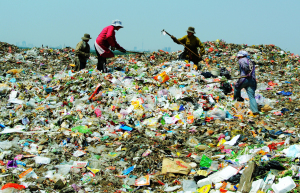
Having lived in a house 50 meters from the landfill for many years, Du Na (right), a 35-year-old villager in Yuanfuzhuang, says that if she was able to afford to move, she would not allow her two children to grow up in a polluted area. |


For almost 10 years, Du Na has watched as a mountain of garbage piled up next door to her home.
"Ever since I moved here after getting married, it's just gotten higher and higher," she said, looking at the landfill, which now covers more than 6 hectares and stands up to 28 meters tall.
The trash titan is about 50 meters from Du's house in Yuanfuzhuang village, a suburb of Kaifeng, Henan province.
"During the morning and evening rush hours, a truckful of waste is dumped here every five to 10 minutes," said the 35-year-old mother of two.
Figures from the provincial environmental protection department show that more than 4 million tons of trash have been dumped on the site since it opened 18 years ago, with another 700 to 800 tons arriving from downtown Kaifeng daily.
Moreover, the sprawling mountain of garbage has steadily grown to claim more than 70 percent of the town's farmland.
"When I moved here in 2003, each villager had about 3 mu (0.2 hectares) of land. Now they have less than 0.7 mu," Du said.
To enlarge the area of the landfill, the local government bought the rights to the farmland from villagers in 2005 for 20,000 yuan ($3,170) per mu.
"We lost our farmland, yet the compensation was enough to cover the cost of living for only two or three years," Du said. "What can we live on after using up the money?"
Wang Zhengya, deputy director of the provincial environmental protection department, said the landfill is the only one in the province's 18 cities that does not have any waste-processing equipment. He blames the situation on "historical reasons", such as funding shortages.
The unprocessed waste has threatened drinking water as well as the air, which are problems that must be tackled as soon as possible, he said.
According to Ministry of Environmental Protection data, there were 935 landfills nationwide in 2008, with a combined capacity of 2.34 billion cubic meters. And 34 percent of these sites do not have any measures to prevent the pollution of the soil and groundwater, according to the ministry.
Health risks
For visitors to Yuanfuzhuang, which is 7.5 kilometers from downtown Kaifeng, it is impossible to escape the odor - a stench of rotten vegetables, decayed meat and smoky air.
Next to the landfill, there is a chemical plant producing pesticides, which has made the air quality even worse, residents say.
"We are inhaling poisonous air every day, and we have no other choice," Du said, adding that the smell used to disgust her, but over the years she got used to it.
The landfill has deteriorated the soil, and the yield of grain and vegetables in the farmland is less than the average level of the other villages, she said.
What worries residents more is the water pollution caused by the landfill. "Whenever we boil a pot of water from underground, we find half a glass of solid deposited substances in the water," she said.
To avoid being poisoned, people buy bottled drinking water, which can be expensive for farming families. A 20-liter bottle costs 5 yuan.
Du's neighbor, 30-year-old Wang Jiansheng, said the local government had promised to drill a deep well to supply drinking water for residents, but the well has never been drilled.
"I don't oppose the construction of the landfill, but the government should first address the issue of drinking water," he said, adding that his biggest concern is for his 9-month-old son. "His physical development will definitely be affected by the pollution, but we have no other place to live."
Several deaths caused by cancer in recent years have stirred more fears among residents, said Zhang Tianjun, another local. Two women, one aged 30 and the other 45, and a 50-year-old man died of cancer last year.
"I don't know whether the cancer was caused by the pollution of the landfill or not, but the number of deaths among younger people has increased," said Zhang, 38. "Some other health problems, such as heart attacks, have also increased."
Power plant to be built
To prevent the garbage mountain from growing, authorities have drawn up plans for a waste incineration power plant.
"The landfill in Yuanfuzhuang has been operating beyond its capacity since it was put into use in 1994," said Fan Jinshun, of the Kaifeng city management bureau. "An incineration power plant will save as much as 80 percent of the area's farmland."
Rong Bo, manager of the contracted power plant project, said construction is scheduled to finish within a year, with the facility expected to handle 365,000 tons of waste a year.
However, resident An Ziming, 60, said many of his neighbors have raised concerns that burning waste will send more poisonous gases into the air and harm their health in the long run.
Waste incineration projects have met with resistance in other cities as well.
More than 2,000 people in Dagang township, near Guangzhou in Guangdong province, protested a government plan to build a waste incineration power plant there in July, Yangcheng Evening News reported.
The protest prompted the local government to suspend construction of the project, and the final site of the plant had not been decided as of April 26, Guangzhou Daily reported.
For residents in Yuanfuzhuang, the best choice is to move away, and most of the rich families have already bought apartments in far-away urban areas, Du Na said.
She also wants to live in the city with her husband and two children, but most properties downtown are out of their price range.
"It costs at least 200,000 yuan to buy an apartment in Kaifeng. Our family saves less than 10,000 yuan a year," she said.
The family has to pay for the medical expenses of Du's in-laws and her grandmother, and raising the 8-year-old son and 2-year-old daughter also cost much, she said.
Despite the many difficulties her family faces, Du said she will continue to save money because she does not want her children to grow up in a polluted area.
"What we want is really simple: Clean water and fresh air," she said.
Xiang Mingchao and Jiao Hongchang contributed to this story.
anbaijie@chinadaily.com.cn














