


A shot in the arm for TCM
|
A child in Kunming, capital of Yunnan province, receiving free traditional Chinese medicine during the SARS outbreak. Bao Lihui / for China Daily |
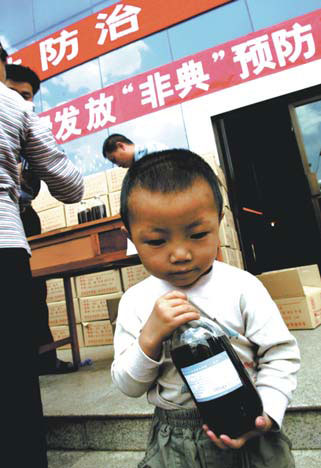
During the SARS outbreak, traditional Chinese medicine made a great contribution to curing the previously unknown and deadly disease. As a result, TCM won the recognition of the World Health Organization and improved its status on the Chinese mainland, Hong Kong and Macao.
On Jan 7, 2003, Guangzhou resident Huang Shengfa developed a high fever and went to the Guangdong Provincial Hospital of Chinese Medicine for treatment. Because the symptoms differed from those of pneumonia, and the patient's condition was serious, the hospital invited experts from other medical institutes to attend a group consultation.
Later that month, seven doctors and nurses who had been in contact with Huang displayed the same symptoms and were hospitalized. The doctors realized that they had caught a highly contagious disease, later confirmed as SARS.
At first, the doctors treated patients with TCM by adopting a plague treatment regime, whereby patients were isolated to limit transmission, and discovered that it was effective. But a combination of TCM and Western medicine proved highly effective in treating some patients whose conditions were severe.
On April 7, James H. Maguire, an infectious disease specialist with the United States' Centers for Disease Control and Prevention and an expert with the World Health Organization, visited the hospital and listened to the doctors' reports on the treatment of SARS. By that time, the hospital had admitted 50 patients with SARS. By the time the epidemic ended, the number had risen to 112.
Maguire discovered from the reports that the average length of stay at the hospital was shorter than in other hospitals that used Western medicine exclusively, and the patients did not have a recurrence after taking TCM. Moreover, the duration of the fever was also shorter.
On April 19, the Hospital Authority of Hong Kong sent respiratory disease experts to the hospital to learn from the experiences there. Four days after the visit, Ko Wing-man, acting chief executive of the Hospital Authority in 2003, called Lu Yubo, the director of the hospital at the time, and asked him to send two experts to Hong Kong to help with SARS treatment.
"I had two major concerns at that time," said Lu. "In Hong Kong, doctors of traditional Chinese medicine are not allowed to use modern medical equipment. To combine traditional Chinese and Western medicines, they had to obtain approval from doctors of Western medicine. Moreover, if the treatment was not effective, the reputation of TCM would suffer. How could I take this responsibility? Besides, our best doctors were mainly seniors. Clinical results showed that people aged 50 or older were at high risk once infected with the SARS virus. What would I do if they didn't come back?"
Eventually, Lu decided to send Yang Zhimin and Lin Lin, two capable middle-aged doctors, to Hong Kong. At first, the doctors of Western medicine only allowed the TCM practitioners to treat the most severely ill SARS patients. Yang and Lin used TCM to improve the patients' conditions by stopping their diarrhea and increasing the strength in their hands and feet. Step by step, they proved the effectiveness of TCM, and the other doctors began to introduce them to patients in the early stages of SARS.
According to a statistical analysis report conducted by the Hospital Authority, a combination of TCM and Western medicine resulted in a fall in the required steroid dose, according to Yang.
After SARS, TCM was used in major public health emergencies. During outbreaks of bird flu, H1N1 flu and other infectious diseases, the government asked for a TCM treatment option in addition to Western therapy and allowed TCM hospitals to treat contagious patients.
In Hong Kong, the Hospital Authority included TCM in its scope of management, set up TCM clinics at a number of public hospitals and provided a certain amount of government reimbursement for TCM treatments. Those actions had a marked effect on the development of TCM.














