Fresh wind for rare earths
|
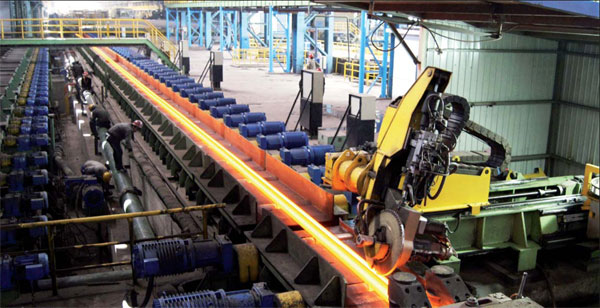
Close to rare earth resources, Baotou Steel Rare-Earth (Group) Hi-Tech has become the largest rare earth producer in China. Zhao Tingting / Xinhua |
Global demand for metals rises as product prices decline in China
Global demand for rare earths, especially the primary type, will continue to remain strong in the long term, despite concerns over the supply of medium and heavy rare earths in the short term, says a top industry official.
Speaking at an industry forum in Shanghai recently, Su Bo, vice- minister of Industry and Information Technology, said efforts to set up large-size rare earths enterprises will be quickened with steps to check illegal mining. The main thrust of the government action is to enhance high-end technology research and industrialization moves, he added.
The minister's remarks come close on the heels of conflicting reports that global demand for rare earth metals from China rose during the first quarter due to falling prices, while most of domestic producers and processors were reeling from losses.
Information provided by the General Administration of Customs says China's monthly rare earth exports rose by 55 percent in March, compared with February, to 1,718 metric tons. Export volume during the first three months grew by 47.3 percent to 3,916 tons. However, the export value of the shipments dropped nearly 71 percent to $91.9 million.
Chen Zhanheng, deputy secretary-general of the China Rare Earths Industry Association, says that export volume has grown due to the falling prices as many overseas buyers are now shoring up reserves after exhausting stocks.
Chen says though there are no clear signs of an immediate pick-up in demand, the market for rare earths will certainly grow as production being regulated and prices declining.
Chen Jiazuo, an analyst with the China Nonferrous Metals Information Network, says that though it took just two years for the industry to fall from its peak, the current prices are still higher than the lowest point in the past 10 years.
Only half of the rare earths export quotas were used by companies last year, as they continued to be wary of sudden price hikes, like the one in 2011, dampening demand. Total value of rare earth exports in 2012 fell 66.1 percent year-on-year to $906 million.
An export quota system for rare earths was established in 1999 to check unbridled exports from China. An output quota was also announced in 2006 to conserve resources and protect the environment.
In 2012, Japan, the United States and the European Union lodged complaints with the World Trade Organization about China's limits on rare earth exports.
Rare earths, which comprise 17 metallic elements, are used in many products including missile systems and hybrid cars.
China currently supplies more than 90 percent of the world's rare earths and accounts for over one-third of the known global reserves. The current global consumption of rare earth resources is between 120,000 and 160,000 tons.
Last year, Japan, France and the US were the top three nations in terms of export volumes and export values, accounting for 80 percent of the total export volume from China.
Though rare earth exports to Japan declined in 2012, shipments to France soared and overtook US in both volume and value.
Price fluctuations have, however, hampered the progress of the industry, as both upstream and downstream players have been affected, says Zhang Anwen, deputy secretary general of the Chinese Society of Rare Earths. Zhang says if prices remain steady for a reasonable period, it would be beneficial for the industry chain.
Rare earths product prices declined by 40 percent last year than 2011. Producers have tried to cease production to prevent prices from dropping further.
Du Shuaibing, an analyst with Baichuan Information, a company that analyses market trends for rare earth raw materials, says illegal production, rampant smuggling of rare earths have depressed prices.
Oversupply of raw materials and increased production also contributed to lower rare earth prices, Zhang says. New production capacities in other countries have also prompted major consumers like the US and Japan to reduce their dependence on China, he says.
Molycorp, from the US, Lynas Corp, a mining company in Australia, and other mining firms in South Africa, Canada and India have developed new rare earth resources, aiming to create a total industry output capacity of 80,000 tons by 2015.
During the first quarter, Baotou Steel Rare-Earth (Group) Hi-Tech, China's largest rare earth producer, reports revenue of 2.29 billion yuan ($366 million), down 35.7 percent from a year ago. Its net profit fell 79.7 percent to 245 million yuan.
The company says during the first quarter, prices of rare earth products declined by more than 50 percent. It adds that during 2012, its net profit and revenue dropped due to the falling demand and the sluggish economy.
Net profit declined 56 percent to 1.51 billion yuan year-on-year, while revenue fell 19 percent to 9.24 billion yuan as a result of low demand in the rare earth market and a drop in prices.
Baotou Steel resumed production on Feb 23 after a four-month halt due to the price slump.
Another producer, Rising Nonferrous Metals Co Ltd, saw a first quarter loss of 29 million yuan due to a drop in operating revenue and gross profit.
Last month, China Minmetals Rare Earth Co Ltd announced a 47 percent drop in revenue, from 7.6 billion yuan in 2011, with net profit falling 74 percent from 1.02 billion yuan in 2011.
Zhang feels that the development of the industry largely depends on domestic consumption and application. Despite government investment in application and downstream development, to have its own application technology will be a major hurdle for China's rare earth industry.
Du, on the other hand, says that rare earth prices will continue to hover at lower levels and urgent steps are needed to curb illegal production.
wangzhuoqiong@chinadaily.com.cn