America's Spelling Bee encourages a holistic way of learning English
|
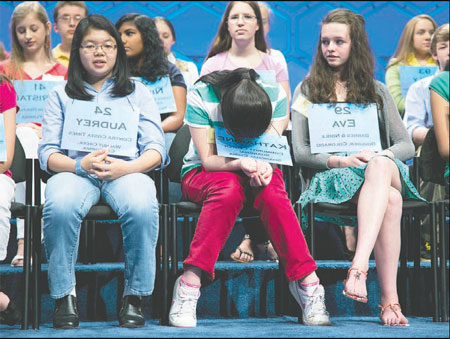
Katharine Wang (center), 11, of Beijing, gathers herself before the start of the semifinal round of the National Spelling Bee on Thursday in Oxon Hill, Maryland. Evan Vucci / AP |
In China, where more than 400 million students are learning English, the US-based Scripps National Spelling Bee is challenging the traditional educational system that places emphasis on memorization and repetition.
"The competition actually encourages students to recognize the phonetic patterns through making inferences based on the roots and origins of the words," said Stella Si, executive director of the Community Center Shanghai (CCS). "This is an important part of understanding the English language, and I think developing this skill can provide much benefit to Chinese students."
CCS has been sponsoring Chinese students in the Scripps spelling bee since the country entered the competition in 2009.
This year, 281 students from the US, American Samoa, Guam, Puerto Rico, the US Virgin Islands, Department of Defense Schools in Europe, the Bahamas, Canada, Ghana, Jamaica, China, Japan and South Korea, were selected to compete at the 86th Annual Scripps National Spelling Bee, held near Washington. CCS supported Qingyi Wang, 14, and Katharine Wang, 11, students in Beijing.
"[Rote memorization] produced a group of students that can read and write well but fall short when it comes to listening, comprehending and conversing," Si said. "With the expansion and improvement of US-China relations, so too do we see the increased need for mutual communication and understanding."
Si said an increasing number of Chinese local schools, particularly in first tier cities like Shanghai, Beijing, and Guangzhou, are placing more emphasis on aural-oral and verbal-written methodologies.
Organizations such as Qooco, Wall Street English and Disney English, are also leading the way in China toward more integrated programs of teaching English as a second-language education, according to the CCS director.
Weihong Yan, director of the Confucius Institute at Pfeiffer University in North Carolina , said he believes US-China relations are playing a part in improving the Chinese education system, but at a slow pace.
"Teaching English [in China] is changing in terms of having more and more innovative English teaching materials," Yan said. "But improving the relationship between the two countries is not playing a very important role in ways that could change the Chinese educational system."
Yan views the heavily exam-oriented system as a hurdle that China must still overcome. While the nationwide focus on standardized tests and grades persists, instructional innovation in China's education system will remain stunted, he said.
The Confucius Institute director compared the current education structure in China to what Albert Einstein experienced in Germany in the early 20th century. Due in part to lack of educational freedom, Einstein immigrated to the US.
"Chinese people love this country," Yan said. "The US has become Chinese students' preferred country for pursuing their higher education."
In five years, Si said she has witnessed a trend toward more interactive learning and stronger English language competencies among the younger generation of Chinese students.
"In general, China as a culture places a much stronger emphasis on a child's education," Si said. "As we see more English programs coming into the schools, we also see the gradual use of Western methods of learning English employed."
Si said she hopes that the success of more integrated methods of learning English can be recognized and then employed in the education system as a whole. She also said the CCS team believes running the spelling bee program in China will continue to encourage a more holistic approach to teaching English as a second language.
"The spelling bee is such an important part of American culture and childhood memories," Si said. "By introducing this program to Chinese children, we want to foster the same fondness of learning, the drama of competition and favorite memories that they can share as this generation of Chinese children grows up."