


Wearable technology the new game-changer
|
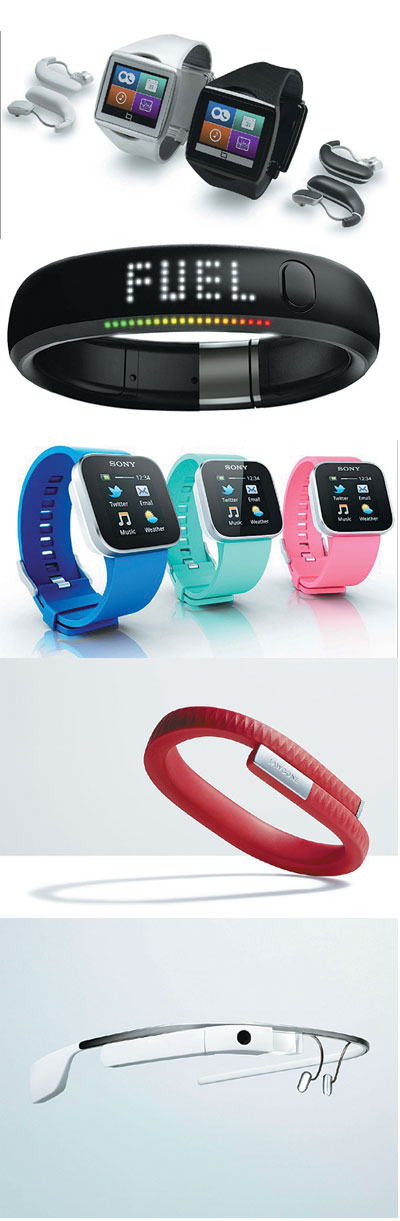 From top: Quakcomm smartwatch, Nike Fuel Band, Sony Crop smartwatch, Jawbone bracelet and Google Glass are wearable devices. Photos provided to China Daily |
Forget smartphones, the future of consumer electronics lies in watches, glasses, rings and bracelets with capabilities that could change the way we live. Gao Yuan reports.
The next big thing in consumer electronics will change your life. If you were expecting the new iPhone to be that revolutionary product, you may want to think again. Global consumer electronics giants such as Apple, Google and Samsung are anxiously preparing themselves for the big trend of the next decade - wearable devices. The e-gadgets that attach to users' bodies are set to change the way consumers use technology and the tech giants know that the products they offer could either signal their company's demise or be a game-changer for the industry.
On Sept 4, at an industry expo in Berlin, Germany, Samsung released its first ever wearable device, the Galaxy Gear smartwatch.
Equipped with a 1.9 megapixel camera and 70 popular apps, Samsung is one of the first sizeable international companies to release a ready-for-purchase gadget that truly qualifies as a 21st-century wearable device.
The product is scheduled to hit stores on Sept 25.
The smartwatch was merely the latest sign the global consumer electronics market is mulling on a big change.
The concept of wearable devices, or "wearables," are nothing new. Watches, earbuds and even glasses all fall in this category as they are attached to users body and can extend users' ability.
But tomorrow's wearables will be way smarter than just telling you the time or helping you read this newspaper. Everyone will be able to get a watch, a pair of glasses, a bracelet or a ring that has more functions and capabilities than James Bond's fancy toys - except not as deadly.
Google Glass was the device that initiated this wearable craze. The glasses were released by Internet search engine provider Google in order to challenge Apple's dominance of the high-end consumer electronics market.
Equipped with a screen in front of the glasses and a chip to access to the Internet and process data, the piece sets users' hands free, with voice and eye movements used to designate tasks.
Google's message to Apple was loud and clear. It is building on Steve Jobs' legacy of multi-media controls in much the same way that the former Apple CEO did with his touch-screen function to dethrone full keyboard smartphones, with the iPhone soon outpacing the once ubiquitous Blackberry.
Bare in mind that Google also owns Android, the world's largest open-source mobile operating system, the company has one thing left to do before launching an all out war against Apple - announce an official public launch date for the next generation glasses.
Google Glasses are currently only available for developers - the public has scant access to this amazing product.
As more companies unveil their wearable strategies, people are getting tired of asking when Google Glasses will be available on the market.
And the question remains: is the product worth waiting for?
Chinese retailers, famous for their instinct for business, have their answer.
"The sales outlook of Google Glass in China is almost certainly weaker than Apple's iPhone," said Li Zhengmin, a dealer at Zhongguancun, the largest electronics sales marketplace in Beijing.
He said Chinese users may take more time to accept a wearable than a new smartphone because the public remains unsure about the capabilities of such a device.
"We offer a reserve service for the product, ranging in price from 12,000 yuan to 13,000 yuan ($1,960 to $2,124)," said another dealer surnamed Hou.
"No one has asked for a reserve so far," he added.
Online sales are gloomy as well.On online marketplace taobao, China's answer to ebay, there are more than 70 shops selling Google Glass, but only a handful can provide the product.
Although the highest offer for the glasses has hit 100,000 yuan, less than 10 reservations have so far been confirmed," said Li Yazhi, owner of a smart wear equipment shop on Taobao.
Lily Cheng, a college graduate living in Beijing, said she is willing to learn more about Google Glass because the features were "so cool" and she thinks it will be the new communication trend.
"But with more wearables entering the market this autumn, I may buy a Samsung smartwatch for 2,000 yuan-3,000 yuan," says Cheng.
Despite confusion over Google Glass pre-sales in China, analysts say the market for wearable devices is huge.
"Wearables have enormous potential for uses in health and fitness, navigation, social networking, commerce and media," said Sarah Rotman, a researcher at consulting firm Forrester.
Wearables will become mainstream once they get serious investment from the "big five" platforms - Apple, Google, Microsoft, Amazon, and Facebook.
The good news is, big international IT giants are fully aware of the great potential of wearables and are willing to invest in the booming sector.
Qualcomm Inc, a US-based mobile chip maker, also announced that they are optimistic about wearables. It even produced an Android powered smartwatch in early September.
Company CEO Paul Jacobs told the media that the device, which also supports wireless charging function, is the company's vision of the future of wearables.
Wearable devices are no longer sensors embedded in people's Nike shoes. Today's wearables are smarter, meaning they have a stronger capability to collect and process data.
The future devices are set to be even more powerful and with the support of cloud computing and datacenter technologies, the computing power of wearables is unlimited.
Because of the unprecedented hardware features these devices are equipped with, developers are able to focus on the design of applications that can fully extend the hardware capability.
Users of technology should prepare themselves to experience the biggest technology shift since the smartphone.
Ren Pengfei contributed to this story.














