Discussion focuses on quality education
|
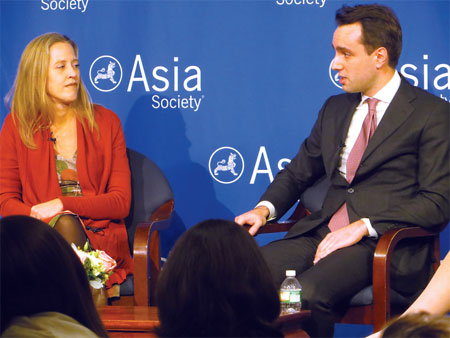
CEO and founder of Teach For China, Andrea Pasinetti (right), discusses global education issues with CEO and co-founder of Teach For All, Wendy Kopp, during a program at the Asia Society in New York on Tuesday night. Caroline Berg / China Daily |
Test scores can be both telling and misleading.
"There's been a bit of controversy about the [Program for International Student Assessment (PISA)] scores and the use of data to compare countries' education systems," Anthony Jackson, vice-president for Education and Leadership at the Asia Society, said about the recently released study.
The PISA results, administered by the Organisation for Economic Co-operation and Development, ranked Shanghai first in math, reading and science, among 15-year-old students around the world.
Jackson moderated a panel of education experts on Tuesday night during a public discussion on innovation and equity in global education at the Asia Society titled, "Making the Grade in Global Education - Asia: Beyond the Headlines."
"We live in a country here that has made precious little progress, and the rest of the world is getting better," Wendy Kopp, CEO and co-founder of Teach For All, said about education development around the world, particularly as reflected in the PISA scores. "We should be running around the world figuring out what are they doing in Vietnam? What are they doing in Poland? I'm dying to visit those two countries."
Poland and Vietnam were highlighted in the PISA results for rapid improvements in their educational systems. The US ranked in the middle at No 36 among 65 nations tested.
Kopp went to China in October to visit schools, study its education programs, and to find out what the drivers of progress have been in Shanghai.
"There's so much that countries around the world can learn from China's urban centers in their approach to investing in teacher development, embracing a rigorous curriculum, and committing to equity," Kopp wrote to China Daily.
The Rural Education Action Project at Stanford University estimates that less than 30 percent of Chinese students in rural areas will make it to high school, and only five students in 100 will get the opportunity to attend college. However, Kopp said in her e-mail that she has been impressed by the Chinese government's commitment to improving education for rural students and reducing inequality.
"Of course, there is still a gap between the educational opportunities of rural and wealthier urban students," Kopp wrote. "But organizations like Teach For China, in partnership with the regional governments in Yunnan and Guangdong, are showing that these students can excel at the highest levels."
During her visit to China, Kopp was struck by the dedication of families and officials alike to ensure students get the best education possible, she wrote in her e-mail.
"I visited a fifth grade math classroom in Yunnan, where students were mastering the same material as my sixth grader in New York," Kopp wrote. "In Shanghai, we heard from one of the architects of the city's education transformation that a key to their success was embracing an 'open door' policy that encouraged educators to learn from the best practices of countries around the world and adapt them."
Susan Fuhrman, president of Teachers College at Columbia University, joined Kopp and Andrea Pasinetti , co-founder and CEO of Teach For China, on the Asia Society discussion panel.
Teach For China is based on the Teach For America model, which Kopp founded in 1989. The program recruits graduates and professionals to teach in schools in low-income communities and become leaders in the effort to solve educational inequity. This model helped inspire social entrepreneurs like Pasinetti to expand educational opportunity by adapting the model to their own contexts.
The Teach For China program has grown from 20 fellows in 2010 to more than 300 through the support of government partners and the encouragement of local communities, Pasinetti wrote.
Last year, Teach For China received about 3,000 applications, Pasinetti wrote China Daily. He also said that this year Teach For China launched a campaign on the Chinese social networking service Renren for college students to mentor children in Teach For China classrooms, and received more than 300,000 applications.