Beijing subway fare rise justified
Beijing's subway system - one of the longest in the world at 465 kilometers - is plagued by excessive congestion and costly government subsidies. Now, in a controversial move, the Beijing municipal government has decided to increase the subway fare, currently fixed at 2 yuan ($0.33) per trip. If the proposal survives an upcoming public hearing, Beijing will join the ranks of cities like Sao Paulo and Mexico City in raising public transport fares.
A public outcry against any fare increase and the subway system's poor service has erupted since the government's announcement. But before passing a judgment, we should analyze why the city authorities have chosen to raise the subway fare.
Beijing has undergone what could be termed a "subway boom" in the last decade. The city's subway's length has increased dramatically from 54 km and just two lines in 2001 to 465 km and 17 lines in 2013, carrying more than 10 million riders every weekday.
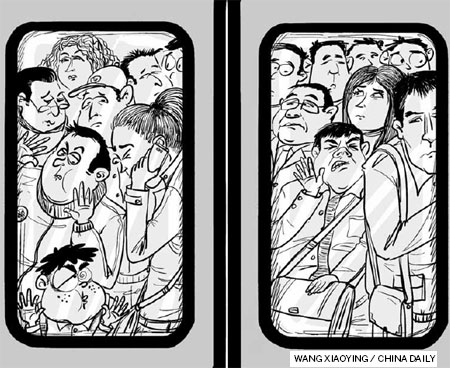
But the size of Beijing's subway does not guarantee its reliability - overcrowding and frequent service disruptions challenge both its service quality and comfort level. Partly because of the low fare, peak-time passenger flows exceed the capacity by 144 percent on some lines, almost comparable to the 171 percent in Tokyo - the world's most congested subway system. And since Beijing's subway constantly runs at its maximum capacity, safety and security concerns are widespread.
Furthermore, the large public subsidy needed to support the system strains the financial well-being of the municipal government. The high annual operating costs of 600 million yuan, combined with the low passenger fare, result in huge operating deficits. In 2012, the public transport subsidy reached 17.5 billion yuan; it is even more than 18 billion yuan in 2013.
The municipal government's goal behind raising the subway fare is to improve the quality of service and ease its financial burden. Beyond these frequently cited motivations, why else would the city authorities raise the subway fare?
Cities across the world generally fall on a spectrum between two extreme ends when it comes to public transport fares. On one end of the spectrum are cities like Beijing and Mexico City that rely heavily on government subsidies and charge little for people to use mass transport systems. These cities underscore the "public good" nature of public transport, where subsidies are justified not only on grounds of public equity, but also because of the social benefits they accrue - discouraging private vehicle usage and mitigating traffic congestion and air pollution.
On the other end are cities like Hong Kong and Tokyo, which favor a higher fare and run public transport systems with nearly zero subsidy through diversified funding resources. Cities in the second group believe that a free market system is a more efficient, equitable way to run a subway.
While the jury is still out to determine which of the two extremes is most beneficial, many cities find a balancing point between the two ends of the spectrum. As a city belonging to the "public good" end of the spectrum, Beijing cannot attain public equity and social benefit by charging exceptionally low fare.
The social benefits that could have been gleaned from heavy government subsidies have been eroded by the Beijing subway's poor service quality. Its lack of comfort and reliability dissuade people from forgoing private cars and taxis in favor of riding the subway.
In fact, the share of trips made by automobiles in the city has risen from 23 percent to 33 percent since the beginning of Beijing's "subway boom." The increase in subway ridership during the same period can be partly attributed to the sharp decline in the number of cyclists - down from 50 percent in 2002 to 15 percent in 2011.
Beijing's low subway fare is not as pro-poor as is popularly believed. In reality, the low fares create a tax burden on all levels of society in order to fill operation deficits. Moreover, considering that the bulk of peak-hour riders are middle-class workers, the current fare structure grants them subsidy unnecessarily, depleting public funds that could otherwise go toward healthcare, pensions and education.
With Beijing's standard subway fare being too low to reap the equity and social benefits it intended to generate, a reasonable fare increase that would strike the right balance between public good and a free market approach to public transport fares is justified. Despite the painstaking process to overcome strong public objection, a reasonable fare structure is an appropriate step toward improving the quality of urban public transport in Beijing.
The author is an analyst at the World Resources Institute.