Shaping the future through Asia-Pacific partnership
China's minister of commerce shares his thoughts and insights on APEC China Year
China again plays host to the Economic Leaders' Meeting of Asia-Pacific Economic Cooperation and other related events in 2014, the much-awaited APEC China Year, after its first host in Shanghai 13 years ago.
In a speech delivered during the APEC Economic Leaders' Meeting in October 2013, Xi Jinping, president of the incoming APEC host, stressed that "we will, taking opportunity and focusing on the future of APEC, seek to build closer partnerships, deepen pragmatic cooperation and enhance the leading role of APEC in shaping the long-term development vision of the Asia-Pacific region".
|
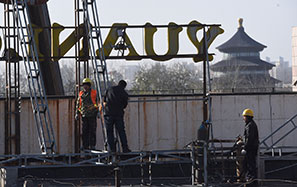
Workers check the facilities before the APEC trade ministerial meeting opens in Qingdao on Saturday. The high-profile meeting seeks to advance regional economic integration and strengthen comprehensive connectivity in the Asia-Pacific region, organizers said. Zou Hong / China Daily |

It will explore such priorities as advancing regional economic integration, promoting innovative development, economic reform and growth, strengthening comprehensive connectivity and infrastructure, and working out a blueprint for common prosperity and development in the Asia-Pacific region.
The Asia-Pacific region is in trade and economic terms the most dynamic region with the greatest potential in the world.
As the largest and highest economic cooperation organization in the region, APEC plays an important guiding role in advancing regional economic integration and economic globalization.
Since it was founded in 1989, APEC has been committed to open regionalism. The share of the Asia-Pacific region in global trade has risen to 46 percent and its share in the world economy to 57 percent.
As a member of the big Asia-Pacific family, China cannot develop in isolation from the rest of the region nor can the region prosper without China. Since joining APEC, China has forged increasingly close commercial ties and deepened economic integration with other member economies.
In 2013, China's trade with other APEC member economies accounted for 60 percent of its total foreign trade. While 83 percent of China's actualized foreign direct investment came from other APEC member economies, 69 percent of its outward direct investment went to them. Of China's top 10 trading partners, eight are member economies of APEC.
The country is deepening its reform in all respects, speeding up the establishment of a new open economy and striving to achieve the goal of doubling its 2010 GDP and per capita income for both urban and rural residents by 2020.
This is bound to translate into huge opportunities for businesses in the region. China will stay committed to an opening-up strategy of mutual benefits.
It stands ready to share its development opportunities from reform and opening up with other APEC member economies, strengthen interactions through economic cooperation, and expand the areas of converging interests.
The 20th Meeting of APEC Ministers Responsible for Trade will be held in Qingdao, Shandong province from May 17 to 18.
We sincerely welcome trade ministers of member economies and other friends to Qingdao to jointly shape the grand vision for Asia-Pacific economic cooperation and development and build a positive, pragmatic and future-oriented cooperation framework that benefits the entire region so as to seek common prosperity and development with an even closer partnership.
Regional economic integration
In recent years, the Asia-Pacific has become the most dynamic region for free trade partnerships in the world. Yet due to the overlap of FTAs and divergences in rules and standards, the tremendous potential of trade liberalization has yet to be unleashed.
It is therefore incumbent on APEC to play a more active leading role, undertake the historic mission of regional economic integration, gradually consolidate the FTA networks among member economies, move faster to launch the process of a Free Trade Area for the Asia-Pacific and realize our leaders' ambitious vision for that at an early date.
China stands ready to work with other member economies to strengthen information exchanges and build capacity, begin the feasibility study on realizing an Asia-Pacific FTA, and create conditions for achieving the ultimate goal of economic integration in the region.
Multilateral trading system
China cooperates with other APEC member economies to maintain the multilateral trading system's central role in setting international trading rules.
All parties should fulfill their commitments to reducing tariffs on environmental goods on the APEC EGs list in a timely manner and actively participate in the negotiations on EGs under the WTO framework.
We should hold up the banner of trade liberalization and firmly oppose trade protectionism in all forms, properly handle all types of trade frictions through dialog and consultation, and together safeguard an open and fair global trading system that benefits us all.
Global value chains
As a major sign of the new phase of intensified specialization and collaboration in trade and industry worldwide, forming global value chains is giving a fresh impetus into further trade and investment liberalization.
We should accelerate reform of the economic structure and promote technological innovation and industry upgrades to build a policy environment conducive to the development of GVCs.
We should also focus on addressing the chokepoints in supply chains, reducing the cost of doing business and facilitating free movement of goods, services and people with a view to improving the regional supply chain performance by 10 percent by 2015.
Meanwhile, we should invest heavily in economic and technical cooperation and capacity building, propel the "two wheels"- liberalization of trade and investment, and economic and technical cooperation - in sync to achieve common and sustainable development of the Asia-Pacific region.
Driving momentum
APEC member economies have managed to navigate the shadows of the international financial crisis and embarked on a critical stage of steady economic recovery thanks to the massive stimulus plans they had put together.
To boost innovative development, economic reform and growth is a common task faced by all APEC member economies.
To enable Asia-Pacific to continue to play a leading role in the new round of global economic growth, APEC should support its member economies to build consensus on innovative development, economic reform and growth, put forward long-term cooperation objectives with a roadmap and timeframe, and share experience in such areas as economic reform, new economy, innovative growth, inclusive support and urbanization.
Strengthening connectivity
The Asia-Pacific has enormous demand for infrastructure and connectivity, and enjoys a broad prospects for cooperation.
APEC should vigorously advance infrastructure and connectivity development within the region to link the economies more closely together in a geographic sense and facilitate quicker and more efficient flows of goods and people.
The realization of the "smooth flows of people and goods" will lay a solid foundation for the economic integration and development of the region.
APEC member economies should make concerted efforts to build all-directional connectivity that joins the two sides of the Pacific and features a trinity of facilities, services and people-to-people and cultural exchanges.
Greater efforts should also be made to build a bigger market out of the Asia-Pacific, and achieve greater connectivity and greater development of the region.
2014 marks the 25th anniversary of APEC. As a link between the past and the future, the meetings this year bear great significance for the future direction of trade and economic cooperation in this region.
China is ready to work together with other member economies to have in-depth and candid exchanges and comprehensively deepen cooperation.
We also hope to join forces with other members to consolidate the trade and economic foundation for the future-oriented Asia-Pacific partnership, and make new contribution to the common prosperity and development of this region as well as the welfare of the people in the Asia-Pacific and around the world.
The author is the minister of commerce.
For China Daily