Vital deals signed on Xi's trip to Mongolia
|
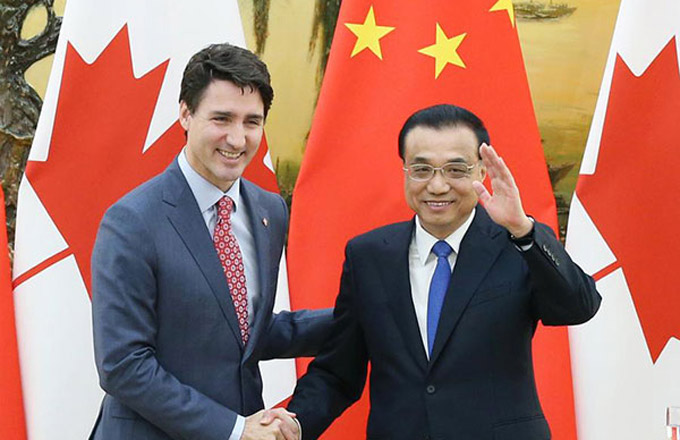
President Xi Jinping and his Mongolian counterpart Tsakhiagiin Elbegdorj attend a signing ceremony on Thursday in Ulan Bator, the Mongolian capital. B. Rentsendorj / Reuters |

Agreements cover the mineral trade, transportation links, energy demand
China and Mongolia signed more than a dozen key infrastructure and energy cooperation agreements on Thursday aimed at boosting landlocked Mongolia's mineral trade and poor transportation links while meeting China's growing energy demand.
Among 26 cooperation agreements signed on the first day of the first state visit by a Chinese president to Mongolia in more than a decade, 17 cover trade, infrastructure, energy and financial cooperation.
The agreements included a memorandum of understanding on strengthening coal-processing cooperation. Sources close to this said the document states support for a long-expected coal gas project worth $30 billion.
In a joint declaration, the two nations hailed the importance of the coal gas project and backed enterprises from both countries in pushing it forward.
The project would be carried out by Sinopec Group and a Mongolian partner, the sources said.
Dai Bing, director of the coal industry information department at JYD Online Corp, a bulk commodity consultancy in Beijing, said the project would benefit both countries, as Sinopec would bring advanced technology to Mongolia and China would have another important gas supply channel in addition to pipeline gas from Russia.
"Transportation of coal gas is also much cleaner and easier than delilvering coal from Mongolia to China," Dai said.
China's demand for coal has fallen and natural gas consumption has soared in recent years, with the government encouraging clean energy, and determined to reduce carbon emissions.
China's largest coal producer, the Shenhua Group, China Development Bank and Mongolian officials also signed a financing agreement for a rail link to carry coal across the border, from Mongolia's Gashuun Sukhait port to the Gants Mod port in China.
The agreements were signed after extended talks between President Xi Jinping and his Mongolian counterpart Tsakhiagiin Elbegdorj.
The Mongolian leader referred to Xi as "Mongolia's most distinguished guest" and described his visit as a historic one.
Talks between the two leaders, originally scheduled for 90 minutes, were extended by an hour, with their discussions covering nearly all sectors, Elbegdorj told reporters.
Xi told Elbegdorj that developing relations with Mongolia is a priority for Chinese diplomacy, adding that the two nations should integrate their advantages during cooperation.
"China has the willingness and capacity to help Mongolia translate its advantages into economic development through close cooperation," Xi said.
He proposed a "three-in-one" cooperation model, integrating mineral resources, infrastructure construction and financial cooperation, to help improve Mongolia's limited infrastructure and transportation links with China and cover Mongolia's shortage of capital.
With natural resources worth an estimated $1.3 trillion, Mongolia has not fully tapped its advantages since a law was introduced in 2012 limiting foreign ownership in "strategic" sectors.
Growth is the weakest for four years and inflation is rising. Foreign investment dropped by 70 percent in the first half of the year, according to Bloomberg.
China accounts for more than half of Mongolia's external trade and receives nearly 90 percent of its exports, mainly copper, coal and animal products. Bilateral trade has soared over the past decade, reaching $6 billion last year.
Gao Shumao, former Chinese ambassador to Mongolia, said that having realized the negative effect of the foreign ownership law, which had been revised last year, Mongolia hoped to reverse plummeting foreign investment and revive its economy.
Both sides also signed a deal allowing Mongolia to use six ports in northern and northeastern China for imports and exports. Officials said the ports included Tianjin, Dalian and Jinzhou.
Contact the writers at wujiao@chinadaily.com.cn and zhaoshengnan@chinadaily.com.cn
Du Juan contributed to this story.