Towns where the spirit of tradition flows
Maotai in southwestern China and Maidstone in southeastern England are perfect drinking partners
At first glance it may seem that a brewing town in the UK and a distillery town in China would have little in common, but having grown up in one and visited the other, it seems to me that people from my hometown would recognize a lot about life in Maotai town.
Both towns sit on rivers, which in different ways have shaped their histories. In Maotai, the distillery uses five tons of water from the Chishui River every day in making China's most famous spirit.
|
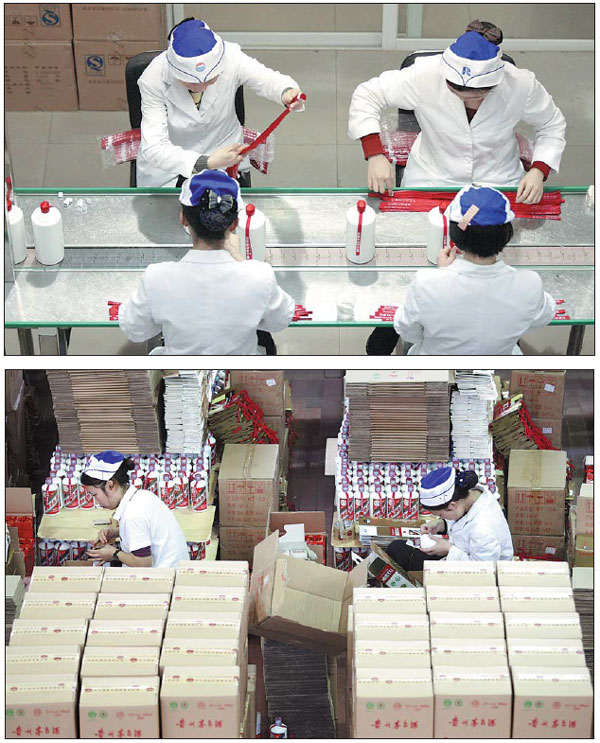
Moutai workers inspect consignments of baijiu liquor at a packaging line. Wang Zhuangfei / China Daily |
In Maidstone, Kent, the River Medway was a trading route for centuries, with flat-bottomed barges carrying goods, including beer, to bigger towns nearby and across the sea to the Continent.
The two towns are now experiencing different turns of history's wheel. Once, not long ago, 80,000 people would pour out of the city of London every harvest to pick Kent's precious hops for its huge brewing industry.
This annual exodus is just a memory for some, while older people in Maotai can remember when baijiu, or white spirit, was produced in little workshops before the distillery was centralized.
Baijiu drink sales suffered badly in 2014, with some famous brand names losing almost half their sales, largely due to the national austerity campaign. Moutai, the most famous brand, is looking abroad to expand its export market, and there is talk about making a weaker version of the 53 percent proof spirit for the foreign palate.
Ding Dagong, deputy director of Maotai multi-tourism administration, says: "We are trying to build the town as a tourism destination, with a 25.2 million yuan ($4 million; 3.5 million euros) investment by the local government."
By the end of 2016, the administration says it will have built more hotels and roads, and will be promoting hiking trails and baijiu tastings, and expanding a popular annual cycle race.
From the airport in Guiyang, capital of Guizhou province, the town is a four-hour drive, a big commitment for a visitor. It is unclear how many foreigners would add Maotai town to their itinerary if they visit China.
On the other hand, because Maidstone is located in Kent, it is perfectly placed for the tourist trade; Europeans going to the UK from mainland Europe by ferry inevitably drive through Kent on their way to London.
Until the 1960s, Kent was the center of England's brewing industry and had made beer from hops grown in hop gardens across the county for almost 600 years. Then something largely unforeseen happened. To illustrate the change, in the 1870s, 19,000 hectares of Kent was hop gardens. Today, only 400 hectares survive.
The landscape changed before everyone's eyes. Hop pickers were replaced with machines. Cheaper hops were imported from the United States, New Zealand and Germany. And then came a generation of lager-drinkers, with lager needing far fewer hops. Hop growing and the beer and real ale industry plummeted.
Maidstone's big riverside brewery when I was a child was Fremlin's, a family-owned business with an elephant as its trademark. Fremlin's was bought by Whitbread around 1972, and in the 1990s Whitbread closed all its brewing interests. It now owns Costa Coffee, among other interests - and operates coffee shops across China.
I was reminded of these turbulent changes when I met farmers Tong Hu and Tang Darong at their home in Tanchang, a neighboring town of Maotai. This husband-and-wife team sat next to each other like two tree trunks, rooted in their land and proud of the life it has given them.
But there is nothing romantic about the farmer's life, and this couple has been rolling with the changes since 2001, when they moved from cultivating rice to growing sorghum, an attractive grass-like crop, for Moutai.
"We were given free seeds, half-price fertilizer, and technical advice. We grew sweet potatoes during the changeover," Tong says. The couple is among 70,000 farmers in the area. Tong says he makes about 20,000 yuan a year farming 1 hectare of land.
All the more remarkable then that Tong and Tang have three university-educated children. Will any of them take over the family farm? Tong replies: "My parents grew corn. Sometimes, as a child, there wasn't enough to eat in the households around here. Lift is getting better. Our children will choose their own careers."
Maotai Town is recorded as making baijiu as far back as 135 BC. Until 1951 when the distillery became a state-owned enterprise, little "workshops" - usually named after their owner - produced the baijiu that were merged to make what is now China's national drink. In 2013, the distillery and the technique for making Moutai became protected by national regulations.
Around a century after baijiu was first recorded in Maotai, the ancient Romans invaded England and brought hops from Italy to Kent. For centuries, little brew houses were scattered all over Kent, in homes or attached to hostelries and often run by women. The idea of brewing hops to make beer with a higher alcoholic content did not arrive until the 15th-16th centuries, brought to Kent by merchants from Belgium.
So the landscape changed, with cone-roofed "oast houses" popping up across the countryside, in which the freshly picked hops were dried in kilns, giving off a soporific smell that drifted on the wind. And things carried on in much the same way until the dramatic changes that began in the 1960s described earlier.
These days the drinks trade plays a very different role in the two towns. Eighty percent of the population around Maotai town is involved in the baijiu trade, whereas Maidstone has only a tiny percentage of agricultural workers left. The main old brewery in Maidstone is now a shopping mall, while Maotai town has ambitious plans for growth.
But towns like these hold one trump card. Spirits, wines and beers all get their distinctive flavors from the climate, soil and water where they are made. As a result, communities come to these towns because the product cannot be made anywhere else. This constant change around old industries rooted in their landscape is what helps them to bend and survive.
In Maidstone, mechanization and cheap imports triggered the loss of jobs around the hop-growing industry. That cannot happen in Maotai. The company's sorghum buyer, Dou Yuanhang, explains: "Most of the process, from planting the seeds to getting sorghum to the warehouse, is done by hand."
It is for the simplest reason, too. "Our geography is mountainous," Dheo says, looking out over hectare after hectare of terraced farming accessible only by narrow footpaths. "No machinery can get to the crop."
There are lessons to be learned by both towns, as there always are from history. None of my childhood friends stayed in farming, just as proud parents are nurturing university graduates in Maotai's sorghum plantations.
China has sensibly wrapped national protections around its liquor, a move that could have salvaged some of the sorghum-growing industry years ago. However, having been forced to diversify, Maidstone is a thriving town with a wide range of smaller industries providing jobs.
There is now a happy new chapter to the sad tale of Kent's brewing decline. In Maidstone, microbreweries are springing up, with some pubs making beer on their premises - just as they did centuries ago. It is a very slight turn of the wheel of history for Maidstone.
If Moutai carries out its expansion plans, local people will soon experience a much bigger turn, which could be life changing. But spread over 2,000 years, they are changes that towns like these take in stride, while their rivers continue to flow steadily through them.
susansimpson@chinadaily.com.cn