Debunking the myth of ivory
Two wildlife experts say the perception that ivory is abundant and abundantly expensive in China is exaggerated
Before setting foot in China, Resson Kantai Duff and Christopher Kiarie imagined streets lined with Chinese people wearing exquisite bracelets, necklaces and earrings, all made of delicately carved ivory.
But after a trip last summer to the country, they realized their impression of its ivory consumption was completely off base.
|
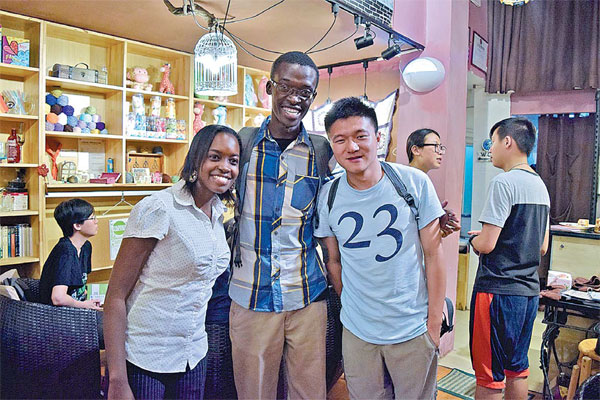
From left: Resson Kantai Duff, Christopher Kiarie and Gao Yufang had a trip across China last summer to learn ivory trade. Provided to China Daily |
"What we realized was that the absolute majority of Chinese are not involved in the ivory trade. When we had some discussions with them, many said they were not the right audience for the ivory trade," says Kiarie, Chinese liaison officer of WildlifeDirect, a Kenya- and United States-registered conservation organization in Nairobi.
Vilifying China for the global ivory trade will not solve any problems, he says, calling on the Western media and governments to rethink their stance against the nation if they want to constructively protect wildlife.
"In Africa, there is a very good story to elaborate this issue: If someone stole something and ran back home, it will be useless to shout that his whole family are thieves," Kiarie says.
The trip by the pair was facilitated by Gao Yufang, a Chinese researcher studying environmental protection at Yale University. They visited major cities in China, including Guangzhou, Fuzhou and Beijing, and had met university students, Chinese environmental nongovernmental organizations, ivory-carving associations, researchers, ivory traders, cultural groups, journalists, and in fact anyone who wanted to know something about Africa.
The three also visited markets where ivory sellers are adversely affected by anti-ivory trade campaigns, talking with groups for or against the trade.
"Those supporting the ivory trade asked how they were to survive if they stopped their trade, which they have engaged in for years," says Duff, who studied biodiversity at the University of Oxford with a focus on elephant protection in Kenya. She now works for Save The Elephants in Nairobi.
The ivory carving industry reacts strongly to the anti-trade campaigns because it has relied on this skill for centuries, she says.
"But that behavior can be changed. We spoke about faux ivory, which is not real ivory but which is still very rare and can still be carved. People are still looking for it because we can still get very good carvings but we do not have to kill the elephants," she says. "(People we talked to) seemed to understand that this is a possibility."
Across China on visits to craft markets, they found that each ivory market had a limited number of ivory on sale. Often, Duff says, people on city streets did not know where they could find a store selling ivory goods.
"When we were going to an ivory market, I expected to see 20 stories of shops filled with ivories, or that everyone buys ivory in China," Duff says. "The team debunked myths and discovered that not many Chinese know about the existence of the ivory trade - there weren't many shops selling ivory. It was also discovered that it is not true, as it has been claimed, that 84 percent of China's middle class wants to buy ivory."
But at shops around China, there were shoppers asking if they could bring in some ivory through illegal channels, mostly from Africa.
"It may not come in the sense that someone is accosting you to engage in illegal trade, but it may happen behind the scenes," Duff says.
They also learned during the trip that many elements traditionally regarded as major drivers of poaching in Africa were exaggerated.
"The price of ivory is not that high," Kiarie says. "Many people say the price of ivory is very high, but in comparison to what we saw on the market, it is not.
"The West makes it look like the Chinese are just lying and that the price of ivory is astronomical. But actually compared with other materials such as jade and precious wood, the price for an ivory tusk was quite limited."
The widespread belief that ivory is very expensive is the result of false reports in the Western media, she says. The result is that many people buy it as a speculative investment.
"In Nairobi, for example, the price of a house 10 years ago was very high. Some thought it was necessary to buy an apartment because in a few years the price would be very high. This is a wise purchase," she says. "And I believe ivory is the same. Now, spreading awareness to buyers who want to invest may not be the way to end the trade. There may be some who want to invest and have not got such information and may change their mind and invest in something else."
Duff says it is a pity that in wildlife protection there is no African perspective, many organizations and individuals in Africa are just copying what has been done in the West. Based on her own academic research and field study on the relationship between wildlife and human communities, she says, and in Africa the communities involved have certain attachments to the wildlife living nearby that may not coincide with the way Westerners would see things.
"The West has an intrinsic value for animals, for lions, elephants, etc. They are to be loved because they are species like all of us and have to be loved. And this is the same in other communities. It is an age-old tradition in some communities. But other communities value animals because they are useful in some way or another. And in many cases, we are told to suppress that and only talk about a love for animals. More recently, many communities have been respecting wildlife on one end and also benefiting from them through community conservation. I believe that is a good balance, and that is an African perspective."
The best way to connect Chinese to anti-ivory campaigns is to link the consumption to people whose livelihoods rely on elephants, she says.
"Communities may connect with benefits and they connect with people. In Kenya, when people speak about elephants, they also speak about their economy. But in China, we see that people may connect better with people. In this case, as a Chinese I may not care if an elephant dies, but I may care if I learn that whatever I am buying may affect someone in Africa who may lose his job."
lilianxing@chinadaily.com.cn