Migrant worker's fruitful endeavor
When Lai Yumei quit her job in 2001 at a plastic flower factory in Guangzhou at the age of 32, the migrant worker had made a plan for her future back home in the mountains near Guilin in the Guangxi Zhuang autonomous region. She wanted to plant cumquats, because she found that the fruit was popular and expensive in Guangzhou.
She is now recognized as the most successful businesswoman in Baisha, where she employs more than 100 villagers at a 20-hectare orchard, a 60-hectare tea plantation, a restaurant and a hotel. Her business now generates a profit of around 30 million yuan ($4.8 million) annually.
Busily serving dinners at her two-story wooden restaurant built halfway up a mountain, she offers strangers no clue that connects the smiling dark-skinned woman in plain clothes with a wealthy entrepreneur.
|
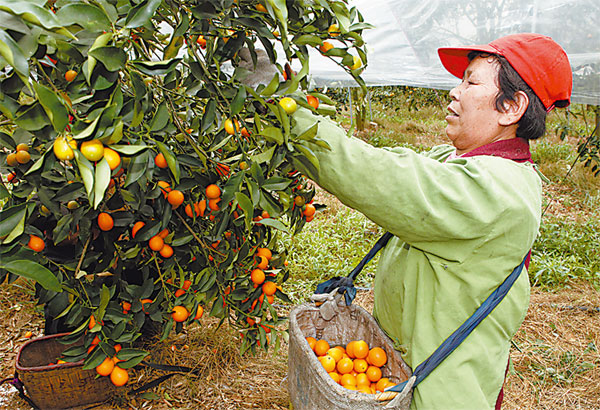
Lai Yumei picks cumquats in her orchard in the mountains near Guilin in the Guangxi Zhuang autonomous region. Huo Yan / For China Daily |
"Were it not for my fellow villagers' generous support, I would not have the orchard," Lai said, recalling the beginning of her business. Dozens of local people helped her reclaim the mountainous fields for free, which requires tremendous manual labor in Guilin's karst landscape, and planted fruit trees.
"They trusted me, and said I could pay them after the trees yielded cumquats," Lai said.
Lai took the lead in the village as early as 1992 in her early 20s to cultivate the virgin land and grow some cash crops. But their efforts were hampered due to the poor transport links between the area and the outside world.
She was among the first batch of migrant workers from the village, leaving the mountains to work in Guangzhou.
It was difficult for a farmer to obtain a bank loan at that time, because of the lack of mortgages. Lai sold her homes, borrowed money from many relatives, and invested all the money together with her savings in the orchard. The township government also provided her with about 100,000 yuan as a subsidy to reclaim the virgin land in the mountains, and invited agricultural experts to help her.
It took them three years, from 2001 to 2003, to reclaim the land and plant the trees, and another three years for the trees to yield fruit. The first harvest came in 2007.
By 2009, Lai had not only paid off all her debts, but also donated money to build a paved road connecting the mountain village with outside world. The smooth road surface meant that the cumquats were in a much better state than before when they reached their final destination.
She reinvested the proceeds of the cumquat sales into a much larger tea plantation and a medium-sized restaurant and hotel.
Lai introduced the trickle irrigation system to her farm, and uses organic fertilizer fermented from the waste of chickens and pigs she raises on the farm.
"Organic fruit is more expensive, and organic farming can also help protect the local environment," said Zhou Ruxi, a 44-year-old farmer and Lai's husband.
"In fact, we explore the skills of pruning, grafting and fertilization ourselves to ensure the trees suit the local environmental conditions," Lai said.
Lai, a self-taught agricultural technician, introduced greenhouse to the orchards, covering the trees with plastic film to protect the fruit from the sun, rain and the cold air in the mountains.
Huang Shuimo, a township government official, said: "Lai's experience has been spread widely in three neighboring towns, and has benefited hundreds of farmers. Lai is every active in helping the other farmers."
More than 240 families in four towns, including Baisha, now plant cumquats. The annual sales revenue last year in the four towns hit 460 million yuan, up 5 percent year-on-year. The average annual personal disposable income of local farmers in the area has risen from 4,000 yuan in 2007 to nearly 20,000 yuan now.
Li Yuming, 68, who picks cumquats in Lai's orchard, said: "I am very glad to work here on a daily basis. The more work I do, the healthier I am."
Li has farmland in a nearby village, and four children working in Guilin, a well-known tourist city. She works eight hours a day, picking about 150 kilograms during the harvest season, for which she receives a free lunch and 100 yuan per day.
Before 2008, the daily payment for a fruit picker like Li was only 13 yuan. The sharp rise in labor costs ever since has been a headache for Lai.
"I have no choice but only to ask them to pick the bigger fruit. About 30 percent of the smaller fruit is left to rot, because they are cheaper and cannot cover the costs of picking and transporting them to the market," said Lai.
"The local government is seeking investors to build workshops to collect and process the small fruits to make them into juice and preserved fruits," said Huang Shuimo.
Lai registered the trade mark for her cumquats and green tea, gained export certificates in 2012, and set up the a cumquat association with local farmers in 2013, when she started selling the cumquats to Southeast Asia, Russia and Eastern Europe, as well as through the Internet.
Her elder daughter, who studied human resources management at a university in Tianjin, helps her to manage the e-commerce sales.
"I hope my daughter can inherit my business, and continue to serve local people. Our roots are here," Lai said.
Huo Yan and Lan Lin contributed to this story.
liyang@chinadaily.com.cn