Strategic patience needed to deal with Japan
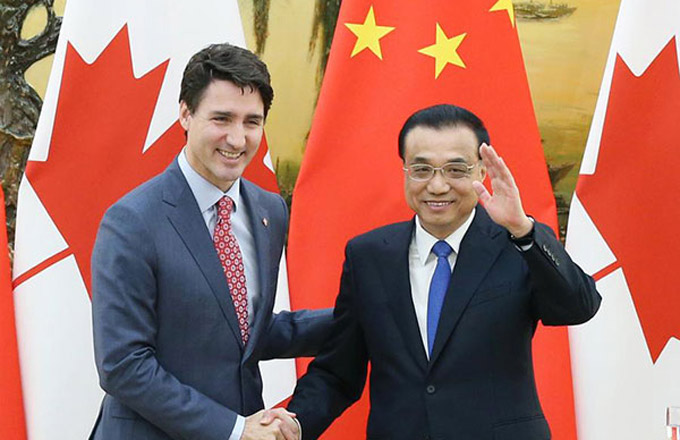
Have China-Japan relations improved after President Xi Jinping met with Japanese Prime Minister Shinzo Abe last year? The ups and downs in Sino-Japanese relations since that fateful meeting are the result of the fickleness of Abe, who is a conservative.
Conservatives like Abe have not only disagreements with China on historical issues, but also value conflicts with the United States. Abe's diplomacy is restricted by ideology, because his diplomacy is fickle, a byproduct of Japan's domestic policies. But his understanding of Japan's interests seems to be based on realism.
Whether or not the Abe administration enjoys solid support at home directly influences its China policy. Abe stopped visiting Yasukuni Shrine, which honors, among others, 14 Class-A war criminals, after he was elected prime minister for the first time in 2006. Even though China-Japan relations improved after he first became prime minister, his decision was not aimed at improving bilateral ties. What he really wanted was to be re-elected on the strength of his efforts to improve Japan's relations with China.
After the LDP won a majority in the upper house in 2013, Abe assumed Japanese people's support to be a ticket to do whatever he felt like. And he visited the shrine on Dec 26, 2013, ignoring the strong opposition from China and the Republic of Korea.
He has also used Japanese people's mandate to turn Japan into a "normal" country violating the principles of the post-World War II world order, which incidentally was established by its strong ally the United States. Moreover, Japan sees its alliance with the US as a testimony to its superiority in Asia. In fact, Abe regards Japan as being superior to its Asian neighbors. He has even borrowed some Western slogans, such as democracy, freedom and human rights, to prove Japan is an "advanced state", which is exactly what Japanese rulers did before WWII.
In his book Toward a Beautiful Country, published in 2006, Abe makes no secret that he despises China. He ridicules many Japanese scholars on China saying they have fallen in love with China, and insists Japan should strengthen its ties with the US, Australia and India instead. Sino-Japanese ties, for him, are just a means to win Japanese people's support, not the end.
Abe was eager to meet Chinese leaders last year because he was losing popular support at home and was being pressured by the US to do so. He certainly didn't intend to improve ties with China.
Dealing with a leader like Abe, China should not expect Japan to apologize for its war history and extend the hand of friendship, and should not think Japan is ready to confront it militarily and hinder its rise.
Abe has no intention of reconciling with China and owning up to Japan's war past. He doesn't have the power and will to challenge China militarily either, for he knows that under the US' military supervision Japan has "lost two decades" and its power, in comparison with the rest of the world, is nowhere near what it was in the 1930s.
What Abe wants is to see Japan as a "normal" country with a powerful military in comparison with China. Since the Meiji Restoration, Japan has judged itself in relation to China. This comparison mentality has not changed.
Having stable relations with Japan is of great importance to China's Asia-Pacific strategy. Japan is passing through a difficult transformation period and insists on siding with the US despite being humiliated under US "control".
With such a neighbor, China needs to exercise strategic patience, wait for it to change and make its strategic intentions clear to its neighbors, in order to prepare for a Japan after Abe.
The author is a researcher of China studies at Waseda University in Japan.