


Confucius has something to offer everyone
Where sensitivities exist about chinese educational programs, they should be acknowledged and addressed
The fortunes of Confucius have waxed and over the millennia since he was dispensing wisdom to the elite of the Eastern Zhou Dynasty (770-256 BC). But despite challenges of various kinds from Daoism, Legalism, Buddhism, modernism, Maoism and other schools of thought, Confucius is still a unifying symbol of China.
Many ideas and rituals associated with Confucius have become so embedded in Chinese culture that they are almost inseparable and indistinguishable from notions of "Chineseness" itself, for example, the centrality of family and the importance of education.
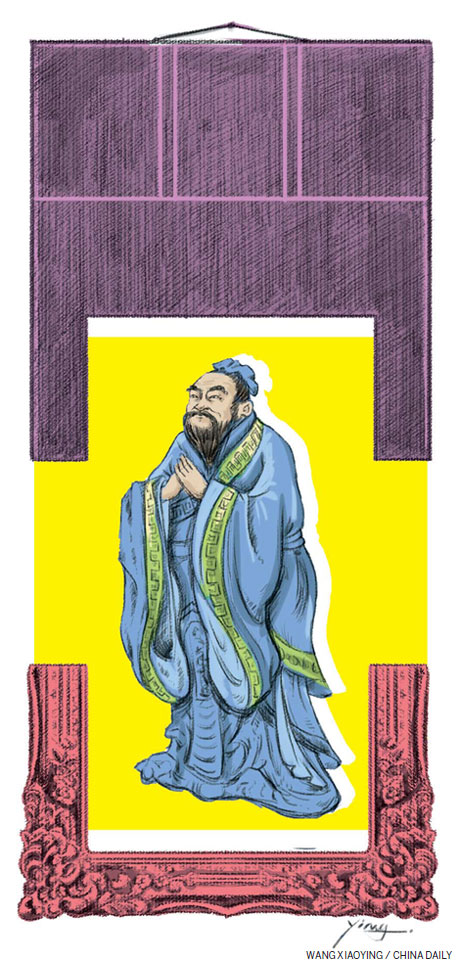
Yet the 20th century was a turbulent time for the ancient sage. Confucius came under attack from the modernizers and nationalists of the May Fifth generation and the hysteria of the "cultural revolution" (1966-76). In both cases, Confucius was said to be holding back China's progress.
But recognizing the utility of such an important symbol, and the enduring merits of many of his teachings, in particular, his sense of values, Confucius has since been rehabilitated.
Many young Chinese are hazy about the intricacies of Confucianism - which in any case has undergone centuries of mutation and hybridization. But to the extent that Confucius' core teachings have much to offer people dealing with the rigors of the contemporary world, it doesn't really matter. As I can attest myself, Confucius has something to offer everyone.
Sometimes I flatter myself that I have a special connection with Confucius. Or rather, I should say that Confucius has a special place in my life. I first encountered him in the mid-1990s, as a 20-year-old backpacker meandering my way through Asia on an extended gap year. If wandering around Asia sounds fun, the truth is I was terribly lonely and frustrated with the lack of direction and purpose in my life. And so it was that one day in Singapore I left a packed and sweaty dorm room in a Beach Road hostel to walk around the city. Little did I know that my life's course would change forever that day.
At the time I knew nothing about Singapore, but the order, dynamism and prosperity of the place - things that were missing in my own life - deeply affected me. Having worked up a sweat I wandered into a bookstore near the train station, more for the air conditioning than anything, and browsing the shelves picked up a copy of The Analects. I was sold by the back-cover blurb about a wise Chinese philosopher from 2,500 years ago. Back at the crowded hostel I was transfixed by a world where ancient sage kings ruled by virtue and gentlemen cultivated themselves to follow the Dao, or the Way.
Of course I didn't really know anything about Confucianism, I was just a naive young foreigner enthralled by my personal "discovery of China's ancient wisdom" (the kind of person who nowadays would get a Chinese character tattoo - luckily I didn't). I wasn't even able to appreciate the irony of discovering Confucius in Singapore, and being touched, without knowing it, by the Confucian-inspired development project masterminded by Lee Kuan Yew, independent Singapore's founding father.
Had I known of the critiques of Confucianism - that it was elitist, paternalistic and conservative, it would not have been an attractive proposition to me at all. But from my first reading of The Analects the message I seized on was the idea of self-improvement through learning. It turned out to be a major event in my life, and within a few months of this eclaircissement I was back in the UK majoring in Chinese studies at the University of Leeds. To paraphrase a line from The Analects, "I had set my heart on learning", and I have now been learning about China for more than 20 years.
When the Confucius Institute program was first established in 2004, a time when my own understanding of China was about to deepen through graduate studies, I felt an odd thrill of familiarity. The Confucius Institutes' mission was also something I strongly endorsed - the promotion of knowledge and understanding of Chinese language and culture seemed to me a very important and noble venture.
As a professor of Chinese studies, I constantly spread the message that China is the global future and that learning Mandarin and about the country is crucial. When I talk to high school children considering their university majors, I argue that China is the most fascinating and important thing they could choose to study. I love the fact that my children learn Chinese in their elementary and secondary schools - how different things are from when I was a student and people said I was crazy for majoring in Chinese.
Notwithstanding my own excitement, Confucius Institutes (and now Confucius Classrooms) have not received universal acclaim, particularly in Western countries, to the extent that they have become a symbol of China's attempt to spread its "influence" over other countries. Opponents of the Confucius program can rightly point to the breakneck speed with which they have become part of the higher education landscape. In the decade since the first one was launched in South Korea (the country where Confucian heritage exerts the strongest influence today), around 500 have been established around the world. Hanban - the Chinese government institution that runs the Confucius programs - says it plans to double that number by 2020.
The scale and ambition of these operations invoke other fears about the "threat" of China's increasingly intense global engagement and rise to economic and political prominence. China's "soft power push" is well known - but an attempt to balance global narratives about China, which are dominated by Western media, and increase levels of understanding about China are understandable. That Confucius Institutes are a vehicle for teaching about Chinese culture and language should make them no different from their American, British, French or German equivalents.
The fact that Confucius Institutes are embedded within host country institutions raises the specter, fairly or not, of external influences. Where Confucius Institutes are hosted by universities with strong organizational and financial standing, the risk is much reduced. But where a university's provision of language and China-related classes is completely reliant on the funding and teaching resources provided by Hanban, the latitude for influence is greater.
But the Confucius program is such a valuable contribution to spreading knowledge of China that where sensitivities exist they should be acknowledged and addressed. The last thing that anyone with an interest in China wants to see is a mass annulment of the relationship between Western universities and schools, and the Confucius program.
The writer is a senior fellow at the China Policy Institute and associate professor of contemporary Chinese studies at the University of Nottingham. The views do not necessarily reflect those of China Daily.














