Coke expands sugar cane irrigation
Initiative has already lifted farmers' production, incomes in Guangxi Zhuang autonomous region
An ongoing agricultural irrigation and industrialization project, launched in China in 2011 by The Coca-Cola Co, is being expanded into the second phase, which is expected to cover 66,666.7 hectares of sugar cane-growing farmland over the next five years.
The drinks giant is to collaborate with COFCO Tunhe Chongzuo Sugar Co Ltd to launch the new phase, in Bayang, Chongzuo, a city in the Guangxi Zhuang autonomous region, with the overarching aim of creating a demonstration water-saving irrigation project, focused on mechanical planting. The first phase covers an area of 66,666.7 hectares of sugar cane-growing farmland.
"The Guangxi Sustainable Sugar Cane Initiative has not only significantly improved water efficiency, but also guaranteed the stable production and quality of cane sugar," said Huaying Zhang, vice-president for sustainability at Coca-Cola in China and South Korea.
Cola-Cola's work on the project has so far centered on providing safe drinking water to farmers, boosting water efficiency by optimizing irrigation facilities and methods, and reusing reclaimed nutrient-rich wastewater from the sugar mills, without compromising growers' yields.
In addition, the company has also built and improved pipelines used by local farmers to access clean water.
Zhang said water resources management and protection are a key part of Coca-Cola's overall sustainability strategy, and that its work in Guangxi, which produces more than 60 percent of China's cane sugar, plays an important role nationally.
Much of the project's success has been down to a method referred to as "dip irrigation".
By integrating fertilizer into the water, it allows farmers to precisely control the use of microbial technologies which can, for instance, kill pests with minimal effect on the cane plants, or on the overall water supply.
The reuse of wastewater also helps farmers reduce the amount of waste from the sugar cane production process.
One villager from Jiangzhou district in Chongzuo, said: "Using these new improved methods of irrigation, we have been able to turn wastewater into rich water, sugar cane production has increased and our incomes have risen considerably. Our quality of life has also been improved."
Zhong Guotao, deputy director of Chongzuo's commerce bureau, and also one of the initiators of the program, said it has greatly improved and optimized the use of water resources by recycling 2.74 billion liters of water every year for local communities.
It has also increased sugar cane production annually, and benefited more than 6,000 sugar cane farmers directly and 150,000 people in local communities indirectly, he said.
One of the first participants in the project, Guangxi Chongzuo Sungain Sugar Co Ltd, has reached its goal of "zero water intake", meaning all the water used in its production comes from the sugar cane itself, or is recycled.
Guo Guanghai, head of Guangxi Chongzuo Sungain Sugar Company Ltd, said waste molasses is also used for the production of yeast, the bagasse - the dry pulpy residue left after the extraction of juice from sugar cane - is used as fuel for power generation and paper-making, and even filtered mud used in the process gets spread on the land as organic fertilizer.
In its own operations, Coca-Cola says it has been implementing what it calls a "3R" water strategy - to reduce, recycle and replenish - for the past 10 years, and has achieved 100 percent water replenishment in 2014 in China market.
wangzhuoqiong@chinadaily.com.cn
|
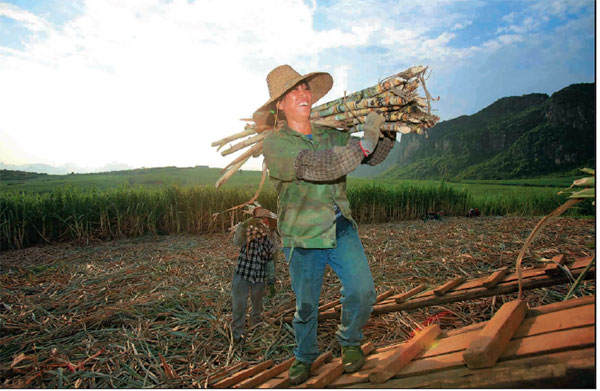
A farmer carries sugar cane at the sustainable agriculture irrigation and industrialization project launched by CocaCola in Bayang, Chongzuo, Guangxi Zhuang autonomous region. Provided To China Daily |