Digital technicians save treasures in 3-D
Night falls. Waves of pilgrims gradually begin leaving Jokhang Monastery in the old part of Lhasa, capital of the Tibet autonomous region.
Then, Luo Wenhua leads his team to begin another night's work - taking pictures of glittering Buddha niches in the monastery, one of the holiest places for Tibetans.
Every evening until midnight, they work on building one of the country's most advanced 3-D high-definition image databases of cultural relics.
|
A lama from Jokhang Monastery checks a digitally categorized fresco on a combination screen. Wang Kaihao / China Daily |
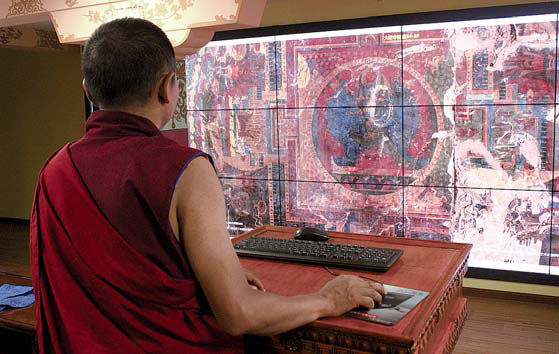
Luo, a researcher from the Palace Museum in Beijing, moved to Lhasa in 2013 for this program to help Jokhang Monastery digitally categorize its thangka - Tibetan paintings on cotton or silk applique - statues and frescoes.
"The photographs of every statue, for example, are taken from 10 different angles," says Luo. "If epigraphs are discovered, more pictures are taken."
The sacred names (in Sanskrit, Tibetan and Mandarin) of the relics and other information are recorded. About 85 percent of the 5,051 statues in the monastery have been covered so far, the oldest dating back to the Tubo era (7th to 9th century), the predecessor of today's Tibet, according to Luo.
In total, 1,439 pieces of thangka have been found.
The Jokhang Monastery was founded during the reign of Songtsen Gampo, the first ruler of Tubo, and its construction continued until the early 20th century.
"It's uncommon for a monastery to have a cultural relics warehouse like Jokhang. However, the inventory needs to be done in a better way because the details in the previous one were often vague," Luo says.
"Now that we are recording details we can fill some of the gaps in the records in Jokhang."
The digitization of the frescoes should be completed by 2017, and the project will then be expanded to cover the ancient architecture.
The database will be in Mandarin, Tibetan and English to facilitate access by overseas scholars.
Luo hopes the material they are collecting can be used to develop something similar to the Palace Museum's digital exhibitions so that full use can be made of the database, but that proposal depends on the monastery's administrators.
Potala Palace, another sanctuary in Lhasa, built in AD 637, is also making an attempt to use digital technology to better preserve its relics.
The Jokhang Monastery and the Potala Palace were added to the UNESCO World Cultural Heritage list in 2000 and 1994 respectively.
Speaking of the relics in the palace, Kunga Tashi, deputy director of administration for the Potala Palace, says: "Though the palace is a reservoir of cultural brilliance, we are not very sure how many cultural relics we have.
"We have our lists on paper but we often face problems in estimating the age of the relics."
In 2012, when the State Administration of Cultural Heritage launched a nationwide survey of the country's cultural relics, the palace got a chance to cross-check the stored treasures using its lists.
About 60,000 ancient books or files, and 40,000 items have been found.
As for the condition of the treasures, Kunga Tashi says, "As the climate in Tibet is drier than many other parts of China, it means most of the relics are still in good condition and not affected by oxidation."
Speaking of the progress of the Potala Palace digital project, Pempa Lobsang, deputy chief of the cultural relics custody department at the palace, says he and 22 colleagues are busy taking photographs and checking the collections, and adds that he expects the work will be completed by the end of the year.
"But now we have to deal with damage to many items, especially textiles," he says.
The challenge for the palace now is to develop the capacity to repair damaged relics.
Tibet's first laboratory to conserve cultural relics was founded in 2001 at the Tibet Museum.
In 2014, the State Administration of Cultural Heritage allocated 14.8 million yuan ($2.2 million; 2 million euros; 1.8 million) to the museum to upgrade its lab, with a special focus on the restoration of thangka.
The lab then also began a series of training programs with its counterparts at the Shanghai Museum, the Capital Museum in Beijing and the China Silk Museum in Hangzhou, Zhejiang province.
"With local expertise being nurtured, we are now not only restoring our own collections but are also helping to take care of items at other institutions and monasteries," says Dadron, deputy director of the Tibet Museum.
The museum is also developing criteria for the restoration and custody of relics, she says.
"The museum can thus become the flagship of an online network to guide comprehensive protection."
wangkaihao@chinadaily.com.cn