New Stage For Chinese Opera
A traditional art form is finding more fans as Bai Yansheng's popular Ace of the Aces, Lingren on Shanxi Satellite TV Station prepares for its second season. Chen Nan reports.
Chinese TV producer, director and host Bai Yansheng has won rave reviews and awards for his TV programs over the years, which have been dedicated to introducing and promoting traditional Chinese operas.
But the series he is currently working on is his most precious project.
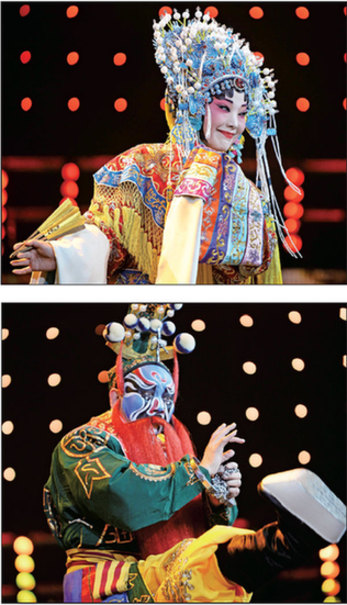
Titled Ace of the Aces, Lingren, the show, produced and aired by Shanxi Satellite TV Station, will start its second season in January 2017.
The first season premiered in May 2016.
In Chinese, lingren refers to an actor or actress. The show, which features top Chinese opera artists from around the country, is a competition spanning three months.
Traditional Chinese opera has over 200 genres, such as the well-known Peking, Kunqu operas and more localized types, such as Chuanju Opera from Sichuan province and Jinju Opera from Shanxi province.
"These ancient art forms offer us endless inspiration," says Bai, who is - as usual - producer, director and host.
The 48-year-old was born and raised in Huanghua city, Hebei province. He has been a fan of traditional Chinese opera since childhood. He was drawn to the local opera in his hometown, Hebei bangzi, due to its martial arts motifs and the song-based storytelling.
After graduating from Hebei University, where he majored in Chinese, Bai joined the local TV station in 1991. He later became a TV host on China Central Television.
Bai toyed with the idea of the show for 10 years. But it was only after quitting CCTV in 2013 that he began working with the Shanxi Satellite TV Station.
Shanxi province is home to over 50 kinds of traditional operas and there is a large local fan base, says Hu Suping, chief of the publicity department of Shanxi province.
Bai is excited that the competitors are veteran opera artists and national award winners.
"As traditional Chinese opera sees its popularity wane, we want to support its revival by showcasing the beauty of this art form through TV," he says.
He adds that one of the biggest challenges he faced was to convince artists to join the show.
"They are stars in their own right. It took me a long time to persuade them," he says.
He also says that it would have been much easier for him to invite fresh talent to perform in the show, but he did not do it because "only through performances by these seasoned artists can audiences see authentic Chinese operas".
Bai says that what matters is not the result of the competition, but the opportunity - both for the artists and audiences - to enjoy traditional operas.
This view is echoed by 65-year-old artist Zhang Lan, who specializes in Yuju Opera, which originated and thrived in Central China's Henan province in the late Ming (1368-1644) and early Qing (1644-1911) dynasties.
"Usually, traditional Chinese operas are performed in theaters. But TV helps us gain more fans," Zhang says.
Zhang is the two-time winner of China's top theater award, the Plum Blossom Prize, and is the director of the Yuju Opera Troupe of Liaocheng, Shandong province.
She started learning Yuju Opera at age 3 from her father, who was also a performer.
Explaining why she joined the show, she says: "We give hundreds of performances in remote villages in Shandong, which enables us to build a special bond with the audiences. But I also want young people to see this art form, and that's why I took part."
When the TV show's first season was telecast earlier this year, it evoked a mixed response with some questioning the show's professionalism as the judges were not traditional Chinese opera artists, while others say the different opera forms could not be compared as each is different.
Bai was also frustrated when his invitations were turned down by some artists and some quit in the middle of the show.
"But we did not give up because we believed this was the right thing to do," says Bai.
"I wanted to appeal to the audience, who were not traditional opera fans. New fans, especially the younger generation, are the future for these old arts."
Meanwhile, Bai also invited five celebrities to be judges for the show, including Guo Degang - a comedian who specializes in xiangsheng, or crosstalk, a traditional Chinese art form - and Guo Baochang, a renowned scriptwriter and director.
Speaking about his experience on the show, the comedian, who started learning pingshu, a traditional Chinese art form of storytelling and singing, at age 8 and later learned other traditional art forms, says: "Traditional Chinese operas best represent Chinese culture and are almost a part of its identity. This is our art form because it uses local language and is full of traditional values."
Fu Jin, a professor from the National Academy of Chinese Theater Arts, who is also one of the judges, says that besides showing people how precious the art form is, traditional opera artists need to create works that audiences can appreciate and be interested in.
"With social media, you get instant feedback from the audience," says Fu.
Contact the writer at chennan@chinadaily.com.cn
|
Ace of the Aces, Lingren, produced and aired by Shanxi Satellite TV Station, features top Chinese opera artists from around the country. |