Life is sweet for sugar industry in Ethiopia
Chinese company works on energy-efficient new factory, bringing jobs and hope to an impoverished region
In Ethiopia, the construction of new giant sugar factories is in full swing. There are now 10 such plants being built, and among them is Omo-Kuraz 5 in the southern Omo region. This is the largest and is being built by a private company from China.
Jiangxi Jianglian International Engineering, a company with headquarters in Nanchang, Jiangxi province, won the engineering, procurement and construction contract in 2013.
Construction work started in 2015 and is 5 percent complete, with sugar-making machines arriving from China. According to the company, the first phase of the project is scheduled for completion by November next year.
|
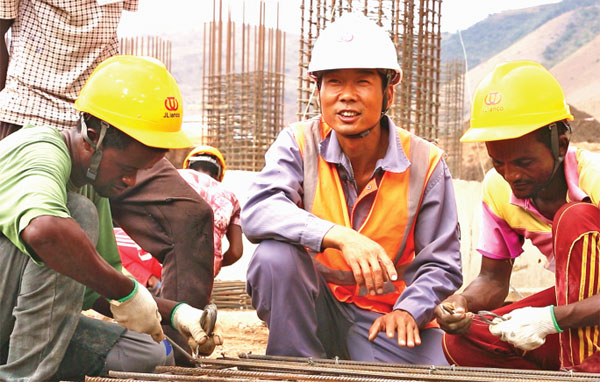
A Chinese engineer of Jiangxi Jianglian International Engineering works with local employees at the construction site of Omo-Kuraz 5 in Ethiopia. Photos Provided to China Daily |
"On completion, the project will increase Ethiopia's annual refined sugar production by 600,000 tons," says Huang Fu, the company's general manager for the project. "It will no doubt help stimulate economic growth in the country."
For decades, Ethiopia has depended on imports to meet its demand for sugar. In recent years, the country has tapped its natural and human resources to develop the sugar sector. According to its Growth and Transformation Plan, the government has identified sugar production as one of the cornerstones for increasing the country's competitive advantage in the agro-processing subsector. By 2020, it is expected to have 13 large sugar factories.
"Our production capacity had not been over 400,000 metric tons before. But now, due to the expansion of the present factories and the new ones that will become fully operational this year, the nation will have the capacity to produce 700,000 tons of sugar this year," says Gashaw Aychlum, corporate communication CEO of Ethiopian Sugar Corp, as quoted by The Ethiopian Herald.
"The nation is planning to export sugar, starting in the coming fiscal year. We could say the nation is in a state of 'sugar development revolution'."
Jiangxi Jianglian International Engineering entered the Ethiopian sugar market in 2013, says Yuan Jialin, the then-team leader for bidding. In order to stand a chance of participating in the bidding, Yuan says he spent a great deal of time persuading Ethiopian Sugar Corporation, the owner of the project.
"We were unknown at that time, especially when compared with bigger and Chinese State-owned companies," Yuan says. "As a private company from abroad, we were the last one who would be expected to win the bid."
The company's strengths in recycling technology helped it stand out. The Omo area, where the project is located, is a barren land and the project's power supply was the biggest problem. According to the company's proposal, on completion the factory will generate power by burning of sugar cane bagasse, the pulpy fibrous material left over when sugar has been extracted. At the same time, the waste sugar molasses produced as a byproduct will be used to make alcohol, and ash from the burning will be used to fertilize sugarcane fields.
The $647 million project has broken records as the largest-ever overseas deal in Jiangxi province.
"Many saw us as a dark horse," Yuan says. "In fact, this success is the result of our long-term endeavor, following the government's encouragement to go global and the Belt and Road Initiative."
Jianglian Heavy Industry Group, the parent company of Jiangxi Jianglian International Engineering, started developing its overseas market in 2003. In 2007, it established the subsidiary to specialize in tapping the overseas market. In 2012, the company undertook a refined sugar project in Indonesia, its first move into the sugar industry.
Building a single sugar factory is like building a town, CEO Aychlum says. With rapid development, new sugar projects in Ethiopia are being located in remote areas instead of being concentrated in one region.
The Omo-Kuraz 5 plant is 1,000 km from the capital, Addis Ababa, at an altitude of 2,500 meters, an area identified as most suitable for sugar cane growing and production. The area lacks infrastructure and services. It takes two days to travel there from the capital, due to the lack of highways and railways.
The area lacks water, which locals have to transport for long distances. When the company kicked off the project in 2015, the first thing it did was to drill wells.
"We dug two wells - one for the construction work and one for locals. It is all free," says Huang.
Pure water isn't the only benefit the project has brought to the community. A large number of jobs have been created.
According to the company, it has employed about 300 Ethiopians in construction, earning an average income of 3,000 bier ($129) a month. That is close to the salary paid to local bank staff. When the factory is in full operation, it will create about 1,000 jobs in the plant itself and another 12,000 seasonal jobs on the plantations.
A construction worker from Addis Ababa, who gave his name as Getachew, says he is happy to get a job with a Chinese company. "I never worked on construction sites before. It is great that I could get training from the company, and now I have become a skilled worker, adept at working with steel bars."
Representatives of Ethiopian Sugar Corporation also speak highly of the Chinese company. "In my experience with the Chinese enterprises, the company has the best management. It abides by the construction plans rigidly and tolerates no mistakes," says Ekalh, a project manager.
Ethiopia is Africa's second-most populous nation, with a mostly young population of about 100 million. It hopes its investments will meet the demands of the job market and keep the nation stable and prosperous. The contribution from Chinese companies is massive and highly visible across the country. Ethiopia attracted foreign investment of $1.2 billion in the first six months of the 2016-17 fiscal year, dominated by Chinese companies, according to the Ethiopian Investment Commission.
lijing2009@chinadaily.com.cn