|
 The 15th day of the 1st lunar month is the Chinese
Lantern Festival because the first lunar month is called yuan-month and in
the ancient times people called night Xiao. The 15th day is the first
night to see a full moon. So the day is also called Yuan Xiao Festival in
China. The 15th day of the 1st lunar month is the Chinese
Lantern Festival because the first lunar month is called yuan-month and in
the ancient times people called night Xiao. The 15th day is the first
night to see a full moon. So the day is also called Yuan Xiao Festival in
China.
According to the Chinese tradition, at the very beginning
of a new year, when there is a bright full moon hanging in the sky, there
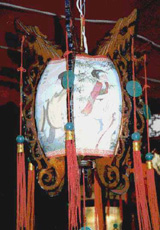
should be thousands of colorful lanterns hung out for people to
appreciate. At this time, people will try to solve the puzzles on the
lanterns and eat yuanxiao (glutinous rice ball) and get all their families
united in the joyful atmosphere.
History
Until the Sui Dynasty in the sixth century, Emperor Yangdi invited
envoys from other countries to China to see the colorful lighted lanterns
and enjoy the gala(節(jié)日的,慶祝的)performances.
By the beginning of the Tang Dynasty in the seventh century, the
lantern displays would last three days. The emperor also lifted the curfew(宵禁令), allowing the people to enjoy the
festive lanterns day and night. It is not difficult to find Chinese poems
which describe this happy scene.
In the Song Dynasty, the festival was celebrated for five days and the
activities began to spread to many of the big cities in China. Colorful
glass and even jade were used to make lanterns, with figures from folk
tales painted on the lanterns.
However, the largest Lantern Festival celebration took place in the
early part of the 15th century. The festivities continued for ten days.
Emperor Chengzu had the downtown area set aside as a center for displaying
the lanterns. Even today, there is a place in Beijing called Dengshikou.
In Chinese, Deng means lantern and Shi is market. The area became a market
where lanterns were sold during the day. In the evening, the local people
would go there to see the beautiful lighted lanterns on display.
Today, the displaying of lanterns is still a big event on the 15th day
of the first lunar month throughout China. People enjoy the brightly lit
night. Chengdu in Southwest China's Sichuan Province, for example, holds a
lantern fair each year in the Cultural Park. During the Lantern Festival,
the park is literally an ocean of lanterns! Many new designs attract
countless visitors. The most eye-catching lantern is the Dragon Pole. This
is a lantern in the shape of a golden dragon, spiraling up a 27-meter
-high pole, spewing fireworks from its mouth. It is quite an impressive
sight!
Origin
 There are many different beliefs about the origin of
the Lantern Festival. But one thing for sure is that it had something to
do with religious worship. There are many different beliefs about the origin of
the Lantern Festival. But one thing for sure is that it had something to
do with religious worship.
One legend tells us that it was a time to worship Taiyi, the God of
Heaven in ancient times. The belief was that the God of Heaven controlled
the destiny of the human world. He had sixteen dragons at his beck and
call and he decided when to inflict drought, storms, famine or pestilence(瘟疫)upon human beings. Beginning with
Qinshihuang, the first emperor to unite the country, all subsequent
emperors ordered splendid ceremonies each year. The emperor would ask
Taiyi to bring favorable weather and good health to him and his people.
Emperor Wudi of the Han Dynasty directed special attention to this event.
In 104 BC, he proclaimed it one of the most important celebrations and the
ceremony would last throughout the night.
Another legend associates the Lantern Festival with Taoism. Tianguan is
the Taoist god responsible for good fortune. His birthday falls on the
15th day of the first lunar month. It is said that Tianguan likes all
types of entertainment. So followers prepare various kinds of activities
during which they pray for good fortune.
The third story about the origin of the festival is like this. Buddhism
first entered China during the reign of Emperor Mingdi of the Eastern Han
Dynasty. That was in the first century. However, it did not exert any
great influence among the Chinese people. one day, Emperor Mingdi had a
dream about a gold man in his palace. At the very moment when he was about
to ask the mysterious figure who he was, the gold man suddenly rose to the
sky and disappeared in the west. The next day, Emperor Mingdi sent a
scholar to India on a pilgrimage(朝圣)to locate
Buddhist scriptures. After journeying thousands of miles, the scholar
finally returned with the scriptures. Emperor Mingdi ordered that a temple
be built to house a statue of Buddha and serve as a repository for the
scriptures. Followers believe that the power of Buddha can dispel
darkness. So Emperor Mingdi ordered his subjects to display lighted
lanterns during what was to become the Lantern Festival.
Yuanxiao
 Besides entertainment and beautiful lanterns,
another important part of the Lantern Festival,or Yuanxiao Festival is
eating small dumpling balls made of glutinous rice flour. We call these
balls Yuanxiao or Tangyuan. Obviously, they get the name from the festival
itself. It is said that the custom of eating Yuanxiao originated during
the Eastern Jin Dynasty in the fourth centuty, then became popular during
the Tang and Song periods. Besides entertainment and beautiful lanterns,
another important part of the Lantern Festival,or Yuanxiao Festival is
eating small dumpling balls made of glutinous rice flour. We call these
balls Yuanxiao or Tangyuan. Obviously, they get the name from the festival
itself. It is said that the custom of eating Yuanxiao originated during
the Eastern Jin Dynasty in the fourth centuty, then became popular during
the Tang and Song periods.
The fillings inside the dumplings or Yuansiao are either sweet or
salty. Sweet fillings are made of sugar, Walnuts(胡桃), sesame, osmanthus flowers(桂花), rose petals, sweetened
tangerine peel, bean paste, or jujube
paste(棗泥). A single ingredient or any combination can be used as
the filling . The salty variety is filled with minced meat, vegetables or
a mixture.
The way to make Yuanxiao also varies between northern and southern
China. The usual method followed in southern provinces is to shape the
dough of rice flour into balls, make a hole, insert the filling, then
close the hole and smooth out the dumpling by rolling it between your
hands. In North China, sweet or nonmeat stuffing is the usual ingredient.
The fillings are pressed into hardened cores, dipped lightly in water and
rolled in a flat basket containing dry glutinous rice flour. A layer of
the flour sticks to the filling, which is then again dipped in water and
rolled a second time in the rice flour. And so it goes, like rolling a
snowball, until the dumpling is the desired size.
The custom of eating Yuanxiao dumplings remains. This tradition
encourages both old and new stores to promote their Yuanxiao products.
They all try their best to improve the taste and quality of the dumplings
to attract more
customers. | 


