 |
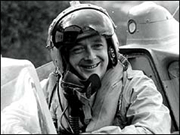
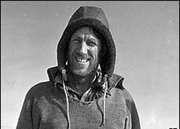
| Edmund Hillary at the
South Pole after leading the first successful overland expedition
for more than 40 years |
| 1958: Explorer Hillary arrives at South
Pole |
England have
Sir Edmund Hillary has reached the South Pole - the first overland
explorer to do so since Captain Robert F Scott's expedition in 1912.
The New Zealander and his team arrived safely after travelling 70 miles
(113km) through mist and poor weather conditions.
They described seeing the round tower of the South Pole for the first
time as a "black blob" on the horizon.
Sir Edmund and his colleagues had only one drum of petrol left when
they sighted the Polar base. This would have been enough for the "tractor
train" to travel 20 miles (32km).
Earlier, the explorer had said fuel consumption was the party's main
worry and that the team were "cutting it fine" because of very soft snow.
Members of the team had to use shovels to clear a path for their tractors.
It took the tractor train, which included three tractors, a caboose and
two sledges, more than 80 days to complete the 1,200-mile journey
(1,930km) journey.
Sir Edmund was reportedly enthusiastic ahead of his arrival at the
South Pole, and had told colleagues of heavy going in snow with a
consistency of sugar, although he said good progress had been made.
In the final leg of the journey, the sky was overcast and there was no
sun to warm the polar plateau. The party had to travel in "white-out"
conditions for most of the time, with Sir Edmund telling Scott Base by
radio: "It is tough, but not too tough."
The explorer later thanked his team, which included Ron Balham, Peter
Mulgrew, Murray Ellis, Jim Bates and Derek Wright, and everyone involved
in the expedition to the South Pole.
A broadcast message congratulating the triumphant group has been sent
by New Zealand Prime Minister Walter Nash. All the explorers have spent 16
hours sleeping following their gruelling journey.
Crossing the polar plateau has led to several problems for Sir Edmund
and the others in his party, including engine failure and poor weather
conditions such as low cloud and strong winds, plus the hidden danger of
crevasses .
Meanwhile, Sir Vivian Fuchs - director of the British Antarctic Survey
- has reported a significant advance to about 200 miles (322km) from the
Pole, and hopes to advance by around 50 miles (80km) per day. The two
parties, approaching from opposite directions, had originally intended to
link up on the Scott Base side of the South Pole.
Both teams of explorers were able to report progress by radio to the
outside world and also made radio contact with each other to discuss
future plans. They were also helped by the Beaver aircraft of the Royal
New Zealand Air Force.
Sir Edmund Hillary's team is one of two Commonwealth Antarctic
Expeditions.There are also 10 other national expeditions currently
exploring the vast Antartic continent.
Since October 1956, the Americans have had a station at the
geographical pole, with 20 men there at any one time. Russia has five
bases - including the biggest in the Antarctic, which is at
Mirny.