Heritage
Yangliuqing New Year woodprints
(chinaculture.org)
Updated: 2008-02-27 10:07
 |
Large Medium Small |
Year: 2006
Sort: Folk Fine Arts
Area: Tianjin Municipality
Serial No.: Ⅶ-1
Declarer: Tianjin Municipality
The New Year Woodprint is a unique art form in China that boasts a long history and far-reaching influence. During the Spring Festival (Chinese New Year), the Chinese decorate their homes with many New Year woodprints, the best of which can be found in Yangliuqing.
A town located in the western suburbs of North China's Tianjin Municipality, Yangliuqing is one of the earliest places to employ engravers to print New Year pictures.Yangliuqing New Year Woodprints originated in the Ming Dynasty?(1368-1644) and prospered in the Qing Dynasty?(1644-1911). In the most prosperous period of New Year woodprints, hundreds of painters and printing artisans gathered in the region. With a long history and distinctive local flavor, the pictures are much adored by ordinary people.
Ⅰ. History
In the late Yuan Dynasty?(1271-1368), a folk artist who specialized in engraving came to take refuge in the town of Yangliuqing. When he first set his eyes on the patches of jujube forests he thought of his special skill since the Chinese jujube tree is the best material for engravings. He then etched some pictures of door gods, kitchen gods and Zhong Kui?(the protector against evil spirits and demons) to sell at festivals for a living. Later, people in the town followed suit.
In the early Ming Dynasty when the Great Canal was dredged, fine paper and watercolors produced in South China were transported to Yangliuqing, breathing new life into the art of engraving and printing in the town.
In the mid-Qing Dynasty, about 100 painting workshops emerged in Yangliuqing and over 3,000 people engaged themselves in creating New Year woodprints. The town then became known as "the home of New Year woodprints" nationwide, where "each of its households was good at painting." By then, two schools of Yangliuqing New Year Woodprints came into being -- the Qi family, which excelled in painting historical stories, and the Dai family, which mainly painted dramas.
At the end of the Qing Dynasty, a new school -- the Huo family, which combined the advantages of the above-mentioned elements -- emerged, forming a triangular balance of power in the circle of Yangliuqing New Year Woodprints.
After the Second Opium War?(1856-1860), Yangliuqing New Year Woodprints began to decline. In 1958, Huo Yutang, the fifth-generation descendent of the Huo family jointly established the Tianjin Yangliuqing Woodprint Workshop with other folk artists, gradually reviving the art of Yangliuqing New Year Woodprints.
Ⅱ. Main FeaturesYangliuqing New Year Woodprints combine the arts of woodcarving, watermarking, color painting and mounting, and feature an exquisite touch, smooth lines, elaborate techniques, lifelike color paintings and a vivid luster, especially the color paintings of human faces, which are fine, bright and true to life.
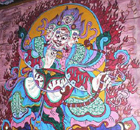
Its subjects mainly include dramatic stories, beautiful women and plump moppets, as well as josses, door gods, images of beauty, boy and girl attendants to a god or goddess, auspicious pictures, birds and beasts, flowers, water and mountainous landscapes and characters from dramas and legends. However, festivity and auspiciousness are always the main themes of Yangliuqing New Year Woodprints.
Ⅲ. Techniques
Making a Yangliuqing New Year woodprint generally adheres to the following five steps: drawing the outline, printing patterns on paper, painting the patterns and mounting the picture. Each picture is an independent creation. Unlike some artists, artisans of Yangliuqing New Year Woodprints must stand upright during the process and paint on "door planks."
Workshops are equipped with a row of door planks that can be opened freely called "painting doors." Xuan paper, which contains the outline of the needed patterns, is pasted on the doors as the painter stands before the drawing. It usually takes the painter three days to two weeks to complete one picture.
After the founding of new China in 1949, the People's Government paid much attention to developing this old folk art. Now, it not only organizes people to collect and research these traditional works, but also encourages innovation. Many artists interested in Yangliuqing New Year Woodprints strive to develop this art, creating many new works to reflect the new era and real life.