Roaming along the Qianmen Street
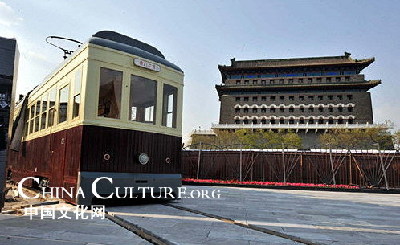
The one-year-long reconstruction of Qianmen Street is almost done. After its reconstruction, Qianmen Street will reproduce old Beijing’s look and feel. Streetcars, decorated archway (pailou) and bird cages as well as bronze drums and candied haws, all familiar to Beijing people will reappear on the street.
 |
|
|
Qianmen is a district that most integrally preserves the local scenes, historical sites and cultural relics. It has been a distinctive street since Ming and Qing Dynasties (1368-1911), famous for its architecture, business, folk-custom and operatic culture. Yongle emperor of Ming Dynasty (1368-1644) made Beijing the capital, and built it around a central axis throughout south to north. The inner town had 9 city gates; Zhengyan Gate was in the center of south town, usually called Qianmen.
 |
|
|
To enter Qianmen Street, visitors need to cross through the Zhengyanmen Bridge and Wu pailou (decorated archway). Roaming along the Qianmen Street, visitors can take streetcars for free, visit time-honored stores such as Yue Sheng Zhai, Quan Ju De and Guang He Grand Theater and immerse themselves in the nostalgic and modern atmosphere. Besides, at the south end of the Qianmen Street, a 6000 square meter place gather old brands of catering industry together, offering different kinds of traditional foods.
As reported, the reconstructive project has been discussed and amended 32 times. Qianmen Street was formed during Ming and Qing Dynasties, and was destroyed by the eight-power allied forces in 1900. Actually, Qianmen Street formed in late Qing Dynasty and the early years of the Republic of China was more familiar to Beijing men, and it reached its heyday during in the 1920s and 1930s. Therefore, the final plan to restore Qinamen Street is in accordance with old photos of Qianmen of that time.
 ? ?  |
|
|
With 700 years of history, the 845m Qianmen Street starts from Zhengyan Gate (Zheng Yan Men) in the north and ends at Zhu Shi Kou Street in the south. Many architectures with Chinese and western styles are preserved, including former sites of Qianmen railway station and China Bank of Communication, which are full of classical European architectural style, while Quan Ju De and Yue Sheng Zhai still keep their primitive and simple Chinese style. Double eave roofs and royal colored drawings reflect the ancient charm, and some buildings have adopted relief sculptures such as flowers, birds and atlas decorating walls, embodying distinctive feelings of the Republic of China.
 |
|
|
According to the reconstruction plan, the buildings on the two sides of Qianmen Street are low-rise buildings; one part is two storey buildings with green tile and red pillar, which imitate the architectural style of Qing Dynasty. Another part of the buildings imitate the architectural style of the Republic of China, adopting brick and cement structure and every building hanging a plaque with golden characters on the black.
Many special street lamps are hung along the Qianmen Street, their appearances imitate bird cages, rattle-drums and candied haws on sticks, filling the street with Beijing flavor.
 ? ?  |
|
|
Located in Zheng Yan Men, Wu Pai Lou (decorated archway) is restored in accordance with its original appearance. Supported by 6 red pillars, at every pillar’s base are two stone carved lions, one standing in front, another in the rear. 12 stone carved lions guard the decorated archway; their bases are engraved with dragons, phoenixes and kylin, symbolizing auspicious meanings.