Home with the Hakkas
 |
|
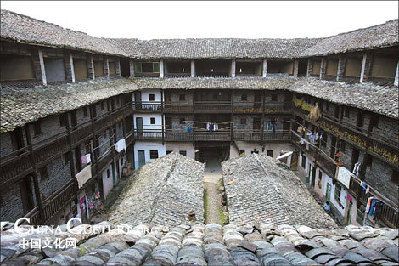
The complex of Yanyi Wei is one of the best preserved fortified farmhouses in Longnan county. Photos by Lu Zhongqiu |
The distinctive "tulou", or "earthen buildings", of Yongding in Fujian province made the list - its unusual historical structures were included in UNESCO's just-released World Cultural Heritage list.
This unique honor was greeted with much fanfare by the local government. Yet, some travelers may wonder if they can still glimpse such ancient dwellings in tranquility, far from the maddening tourist crowds.
Fortunately, there are equally excellent, yet lesser-known, examples of similar "Hakka" residential architecture, just off the beaten track.
One ideal destination is Longnan county, a verdant and scenic region in the south of Jiangxi province, located in the heart of the area inhabited by the distinctive Hakka peoples.
 |
The Hakka, or Kejia in Mandarin, are a subgroup of the Han Chinese people who live primarily in the provinces of Guangdong, Jiangxi and Fujian. Their ancestors settled there centuries ago, often to escape wars, natural disasters and severe persecution in their homelands in central China.
The name Hakka means "guests". Today Hakka communities are scattered all over the world.
The Hakka culture is especially famous for the unique architecture of its ancient residential buildings. The homes in Longnan, called "weiwu" or "wei," are usually taller and more rectangular in shape than similar structures in Yongding, the UNESCO heritage-site.
More than 500 Hakka weiwu are scattered across southern Jiangxi, with some 370 found in Longnan. The country is aptly known as "the land of Hakka weiwu".
First built during the Ming Dynasty (1368-1644), the fortified houses in Longnan were designed to allow residents to defend themselves in the event of wars and frequent clan conflicts.
The houses thus have several impressive and innovative defensive features.
 |
|
|
For instance, the base of the exterior walls are situated five meters underground, to prevent attacks from subterranean enemy tunnel diggers.
The dwellings have thick wooden gates, often with iron sheeting or other precautionary structures. For example, the gate of Yanyi Wei, a notable structure in Yangcun village, has an ingenious water funnel on top - to extinguish flames set by enemy arsonists.
Another defensive feature is the strategic location of watchtowers, built at the four corners of the outer walls.
Wells were located both within the courtyard, and outside. The inner wells were used only at times when the house was besieged.
While the tulou in Yongding were most often built from packed earth, the weiwu in Longnan were constructed from more durable materials. The bases of the outer walls were made from sandstone and granite; the walls themselves were built from gray bricks and stones.
In the center of each weiwu complex sits an ancestral hall, and an open space for common use. The residential spaces are located in surrounding buildings.
Several small apartments are found on each floor. Rooms located one above another often belonged to a single family, and were linked by vertical passageways.
Apart from some modest alterations (for instance, converting some residential spaces to storage rooms), the original structures of the ancient farmhouses have not been modified.