Ancient ideas behind Olympic buildings
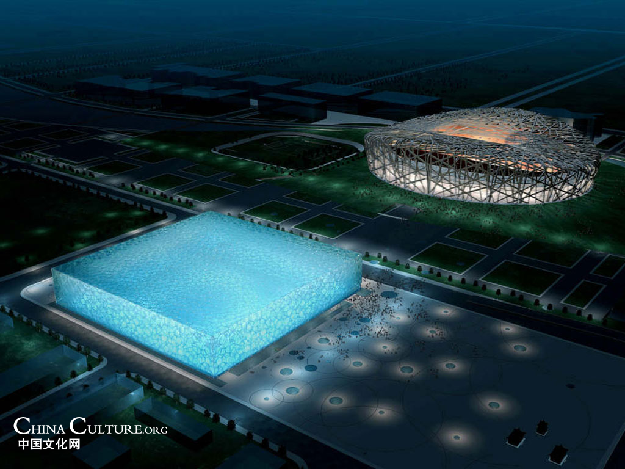
Situated in the north of the Beijing’s axis, the shapes of the Bird’s Nest and Water Cube are respectively round and square, representing the semi-circular dome of the sky and the square earth in the traditional Chinese philosophy.
The Philosophy of the Round Heaven and Square Earth
Both situated with in the Olympic Green, a few minutes walk form each other, the square, blue Water Cube is in harmony with the circular shape and red color of the Bird’s Nest. Both of these building hark back to traditional beliefs and architectural practices of ancient China with their basis in religions like Confucianism.
 |
|
|
The square is a traditional shape in Chinese architecture, for instance, the configuration of Beijing city is square grid pattern; the civilian houses, Siheyuans, and the Imperial Palace are also all built on square patterns. Thus, the design of the Water Cube not only balances the Bird’s Nest but also conforms to ancient architectural patterns of China.
With straight edges at right angles, the square was regarded as a symbol of moral integrity, and its regularity and the stability also reflected the social rules of ancient times, as ancient people held that nothing can be done without norms and standards.
Ancient Chinese believed that heaven was like a dome covering the square earth. This comes from traditional Chinese philosophy named 天圓地方(Tian Yuan Di Fang, literally meaning that the heaven is round and the earth is square). Derived from the Chinese Yin and Yang theory, the chaos of the universe was initially called Taiji, which refers to the origin of yin (negative, or female), yang (positive, or male) and of universal changes. When the earth was not separated from the heaven the universe was a great mass like a huge egg. Then Taiji evolved into Liang Yi (two phases) and the Yin and Yang theory came into being as well as the separation of heaven and earth. Since the celestial objects like sun and moon are eternally moving in circles over the sky, while the earth is serenely bearing the people on it like a stable square, as a result, the idea of circular heaven and square earth came about.
 |
|
|
When looking at the physical world circular objects are of instable and active just like the round sun and moon. On the contrary square objects possess characteristics of stability and inactiveness like the earth. Generally, the activeness represents Yang and inactiveness represents Yin, therefore, the round heaven (天圓Tian Yuan) is a symbol of Yang, while the square earth (地方Di Fang) is a sign of Yin.
 |
|
|
The philosophy of round heaven and square earth was used in the traditional Chinese architecture as well. The Temple of Heaven and the Temple of Earth were built in accordance with this principle.
Covered with blue glazed tiles, the three-storied Hall of Prayer for Good Harvest in the Temple of Heaven is 38m high with each storey narrowing upwards, indicating it is connecting with the heavens. It was said that the emperor is the son of the heaven and only the emperor had the power to talk to heaven, thus, the building was built for the emperor to connect with and worship heaven.
The Temple of Heaven is round and there are an odd number of balustrades it built around it, seen as a positive number, symbolizing heaven or Yang. The Temple of Earth is square, having four sides, each with eight steps, these even numbers or negative numbers represent the Earth or Yin.
 |
|
|
The Temple of the Sun and the Temple of Moon were also built according to this principle.
This philosophy was expressed in civilian buildings as well, especially in Siheyuans or traditional houses in Beijing.