The Imperial Examination System and its vagaries
The Imperial examinations in Imperial China determined who among the population would be permitted to enter the state's bureaucracy. The Imperial Examination System in China lasted for 1300 years, from its founding during the Sui Dynasty in 605 to its abolition near the end of the Qing Dynasty in 1905.
Early Methods of Official Selection
The celebrity that Jiang Ziya achieved 3,000 years ago lives on, simply in his being regarded as the patron saint of human resources. King Wen first appointed Jiang Ziya state tutor and later prime minister in charge of both civilian and military affairs. Jiang assisted King Wen, and later his son King Wu, in their establishment of the Zhou Dynasty (11th century -256 BC), which ruled for 800 years. China was a slave society during the Shang and Zhou dynasties. Officials, in common with emperors, inherited their exalted positions rather than being appointed on merit. Jiang Ziya, as a talented commoner that rose to prominence within the nation’s ruling organ, was the first exception to this convention. Jiang’s appointment signaled a positive change in approach to the selection of court officials. It was not until the late third century BC of the Han Dynasty that specific rules for the selection of officials were institutionalized.
In the Han Dynasty (206BC-220AD) the local administration would select people to take part in administrative affairs according to their merit concerning such factors as honesty, filial devotion and justice. Later the Nine Rank Judging System was applied in the Wei Jin Dynasties (220-420) to recommend the talents to serve the government. The latter innovation, however, gave rise to selections that were made on a purely subjective basis. Nepotism and bribery were consequently rife and only candidates from privileged family backgrounds were appointed to high-ranking posts.
The latter innovation, however, gave rise to selections that were made on a purely subjective basis. Nepotism and bribery were consequently rife and only candidates from privileged family backgrounds were appointed to high-ranking posts. This situation changed for the better in the Sui Dynasty (581-618). It was then that the imperial examination system came into force.
Development & Vagaries
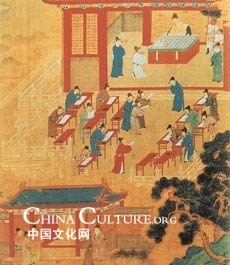 |
In the Sui Dynasty, Emperor Yangdi initiated an imperial examination system in 606AD, which was called the Keju System.
This system was further developed in the Tang Dynasty (618-907AD). In the Song Dynasty (960-1279AD) the emperors attached more importance on the examination. They personally presided over the examination and even divided the successful candidates into three groups and conferred them titles. The emperor would announce the names in order of their scores and bestow them a banquet. All the successful candidates would have a post. The person who got the highest score would be granted the title of Zhuangyuan, who was entitled to enjoy favorable benefits and high honors. Therefore most intellectuals took the imperial examination as the only access to official rank and glory.
In the Ming and Qing Dynasties, the branch tested was only one and the contents tested were limited to “the Four Books”, namely the great Learning, the Doctrine of the Mean, the Analects of Confucius and Mencius and “the Five Classics”, namely, the Book of Songs, the Book of History, the Book of Changes, the Book of Rites and the Spring and Autumn Annuals. All the candidates had to write a composition explaining ideas from those books in a rigid form and structure, which was called Eight Part Essay. To start with, two sentences should be used to tell the main idea of the title, which was called “to clear the topic”. Then it should be followed by several sentences to clarify the meaning of the topic, which was called “to continue the topic”. The remaining part had to carry on discussions on the topic in the form of parallelism and antithesis, which was rigidly restricted. The ideas must tally with the ideas from the Four Books and the Five Classics. Liberal ideas were not accepted.
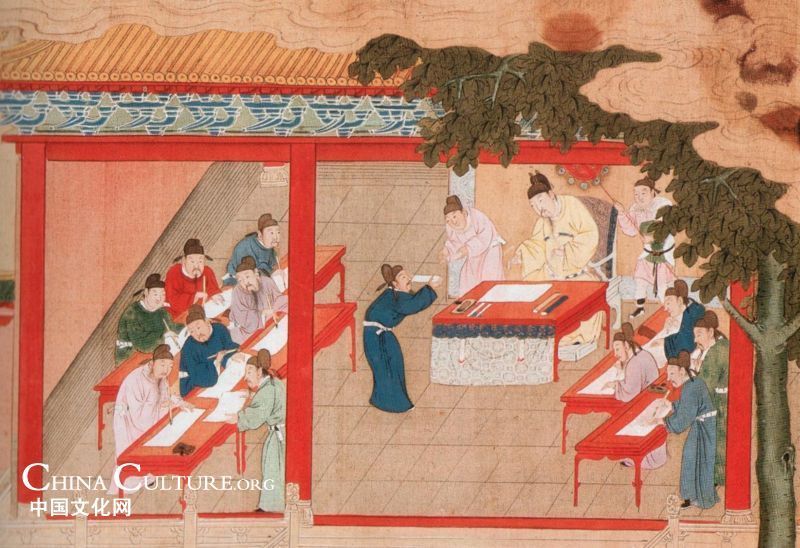 |
The examination was held once every three years. It had four levels: the county examination, the provincial examination, the academy examination and the palace examination. Only when one passed the lower level examination were they qualified to attend the next examination. All the candidates for the county examination were called tongsheng. Those who passed were called Xiucai. Those who passed the provincial, the academy and the palace examinations were called Juren, Gongshi and Jinshi respectively. The first three of Jinshi were ranked Zhuangyuan, bangyan and tanhua respectively. All the jinshi would be given a post by the emperor and their names would be engraved on the tablets.
Historic Role
Only a minority of participants in imperial examinations eventually entered officialdom. But the system fostered an intellectual element within the populace that in turn propelled cultural and social progress in ancient China. During the 1,300 years the imperial examination system was in force it nurtured a zeal for learning that boosted development of government-run and private schools around the country. The keju produced more than 100,000 jinshi and millions of juren. Most of the famous administrators, politicians, thinkers and military strategists in Chinese history originated in the keju ranks.