Wearing history — Chinese dress since 1949
Culture and fashion are very much two sides of the same coin. Against a background of cultural, historical, and social change, this article explores how clothing fashion in China has changed since 1949 and interrelated with the dynamic cultures during these different periods.
When the People's Republic of China was established, China's intelligentsia was fond of both Western-style suits and Chinese-style robes. Cheongsams were also particularly popular among women.
Traditional Styles Began to Change
As new China's ideology changed, Western-style suits and traditional clothes gradually faded from the mainstream. Instead, people imitated cadres' uniforms. Chairman Mao Zedong's favorite suit, known in the West as the "Mao suit," but actually designed and first worn by Sun Yat-sen, also became popular among common people. The outfit evolved into the single breasted "People's Suit," featuring sharp lapels and slanting pockets. Blue, grey and black were the colors of choice.
In the 1950s and early 60s, China was deeply influenced by the Soviet Union, even in clothing styles. The "Lenin Coat," featuring double lines of buttons, slanting pockets and a belt, came into vogue. In the meantime, people were keen on shirts based on the Soviet tank-crew uniform. In this period, most Chinese women liked to wear platye (a Russian word referring to a woman's button-up dress). The Soviet female experts working in China and heroines in Soviet literature often wore platyes, featuring round-collars, loose short sleeves, pleated hemlines and a belt. The design was well received among the Chinese female intelligentsia. Platyes were often made from cotton and were printed with dense flower, tartan or striped patterns. China used to import large quantities of patterned fabric and called for people to purchase it. At that time, even pedicab drivers wore cotton print.
|
 The "Lenin Coat" came into vogue in China in the 1950s. |
During this period clothes were also influenced by other socialist countries. For example, a kind of sweater from Albania was quite popular in China.
Money was very tight, so clothes were generally simple and unadorned. Being a tailor was an enviable job, since most people had their clothes hand made. Girls who were good at needlework always had a host of admirers chasing after them. The ability to repair old clothing was one of the criteria by which good tailors were judged. From 1954 to 1983 people had to buy clothing with coupons in China. Especially in the late 1950s and early 60s, everything had to be purchased with coupons.The average city person could only afford three or four meters of cloth a year. As a result, people could only add new clothes during Spring Festival. Parents usually chose a bigger size when buying clothes for children so they would grow into them. It was common to pass down a coat from the older brothers and sisters to the younger siblings. People usually chose solid materials and black, blue and gray colors, so the clothes would last.
Cloth and military shoes were common. But military uniforms at this point were rare, since being a soldier was regarded as not a very good job.
An Ocean of Army Green
Military uniforms became popular during the "cultural revolution" (1966-1976), an era in which people admired soldiers. Young men often wore green uniforms, a Sam Browne belt, a Chairman Mao badge, a green bag, a Red Guard armband, military shoes, and waved a copy of the "little red book" — Quotations from Chairman Mao. Young women were also encouraged to put on military uniforms by one of Mao Zedong's poems that exalts women who favor masculine heroism more than feminine beauty. The pushing of a singular ideology led to a uniform dress style, and in this period only military uniforms and "Mao suits" could be seen in China.
|
 Uniforms of workers' militia in the 1970s covered up gender distinctions. |
In the mid-1970s Mao's wife Jiang Qing improved the platye and made it completely Chinese in style. Though many female cadres hastened to wear it, it wasn't popular among common people.
The "cultural revolution" required people to abolish "antiquated" concepts, culture and dress, as well as everything related to the bourgeoisie. As a result, people wore neither traditional Chinese costumes nor Western-style suits. Those who wore jewelry or put on make-up faced serious consequences. To show their austerity, people even washed new clothes a few times to make them look timeworn.
The Arrival of Fantastic Garb
Dress in China underwent a drastic change after the "cultural revolution." In 1979, French designer Pierre Cardin held a fashion show in Beijing. His bold and futuristic designs excited Chinese audiences, most of whom were still wearing simple cotton-padded jackets. At that time, clothing different to common apparel was known as "fantastic garb." One example was flared trousers. These items were looked down upon from the high plane of ethics and politics, and wearers of flares were regarded as hooligans. It was not unusual to see teachers take a pair of scissors to students' bell-bottomed pants at that time.
Gradually, people came out from under the shadow of class struggle. State leaders began to wear Western-style suits in the 1980s. Soon after that, suits became all the rage in China. But some people cut a sorry figure, since ignorance of dress etiquette ran high. Suits were often worn with cloth shoes, or with shirts hanging out over people's belts.
|
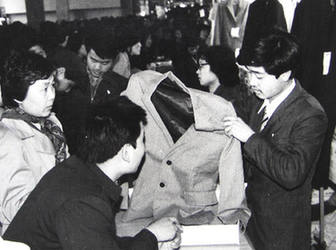 Suits became all the rage in China in the 1980s. |
In 1984, a film named Red Dresses Are in Fashion, telling the story of a female textile worker, rectified the attitude towards so-called "fantastic garb." The model worker in the film put on stylish red skirt like other girls on the street. This was the mainstream media's affirmation of beautiful clothing, and red skirts became the most popular female clothing item that year.