In harmony with trees
Located 25 km from the county town, for more than 1,000 years, the village was an isolated and self-sufficient place. The villagers kept to a traditional way of living, hunting for food and cutting down the area's towering trees to build their wooden houses and feed their fires.
But all that changed in 1984, when a scientific expedition team found a hidden karst forest. The experts were surprised by its rich diversity of rare species and spectacular examples of humid tropical to subtropical karst landscapes, which are characterized by limestone rocks and underground caverns.
Wu Minghui, 52, remembers clearly how a county-level nature preservation zone was established that very year, bringing the word "karst" into their lives for the first time.
The forest was listed as a national nature reserve in 1988 and included in the South China Karst region, one of the country's six regions included in the UNESCO World Heritage List in 2007.
| ?
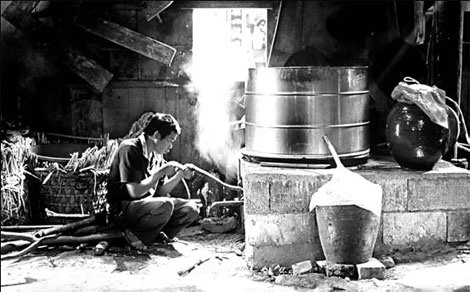 People in Yaogu village, Libo county, using traditional methods to make liquor. |
However, as measures for protecting these forests intensified, Wu and other villagers lost their traditional way of life. "How could we suddenly change our way of living?" Wu asks.
"But the villagers also realized how distinctive and fragile the forest was. We began to think about what we could do for it," Wu says.
Wu describes the past two decades of preservation work as a "difficult and complicated mission". He was among the first four farmer-turned-forest rangers in the Libo Karst National Scenic Area and Nature Reserve in 1984.
Wu likes to call himself "Mountain King", tasked with protecting 334 hectares of forest lands. His day begins at 5 am and his responsibilities include patrolling the forests and keeping it free of quarrying, logging and land reclamation.
"Most of the villagers give us the cold shoulder. They believe they have the right to make full use of the mountain," Wu says.
"By cutting and selling trees, villagers earn money for fertilizer, for their children's education and generally for better living conditions."
Although Wu works hard to chase down the wood cutters, he also sympathizes with them. "I feel guilty chasing them away, because they are taking risks just to make a living. We know each other and they are good villagers," Wu sighs. "It feels like I am setting obstacles for them to live a better life."
| ?
 The old pastoral way of life has been well preserved in Libo county's rural areas. |
"We hold meetings to explain ourselves," says Ran Jingcheng, chief director of the reserve's Management Bureau. "Protection is not a fight between us and the villagers; rather it is about close cooperation. When we protect the forest, we also benefit the villagers."
Qin Zhengji, a 41-old villager, understood this after attending talks organized by the bureau on Karst topography and its conservation. Qin is now familiar with many rare trees, which he used to cut down for use as firewood.
He proudly points at a hillside where the greenery extends all the way down. "It was once stripped of its trees and this even affected our fresh water supplies. But we volunteered to plant more trees and now find that the quality of water is getting better."
Villagers also help to look after the forest. Ran says when a fire broke out in the forest last year, 60 villagers were already there trying to put out the fire when his team arrived. Also, the bureau gets immediate reports if trees are cut in the protected zone.
Qin says although they don't quite understand what the World Heritage List means, they know that protecting their forests is a solid guarantee for their future.
The village has also taken measures to adopt eco-friendly development in order to minimize human impact.
Qin Chunshai, the village head, says of the 55 households in Yaogu, 70 percent are equipped with bio-gas pools, which generate electricity for domestic appliances.
"We search for alternatives to increase our living standard, for example, developing eco-tourism." He is happy that a highway between Libo, the county town, and the village is bringing visitors. Apart from guiding tourists through the forest, locals earn money by selling home-made cloth, wine and decorations.
However, the village head expresses worries over the increasing number of visitors. He says the forest is different from other scenic spots and visitors should focus more on its biodiversity and unique landscape.
"Villagers now have high awareness about protecting the forest, but we are not sure others will treasure this land the same way."