Chinese lacquerwares must break through
Two preconditions must exist for an art to flourish. There must be artists (creating the art) and a consumer (a market). Now is a perfectly opportune time to revive Chinese lacquerware. However, are there enough artists; is the market big enough?
 |
|
|
In Fujian Pavilion, a part of the China Pavilion in Shanghai EXPO, there is a pair of gold drawing lacquer vases, 3.6 meters high and patterned with dignified peony flowers. These two vases are light enough that a strong male could lift them. As introduced by Chen Biyu, vice director of Economy and Trade Committee of Fuzhou, it took five years to make this pair of vases, and involved over 100 procedures. The two vases’ value exceeds two million RMB. These two vases are made by a Chinese traditional art craft technique—bodiless lacquer. The vases along with a modern lacquer painting of ancient Fuzhou community do not merely imitate traditional lacquerwares, they have reached a new level altogether.
“Chinese lacquerwares must break through, or it will perish.” said the painter of the modern lacquer painting, Tang Zhiyu.
 |
|
|
Fuzhou Lacquerwares, Once Sparkling and Splendid
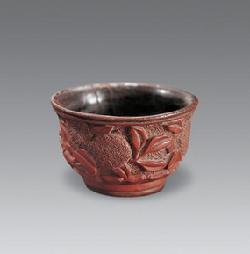
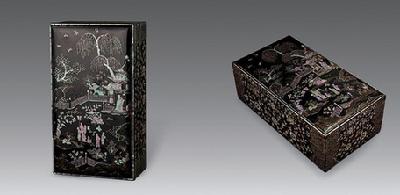
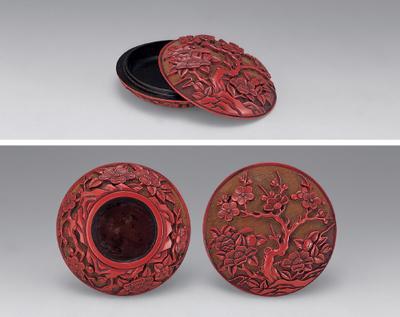
Modern Chinese lacquerwares are mainly produced in Beijing, Jiangsu, Yangzhou, Shanghai, Chongqing, Fujian, and Pingyao. Technically they are classified into categories as inlaid, carved or glassed lacquer. The distinguishing feature of Fujin lacquerwares is its lack of body.
 |
|
|
The process involved in the making of bodiless lacquer is very complicated. First, make the inner body with clay, plaster or wood, then stick the grass cloth, silk cloth and other materials on the body, using raw lacquer as an adhesive. Paint two layers of lacquer successively on the surface. Let the product dry in the shade. Remove its inner body and a primitive product will come into being. Next, dozens of procedures are done to it such as filling in dust, lacquering, polishing, and letting it dry in the shade. At the end of these procedures, it has become a semi-finished product. Finally, colored lacquer and other ornaments will be added, and the bodiless lacquer is at last finished. Fuzhou lacquer wares are firm yet lightweight, resistant to heat, acid, alkali and electricity. It is considered one of the “Three Chinese Handicraft Treasures” and has been exported to many countries all over the world. Because of this Fuzhou is considered a famous city of lacquer.
 |
|
|
Lacquerware Faced a Crisis
In 1959, before the ceremony of China’s 10th National Day, Premier Zhou Enlai lifted a two-meter high bronze-colored lion in front of the foreign guests, which astonished all the presenting guests and brought Fuzhou bodiless lacquer to the front of the world. “The lion was made of Fuzhou bodiless lacquer, weighing only several kilos.” explained Premier Zhou.
However, during the 1980s, almost all traditional crafts were facing a severely decreased market. Lacquer was no exception. Less than ten lacquer plants survived the crisis. Fuzhou No.1 and No.2 bodiless lacquer factories went bankrupt. Stocks were undersold at even 10% of the original price. The reasons that led to such a situation are complicated. In the 1960s and 70s Chinese lacquer was well-received and was once the greatest hit at the Guangzhou trade fair. At that time, Japanese often came to Fuzhou to learn lacquer, but our key techniques were kept a secret. Years later, after the monopoly was broken down, lacquerware production was seen as profitable, thus factories mushroomed. As a result, there were not enough resources and skillful artisans. Under fierce competition, in order to cut cost and shorten working time, some manufacturers dumped lacquerwares made by substituted chemical lacquer, which only resulted in even more viscous competition.
 |
|
|
Meanwhile, collectors from Japan and Taiwan came to China mainland one after another, purchasing Fuzhou lacquerwares at very low price. Even lacquerwares in airport duty free shops were sold out. Media complained that it was the end of Chinese lacquerware. From then on, Chinese lacquerwares could only be found in Japan.