Getting a foot in
While world literature has found its way into China, Chinese literature is still fumbling to find its feet in the world, writer Liu Zhenyun says. He made this somber observation at a recent Chinese literature translation symposium. It gathered more than 30 Sinologists, translators and writers from 13 countries to share their experiences, problems and suggestions.
 |
|
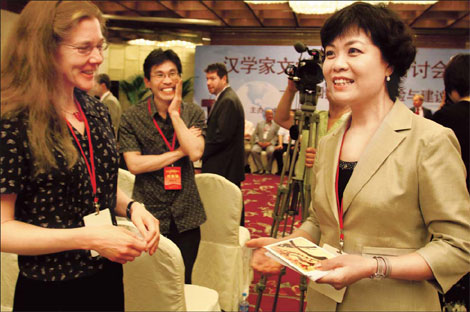
Tie Ning, writer and chairperson of the Chinese Writers' Association, talks with American scholar Sabina Knight during the recent Chinese literature translation symposium in Beijing. Photos by Jiang Dong / China Daily |
Michael Berry, American translator and associate professor with the University of California at Santa Barbara, agrees with Liu, saying: "A literary work has no footing among world literature without a translation, however excellent it is."
According to Wu Wei, director of the China Book International (CBI) Promotion and Planning Office, 348 translated titles were published in the United States last year, of which only seven were from China although more than 15,000 works are published in the country every year.
Julia Lovell, British translator and lecturer in Chinese history at the University of London, believes this situation has a lot to do with publishing and teaching trends in the Anglophone world since the 1950s.
She points to the response to Japanese and Chinese literature during the Cold War, to explain why substantial numbers of British readers are familiar with names like Yasunari Kawabata and Haruki Murakami from Japan, but barely have a clue about the Chinese authors Shen Congwen (1902-88) and Qian Zhongshu (1910-98).
According to Lovell, American publisher Knopf carefully marketed selected works of modern Japanese fiction in keeping with the broader US project of reinventing Japan as a regional ally.
At the same time, teaching materials used in the earliest courses in modern Chinese literature - mainly "red classics" - were "politically correct works", strengthening the stereotype of Chinese literature as "dully propagandistic", she says.
A vicious cycle ensued, in which publishers were wary of taking on modern Chinese literature because it was little known, and were also unwilling to invest in quality translation and editing for the works they did publish. This in turn confirmed the stereotype and further weakened interest in Chinese literature.
Lovell sees another reason for why modern Chinese literature has not taken off among Anglophone readers and that, she says, is logistical.
"Most major publishers do not even give it a platform on which to rest beside their glossily marketed rivals," she says.
"They are not prepared to believe that these works can provide not just worthy pseudo-documentary information on Chinese history, but also more universal literary satisfactions: delicate psychological portraits, powerful evocations of time and place, and philosophical insights into the human condition."
 |
|
Isabelle Rabut, French translator and professor with Michel de Montaigne Bordeaux 3 University, says major publishers fail to see the merits of modern Chinese literature. |
Isabelle Rabut affirms Lovell's observations, citing novelist Chi Li's popularity in France.
"Chi is well received by French readers, because she enables them to delve into the lives of ordinary Chinese and to experience their drudgeries and hardships," says the French translator and professor with Michel de Montaigne Bordeaux 3 University.
Julia Lovell, British translator and lecturer in Chinese history at the University of London, believes this situation has a lot to do with publishing and teaching trends in the Anglophone world since the 1950s.
She points to the response to Japanese and Chinese literature during the Cold War, to explain why substantial numbers of British readers are familiar with names like Yasunari Kawabata and Haruki Murakami from Japan, but barely have a clue about the Chinese authors Shen Congwen (1902-88) and Qian Zhongshu (1910-98).
According to Lovell, American publisher Knopf carefully marketed selected works of modern Japanese fiction in keeping with the broader US project of reinventing Japan as a regional ally.
At the same time, teaching materials used in the earliest courses in modern Chinese literature - mainly "red classics" - were "politically correct works", strengthening the stereotype of Chinese literature as "dully propagandistic", she says.
A vicious cycle ensued, in which publishers were wary of taking on modern Chinese literature because it was little known, and were also unwilling to invest in quality translation and editing for the works they did publish. This in turn confirmed the stereotype and further weakened interest in Chinese literature.
Lovell sees another reason for why modern Chinese literature has not taken off among Anglophone readers and that, she says, is logistical.
"Most major publishers do not even give it a platform on which to rest beside their glossily marketed rivals," she says.
"They are not prepared to believe that these works can provide not just worthy pseudo-documentary information on Chinese history, but also more universal literary satisfactions: delicate psychological portraits, powerful evocations of time and place, and philosophical insights into the human condition."
Isabelle Rabut affirms Lovell's observations, citing novelist Chi Li's popularity in France.
"Chi is well received by French readers, because she enables them to delve into the lives of ordinary Chinese and to experience their drudgeries and hardships," says the French translator and professor with Michel de Montaigne Bordeaux 3 University.
 |
|
Michael Berry, American translator and associate professor with the University of California at Santa Barbara, attends the symposium. |
"Literature is irreplaceable in terms of two values: One is the experience of ordinary and private daily life; the other is the experience of historical upheavals and traumas."