Art
Buddha statues in China
By Feng Hui (chinadaily.com.cn)
Updated: 2010-09-20 10:43
 |
Large Medium Small |
Buddhism was introduced to China during the Eastern Han Dynasty (25-220), during a time of great economic, political and cultural instability. With their economy struggling and their ethnic groups divided against each other, many Chinese people of all different social rankings embraced Buddhism as an alternative to a way of life that seemed to be crumbling before their eyes. With the spread of Buddhism, Buddhist art, particularly Buddha statues, flourished throughout ancient China. Buddha statues varied in figure and subject depending on the dynasty in which they were produced.
 |
|
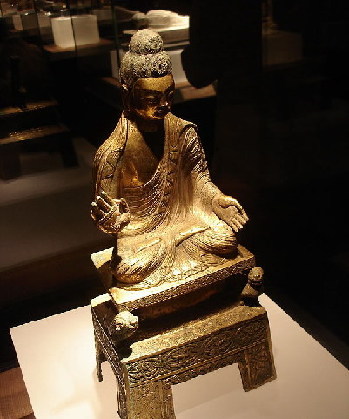
The statue of Sakyamuni, plated with gold and bronze Produced in Taihe reign of Northern Wei Dynasty(477-499) |
After more than 370 years of turbulence in the Northern and Southern dynasties (420-581), ancient China was united again under the Sui Dynasty (581-618), and then Chinese feudal dynasties reached their peak during the Tang Dynasty (618-907). Buddhism, as a spiritual belief of some people that time, had gradually taken root in ancient Chinese people’s daily lives. The art of the Buddha statues rapidly developed from those of the Northern and Southern dynasties. The statues, whether made of bronze, stone or clay, vividly displayed the majesty of the Buddha, the benevolence of the Bodhisattva and the compliance of the arhat.
 |
|
The statue of Kuan-yin (a Bodhisattva) of the Song Dynasty(960-1279) Made from blue and white porcelain Excavated in Fengtai District, Beijing |
Under the influence of Zen Buddhist ideas, the holy and idealized qualities of the Buddha statues began to lose emphasis during the Song Dynasty (960-1279). The statues of the Buddha and Bodhisattva were replaced by more secularized arhat statues. This change put more human feelings into the statues, making them look more like humans than gods, which played a positive role in the spread of Buddhism.
 |
The Buddha statues of the Yuan Dynasty (1271-1368) were unique for the statues’ faces, figures, postures, costumes and lotus thrones (the Buddha’s seat, in the form of a lotus flower).
 |
|
The stone statue of Sakyamuni Liao Dynasty (916-1125) |
During the Ming and Qing dynasties (1368-1911), as the number of large-scaled grottos carved for Buddha statues dwindled over time, more and more temples emerged for enshrining Buddha statues.
 |