Wages of conflict
By Xu Lin (China Daily)
Updated: 2010-12-15 09:56
 |
Large Medium Small |
 |
|
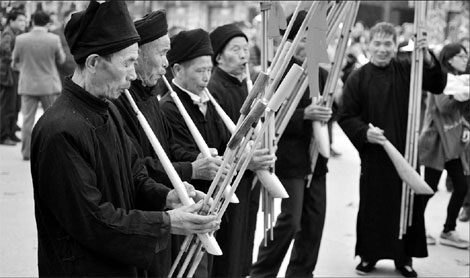
Elderly Miao villagers give a performance during the Guzang festival, which falls once every 13 years in Xijiang, Guizhou province. [Photo/China Daily] |
While most films about the Miao ethnic group focus on their vibrant culture and customs, a new documentary aims to present the flip side of this. Xu Lin reports.
Director Liu Dapeng, 29, says he was unprepared for what he saw when he arrived in Guizhou province's Xijiang, in November. In the town to shoot a documentary about the Miao, he says he sensed conflict in the community, brought about by tourism.
His film is part of the Images of Chinese Ethnic Groups series, sponsored by Tencent Charity Fund and Shenzhen Pai'ai Culture and Technology Corporation Limited.
Xijiang is one of the largest Miao-inhabited towns in China, with more than 1,000 households.
Liu says when he arrived he felt lucky to be able to capture the ethnic group's Guzangfestival that happens just once every 13 years.
During this festival, the Miao beat drums to summon their ancestors' souls, believed to reside in them, so they can take part in sacrificial ceremonies.
The Miao put on their traditional costumes, watch bull fights, slaughter pigs and cattle, enjoy feasts and perform traditional dances.
After the festival, they dress in their everyday clothes, except for those who work at scenic spots and Miao-themed restaurants.
Like elsewhere in the country, tourism has brought tremendous change to once secluded Xijiang, which did not even have a cement pavement before the 1980s.
In the past, floods and wars drove the Miao deep into the mountains and it became a tradition that the higher a family lived in the mountains, the greater was their status.
But now, it is those traditionally considered lower in the pecking order, living at the foot of mountains, who are the new rich, with their hotels and restaurants catering to the throngs of tourists.
Those living higher in the mountains make a meager living, as most tourists aren't keen to climb at least 20 minutes to patronize restaurant there.
As a result, today the higher a Miao's social status, the poorer he is.
"I could never have learned this from any book," Liu says, adding the newly rich are challenging the traditional Miao hierarchy.
Villagers living at the foot of the mountain told Liu that Xijiang's Guzangtou, the person who oversees the Guzang festivities and lives at the top of the mountain, used to be elected and that this tradition should be restored.
But the current Guzangtou insists this prestigious title has traditionally been passed on from father to son in Xijiang, although he does concede that this is not the case in other Miao-inhabited areas.
"Although the villagers were willing to tell me about all this they kept silent in front of the camera. So I could not record this part in the documentary," Liu says.
After living closely with the Miao people, he feels clashes between the demands of tradition and those of modernity pervade most Miao families.
He gives the example of Li Yuliang and Yang Xiaolan, who once worked as migrant workers in cities and now work at the local tourism bureau. Their 20-year-old daughter, Li Fangfang, who opened a barber shop in Beijing with her Han boyfriend, has returned home because of her parents' pleas.
The daughter's yearning for urban life does not go down well with her parents, who want her to retain a sense of belonging to Xijiang.
When Li Fangfang visited her parents, her mother tried not to quarrel with her. But when the mother failed to negotiate with her daughter, she simply insisted Li stayed in Xijiang.
Liu says this is a story about all of China. Many youngsters leave for the city to study or work, while some parents believe they can lead a better life in their hometown.
"The mother reminds me of my mom, who wants me to leave Beijing for my hometown in Northeast China's Liaoning province," Liu says.
"The film will show a new picture of the Miao," says the media art major from Beijing Film Academy.
In 2006, Liu joined an exchange program to work as a documentary director for Yokohama Fund, Japan, where he did a film on the Japanese artist Koji Enokura.
The 90-minute Image of Chinese Ethnic Groups - Xijiang will premiere in theaters at home and abroad in May 2011.
