Finally a place to call home
|
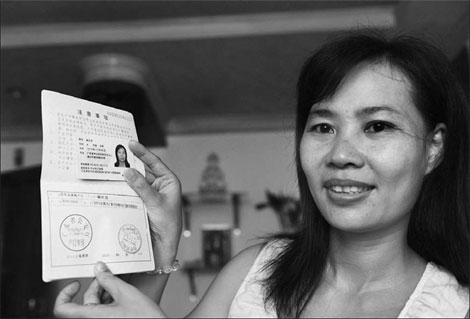
Xie Hongfen got her hukou, in Zhongshan, Guangdong province, after the city introduced a score-based program allowing migrant workers to apply for the city's household registrations. Provided to China Daily |
An innovative program in Guangdong province allows migrant workers to transfer their hukou, or household registration, to their place of work in cities. Li Wenfang reports.
For years, her son's enrollment at a public school in Zhongshan, Guangdong province, has been at the top of Xie Hong-fen's New Year wish list. Hailing from a village in Guangxi Zhuang autonomous region, Xie, 36, has been working as a clerk at a construction company in the coastal city of Guangdong for the past 10 years. So has her husband.
However, despite being well-settled in the city with stable jobs and their own apartment, the couple were still counted in the migrant population because neither Xie nor her husband had a Zhongshan hukou, or household registration.
Set up in 1958 to control mass urbanization, China's hukou system effectively divides the population in two - the "haves" (urban households) and the "have-nots" (rural households).
Under the system, rural citizens have little access to social welfare in cities and are restricted from availing themselves of public services such as education, medical care, housing and employment, regardless of how long they may have lived or worked in the city.
As China struggles with the social effects of a widening rural-urban divide, calls to reform the hukou system have grown, especially with millions of farmers moving to towns and cities to find work.
But the reform of a system that involves nearly 800 million rural residents takes more than just time.
Many cities and provinces have come up with pilot programs or policies to create an open and fair scheme that allows as many migrant workers to have their hukou registered in the city where they work, as possible.
When Zhongshan, a city whose migrant population of 1.2 million represents 45.7 percent of its total, became one of the first to introduce a score-based program allowing migrant workers to apply for the city's household registration, Xie couldn't wait.
Without a Zhongshan hukou, Xie's 7-year-old son was not entitled to free education at a government-funded primary school, which is reserved for local residents.
Xie's only option was to send him to a less prestigious privately run school at a cost of more than 1,000 yuan ($151) a month.
According to the program, which is score-based, one has to accumulate a certain number of points, based on such parameters as academic background, voluntary work and social insurance to get a household registration in the city.
Specifically, a college diploma counts as 55 points, and a master's degree, as 100 points. A blood donation, 50 hours of voluntary work and 1,000 yuan in charity donations, all count for 2 points. Violation of the family planning policy and criminal offenses, on the other hand, invite a deduction of points.
The application process was thrown open in December 2009 and it took Xie nearly two months to prepare for her application, which involved things like verification of her college diploma.
Xie, who graduated from a vocational college in Nanning, capital of Guangxi, collected 122 points, including 55 for her academic background, 15 for her assistant engineer certificate, 10 for her property certificate, 10 for her labor contract and 10 for her social insurance.
In late May 2010, the office of the administration of the migrant population of Zhongshan made public the points each applicant had accumulated. Xie made it to the final list, with just 5 points more than the cutoff.
"When I saw the result and realized I had made it, I felt like I had won a big lottery," Xie recalls.
She applied to the Zhongshan police for transferring her hukou on July 5 and received her new hukou on Aug 30, becoming one of the first beneficiaries of the program.
By the end of 2010, a total of 2,139 migrant workers in Zhongshan had successfully transferred their rural hukou to the city.
Thanks to the smooth running of the pilot program in Zhongshan, it was adopted by the Guangdong provincial government in all its cities from June 2010.
More than 103,600 migrant workers in the province had received their urban hukou in Guangdong by the end of October, according to the provincial human resources and social security department. As the largest provincial-level economy in China, Guangdong is home to more than 30 million migrant workers.
Xie says she is now working on transferring her son's hukou from her hometown to Zhongshan.
"It may take time, but there is nothing to worry about," Xie says with a smile.
Luo Yang contributed to the story
(China Daily 01/26/2011 page20)