In seventh heaven
Updated: 2011-07-26 11:16
By Erik Nilsson (China Daily)
|
|||||||||


 |
|
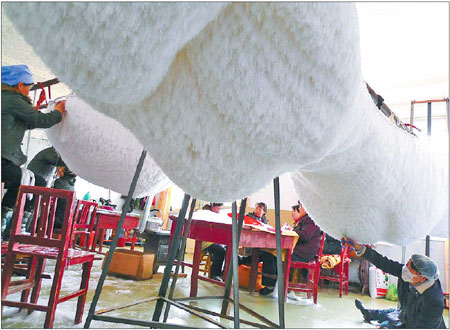
Craftswomen from the Ningxia Hui autonomous region work with Wen Fang on the installation piece, We. Photos Provided to China Daily |
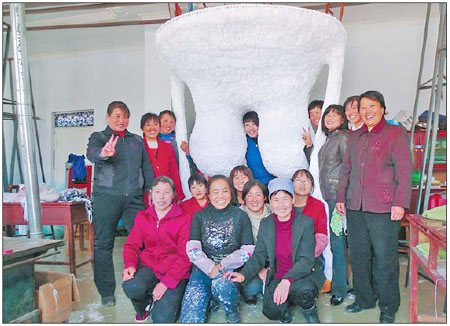
Not only had they never viewed, let alone made, contemporary art, but also, they had never seen, nor used, elevators - and they were scared of them. So the 15 women from a remote desert in the Ningxia Hui autonomous region preferred to take the stairs when they visited Beijing to create the Heaven exhibition with local artist Wen Fang this spring.
"Coming to Beijing to create the installation offered so many firsts," farmer He Xiaoli says. "It was my first time on a plane and a train, to see a movie and to sing karaoke. The most amazing was to see the Bird's Nest. It felt like I was dreaming."
Experiencing art was a different kind of first for the 27-year-old and her peers, she says.
"I didn't know what art was," He says. "When we were creating it in the studio, I couldn't imagine what it would look like when we were done. I was shocked when I saw it displayed. I've come to realize art is a miracle - it makes the impossible possible."
The 300-square-meter installation exhibition, which fuses traditional handicraft work with contemporary elements, was shown at Li-Space in Beijing's Caochangdi art zone until July 17.
When it is sold, 50 percent of the profits will go to the women, whose annual household incomes hover around 10,000 yuan ($1,551). The women also received monthly allowances of 1,000 yuan for medicine and books from Wen for three months. French fashion brand Dior funded their five-day Beijing trip.
Last year's Art for Craft's Sake show brought in 47,000 yuan for 15 Ningxia women, who belong to the Ningxia Hundred Flowers Women's Cooperative in arid Tongxin county's Yuwang town. The settlement is nestled in the Xihaigu area, a huddle of crumpled loess dunes the United Nations has designated as one of the planet's least habitable locations.
Wen says she got the idea for the project after earning 200,000 yuan from art sales in one month.
 |
|
Wen Fang (center) and the Ningxia craftswomen at Wen's studio. |
"Right now, there's a lot of money in contemporary Chinese art," the 35-year-old says. "I want to build a bridge between traditional and contemporary art. We can alleviate poverty in this way."
Tongxin's wealthier women earn about 800 yuan a month as migrant laborers in the county or up to 1,000 yuan in the autonomous region's capital, Yinchuan.
Others, such as Xie Tanfang, stay home. Xie was delighted to earn the extra money from the installation project. The mother of three - two children are in college on student loans and another is a soldier - is terminally ill, and her husband is disabled. Her family's annual income totals about 10,000 yuan.
"Most of the money will go to pay off our debts and buy medicine," Xie says. "This is my first time to travel outside, and it's very meaningful. I might not live much longer, so this tour may be the most exciting experience I'll ever have."
He Xioali says the extra money has elevated her social position in both the community and her own household. She and her two children, ages 4 and 5, depend on the 10,000 yuan to 20,000 yuan her husband earns annually as a migrant worker. He even splurged to buy a 1,000-yuan camera to record her journey to Beijing - a purchase that made Wen particularly happy.
"I hope the project will not only provide economic benefits but also happiness and enlightenment," Wen says. "As an artist, you can take a lot of inspiration from traditional art (My art) and the embroidery by the local craftswomen reveal the unique alchemy between two worlds - the tradition-soaked rural world with its age-old craftsmanship and the creative energy of a young urban artist."
She explains the work incorporated not only Ningxia's ideas but also its products, especially yak wool.
"I hope this exhibition can allow me to become a go-between for women and enterprises to create long-term prospects that benefit both," she says. "While working with us, these Ningxia women can become known by urbanites and celebrated for their handicrafts."
In her artists' statement, she explains that she came up with the title Heaven during a bone-juddering tractor ride with several of the women on one of her five trips to the county.
"Their faces, exposed to the flying sand and rolling pebbles, were carved with unbending perseverance," she writes. "Suddenly, you catch a bright smile that bursts through beyond their weathered faces. It is just like discovering a wild flower in a wasteland There are always people who can show us tenacity, optimism and dignity within the capacity of their tender lives."
Wen recalls that it took the women awhile to get used to interacting with urbanites.
"They don't knock," she says. "They just come in uninvited. This is their habit from where they live."
She says the women also woke up early and spoke loudly, even when others were still asleep.
"But they adapted to city life."
It was a learning process, too, when Wen showed them how to use a computer. They just wanted to click advertisements until Wen explained what they were and that they often "cheat" people.
Wen says she believes the project poses and answers the question, "Can art relieve poverty?"
As she puts it: "Art should be creative and solve problems. Just as we call creative cooking 'culinary art' and creatively solve communications problems between countries using 'the art of diplomacy', I hope to use art's creativeness to find a new way out of poverty for rural China's craftswomen."
She points out socially conscious creative types are often dismissed as "minor artists" in the West.
"But we in the East can explore our own path and not merely let art be a commodity within the occult of luxury - wares for rich men to enjoy - but let art also have a relationship with common people," Wen says.
"These women don't need pity. They should be respected and regarded as creators."