Centers of culture
 |
|
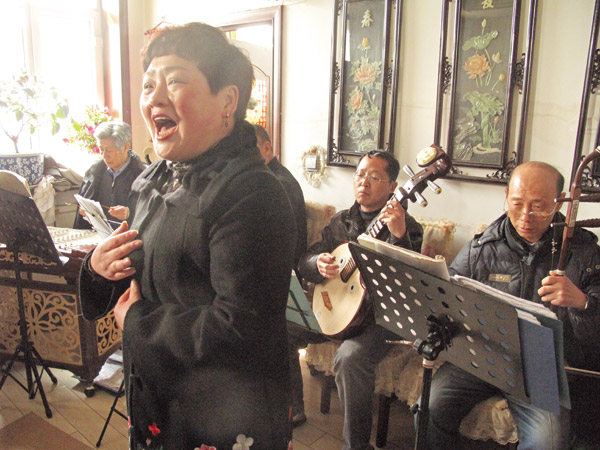
Villagers stage a performance at a "cultural yard" in Mudanjiang, Heilongjiang province. Photos by Mu Qian / China Daily |
 |
|
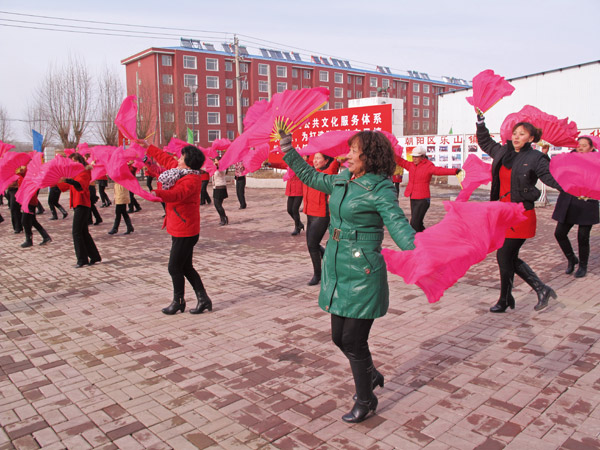
A dance troupe practices at the cultural station of Leshan township in Changchun, Jilin province. |

The reformed and revived cultural center system brings a better quality of life. Mu Qian reports in Beijing.
Liu Xiuyun felt she had lost focus after retirement. All the 70-year-old did was watch TV and cook - until she joined a cultural center's choir in Jilin's provincial capital Changchun.
She rehearses three days a week with people who share her hobby, under the direction of a professional musician.
"Singing in the choir has become a major part of my life," Liu says.
"It's good for my physical and spiritual health."
The Sound of Love choir gives concerts in communities throughout the city and joins singing competitions. Although the choir hasn't received any awards, Liu says the experiences were reward enough.
But the choir is just one of the programs run by the Cultural Center of the Kuancheng District in Changchun. It also offers free courses in guzheng (a six-stringed Chinese zither), keyboard, dance, calligraphy and tai chi.
"Chinese people are demanding more culture in life," the center's director Dong Hong says.
"We hope to create more opportunities for ordinary people to embrace culture and improve the quality of their lives."
The center also runs free public lectures in its 306-seat theater. When Dong read the news that 70-year-old Wu Jijun wanted to perform a concert of her own music, Dong contacted her through the reporter and agreed to provide the theater for free.
The center is one of many in the country. Cultural centers - called "mass art centers" in some places - create a system of governmental cultural organizations established after New China's 1949 founding.
The system covers various levels, from the local to the provincial.
But it hasn't always functioned well. A lack of funding over the past two decades forced some to rent out space to game parlors or poolrooms. Some even closed.
The landscape began to improve in early 2011, when the Ministry of Culture and Ministry of Finance issued a statement declaring public art museums, libraries and cultural centers at State and provincial levels would be open free of charge by the end of 2011. It also said such public-funded cultural organizations at all levels will be open for free by the end of 2012.
Most centers have been able to reclaim the spaces they rented out after receiving central and local governments' financing. And many have begun to run more cultural programming.
"Cultural centers were so popular in the late 1970s and early '80s that they were always crowded with people thirsty for cultural activities," Tianjin Mass Art Center director Li Zhibang says.
"But our cultural service system became mixed up in economics during the development process. The governmental cultural center system should play a big role in improving the quality of cultural life. Now, it's time for them to thrive again."
And they have been reviving since the admission-free policy was adopted.
The Ministry of Culture reports the number of visitors grew by 19.7 percent from March to October 2011 compared to all of 2010. Also, library visitations grew by 30 percent during the period.
Li believes libraries attract more people because their purpose is clearer than cultural centers'.
"Many people don't know what they can do at cultural centers," he says.
Li believes their special function is to provide art training, performances and lectures for free or at low cost.
In far-flung rural areas outside of the centers' reach, farmers organize their own art activities. The government has designated and subsidized many "cultural yards" in the countryside.
Zhang Wanxing has for years offered his own home for farmers in Zhengnan village, in Heilongjiang province's Mudanjiang city.
The 73-year-old has received subsidies for such expenditures as musical instruments since the government dubbed his house a cultural yard in 2009.
Villagers gather at his home twice a week to play music and croon traditional operas. He also has a library with about 1,500 books, some of which the government provided and some of which he collected himself.
"I volunteer to organize cultural activities because it makes us happy," he says.
"The subsidies enable us to enjoy better lives."
Zhang's culture yard attracts young and old. Sui Shengnan, a 9-year-old girl and frequent visitor, won gold at the Dandelion Singing Competition of Heilongjiang Province last year.
In October 2011, the Central Committee of the Communist Party of China (CPC) approved reforms that, for the first time, set "cultural propositions" as a Central Committee Plenum subject.
Last year, the ministries of culture and finance launched the "national demonstration areas of public cultural services system", which will establish 90 demonstration areas in six years to cover more than one-third of China. It will advance the public cultural service system's construction nationally.
Thirty-one cities, including Changchun and Mudanjiang, are among the first demonstration area candidates. The central and local governments will invest in the areas constructions.
Wu Zhinan, a Shanghai Academy of Social Sciences researcher and member of the Ministry of Culture's expert committee for the national public cultural services system, believes more is needed than just investment. The country must train professional cultural managers and create policies preferential to social sectors, he believes.
"China has paid much attention to economic development over the past few decades, but without adequate cultural construction, there won't be a balanced society," he says.
"We're now making up for this missed lesson."