|

Artisan Huo Xiuying's 10-sq-m nianhua studio is hidden away in an off-color residential building, part of a 90-sq-m apartment that has been home to three generations of her family since the early 1990s.
In the cupboard of the small sitting room are a lot of trophies that proclaim the 71-year-old woman's artistry. Hanging on the walls of the studio are colorful nianhua, or Chinese New Year pictures, of various sizes.
Spring Festival is the busiest time of the year for Huo and her husband Gao Enke, a retiree from Tianjin People's Theater, and the couple has been busy in the studio.
"At this point all nianhua are traditionally ready for the market," says Huo, a sixth-generation inheritor of nianhua craftsmanship, from Yangliuqing, hometown of famed Yangliuqing nianhua, about 15 km to the west of Tianjin.
Huo recalls that when she was young numerous people bought nianhua products, even customers from Inner Mongolia and provinces in Northeast China.
"I remember those happy days when I took nianhua pieces to the market and came back with a small sum of money in my pocket," she says.
"I learned that people from those places used Yangliuqing New Year pictures to decorate their tents or brick walls," says Huo, whose father Huo Yutang opened the Yuchenghao Nianhua Studio in 1926 .
|

Oxen are a feature of this year's creations. Photos by Wang Xiaodong |
Now the sixth and seventh generations of artisans from the Huo family have established four branches of the Yuchenghao Studio in Tianjin, one of the few well-known brands that have survived the test of time.
Due to social turbulence in the early part of the last century, nianhua, like many other Chinese folk art genres, declined sharply and only a small number of artisans are able to make a living by selling nianhua products, Huo says.
In the early 1950s, Huo's father initiated a Yangliuqing nianhua production cooperative, along with a dozen nianhua artists, in a bid to revive the century-old art.
It was during that time that Huo Xiuying, then a teenager, began learning basic nianhua skills under her father's guidance.
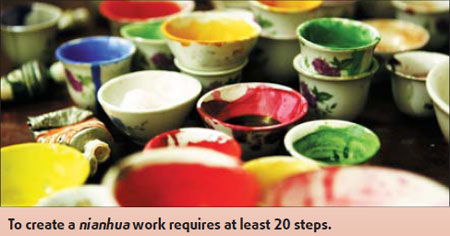
Generally, a nianhua piece requires at least 20 painstaking steps, ranging from sketching, engraving, printing and hand painting to mounting, Huo explains.
"A vivid nianhua piece needs a more than 20-step process to complete. And the success of an exquisite portrait depends not only on hard work but also a stroke of good luck," says Huo, who spent three years honing the basic skills to become a qualified nianhua artist.
"At that time, we stayed in the collectively-owned art studio until very late, learning the skills, although we were longing to see a movie show," recalls Huo, dipping her painting brush in a cone-shaped pigments container.
"As we did not have watches, we girls had to tell the time by the whistle of the trains passing by."
Huo did not expect that her early training in nianhua would turn into a lifelong commitment.
In Huo's view, nianhua is important: "It keeps alive the traces of Chinese culture and history. Art is one way through which we can identify with our national roots and communicate with our ancestors."
Huo admits, however, that Yangliuqing nianhua, like many other folk art genres, is faced with piles of challenges in this globalized world.
"People's lifestyles have changed. Our means of production have changed. The whole of society has changed. What is happening now is way beyond my imagination as a small girl in the 1950s," Huo says.
Huo has witnessed the Yangliuqing nianhua turn from a mass consumer product into a highbrow artwork in recent years.
"In the past, people came to Yangliuqing to buy nianhua every year, replacing the old with the new at their doors, kitchens and sitting rooms every New Year's Eve, before setting off firecrackers, and sitting for a family reunion feast," Huo says.
"Now people buy nianhua works and have them framed and hung high on the walls. They do not replace them when another year comes."
The traditional nianhua actually has multiple functions, Huo points out. In her family collection, there are ancient woodblocks called bi huo tu (fire-proof pictures) that have vivid love scenes, accompanied by explicit instructions.
The eight-episode bi huo tu nianhua set was either placed under the roof of a new house "to help expel evil and prevent fire accidents," or presented as a gift by parents to a married daughter as a kind of sex manual, Huo says.
Another example is Gangyu (water vat and fish) nianhua, a special category of Yangliuqing nianhua that depicts fish in bright colors. The nianhua pieces, usually hung on the wall close to a water vat, served as an indicator of water quality, Huo explains.
In old China, residents in Yangliuqing fetched water from a nearby river. They had to put alum stones into the turbid water, then stir it with a bamboo stick, and then wait until it became clear before they could use it.
People could use the water for cooking "only when it became clear enough to reflect the fishes in the nianhua piece," Huo says.
The traditional courtyard has gone and so has the old lifestyle, and as a result the Gangyu nianhua, like many other nianhua sub-genres that reflect old traditions, have been forgotten by today's artisans and consumers, says Huo Qingyou, a younger brother of Huo Xiuying, who runs another branch of the Yuchenghao Studio at Yangliuqing.
According to Huo Qingyou, there are only 39 nianhua studios still operating in the township. And the skills these folk artists have inherited are mainly derived from the old masters at the Yangliuqing nianhua Production Cooperative in the 1950s.
Although he grew up in a big family of nianhua masters, the 56-year-old did not take it really seriously until the late 1970s when he thought selling nianhua would be a good way of making a living.
Huo spent six years laying a solid foundation for his independent artistic creations, learning from his relatives, including Huo Xiuying.
In Huo Qingyou's view, a good Yangliuqing nianhua artist should be patient, careful with details and have a respect for the ancient art.
However, Huo Qingyou is worried that many young people are churning out Yangliuqing nianhua pieces, with the aid of new technologies such as serigraphs and Photoshop software.
"That could be the end of Yangliuqing nianhua art. I believe that the appeal of a piece of genuine folk art lies in its meticulous handwork and artistic spontaneity. Massed produced nianhua works are no longer real nianhua works," Huo says.
(China Daily 01/30/2009 page7) |