We have launched E-mail Alert service,subscribers can receive the latest catalogues free of charge

System Framework Options for Economic Cooperation among China, Japan and South Korea
2004-03-12


Zhang Xiaoji
Before the Asian financial crisis, East Asian countries mainly pursued a unilateral liberalization policy based on the most-favored-nation treatment (MFN), while they were also an important force in support of a multilateral trade system. The economic links among them were mainly based on market forces instead of inter-governmental institutional arrangements. The 1997 Asian financial crisis changed the policy orientation of these countries and, as a result, regional economic integration entered the fast track of institutional arrangement. The 10 ASEAN countries established a regular leaders meeting system with China, Japan and Korea (abbreviated as 10+3), thus forming a mechanism for East Asian regional cooperation. China, Japan and Korea are all countries with important influence in East Asia, and their dialogue and coordination within the 10+3 framework are playing an increasingly important role in promoting their cooperation. At their meeting in the Cambodian capital of Phnom Penh in November 2002, the leaders of the three countries agreed to launch at an appropriate time a possibility study on establishing a free trade area among these countries. This move is of positive significance to promoting the economic cooperation among them and to further realizing the economic integration in East Asia.
I. The New Trend of the Development of Global Regionalism
1. The intra-regional trade of the European Union and the North American Free Trade Area is accounting for an increasingly greater proportion of the global trade
In the 1990s, a wave of regional economic integration swept across the globe. By the end of 2001, a total of 179 regional trade agreements (RTA) had been formally notified with the World Trade Organization. Most of the WTO members joined one or more RTAs, and the trade among RTA members in 2001 accounted for 43 percent of the global trade.
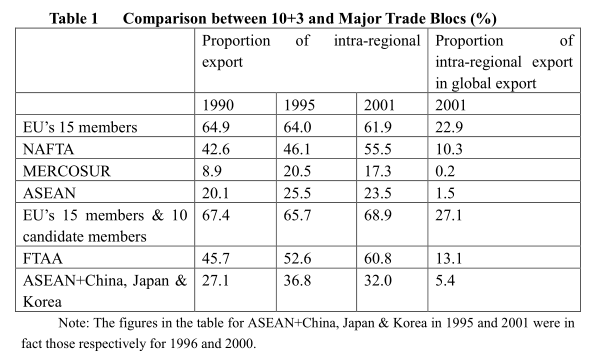
Countries generally promote economic integration through RTAs out of diverse considerations. For example, economic integration can be used to prevent possible political or military conflicts; free trade areas are established to expand regional market, attract outside investment and increase international competitiveness; small countries can strengthen their positions in the multilateral trade negotiations with their membership in regional organizations; binding free trade agreements can help affirm or promote domestic reforms. There has been no consensus on whether regional free trade agreements can help realize the initial goals of various countries. In fact, some free trade agreements now exist in name only. However, new regional trade arrangements are still coming forth one after another around the world. The driving force comes not only from the self interests of their members but also from external pressure. A multilateral trade system cannot guarantee that all countries can share the benefits of economic globalization. At present, the intra-regional trade of the European Union and the North American Free Trade Area, the two largest trade blocs in the world, are accounting for one-third of global trade. Furthermore, the European Union is continuing to expand its intra-regional market by accepting new members. Pushed by the United States, the NAFTA-based economic integration will expand to form a Free Trade Area of the Americas (FTAA). The intra-regional trade of the two greater trade blocs now in formation has exceeded 40 percent of the global trade (Table 1). Other countries are all seeking regional cooperation partners in order to avoid the damage shifted from the two trade blocs or to seek fast access to these two large markets. This is a worldwide domino effect of regionalism.
By drawing on the lessons of the failure of the Seattle Conference, the World Trade Organization added development as a topic and content when it launched the Doha Round negotiations so as to meet the strong demand of developing countries for sharing the benefits of trade liberalization. However, the progress in negotiations indicates that the European Union and the United States seem reluctant to reach a compromise on agricultural product trade and other major issues, in which developing countries have shown great interest. So it is still uncertain whether the demands of developing countries can be manifested in the results of negotiations. In addition, the results of the Uruguay Round have not been truly materialized. For example, the execution of the Agreement on Trade in Clothing (ATC) has been postponed several times and, as the importing countries have taken new technical barriers, the results of trade liberalization have been diluted. If the multilateral trade mechanism cannot play full roles in pushing forward trade liberalization and cannot enable developing countries to share the results of trade liberalization, more countries will resort to regionalism and use regional trade liberalization to promote and supplement the roles of the multilateral trade mechanism.
3. Changes are taking place in the membership and contents of regional trade agreements
In the past, members of a regional trade agreement were countries with similar levels of economic development. All the members of the European Union were developed countries, while the MERCUSOR, the Association of Southeast Asian Nations and the Southeast African Common Market were all made up of developing countries. If APEC cannot be regarded as a truly regional economic organization, NAFTA is the first regional organization made up of both developed and developing countries. Now, more and more RTA dialogues or negotiations are conducted among countries with different levels of development or even trans-continental (for example, those among EU members and Japan and Mexico). In relation to the levels of economic development, other factors such as geo-economics, regional security and global economic strategies seem to be more important when countries select regional cooperation partners.
RTA can be in many forms. In particular, FTA-based system arrangements are increasingly accepted by various countries. Most new free trade agreements exceed the scope of trade in goods, with trade in services, trade and investment facilitation and technical cooperation being the areas of expanded cooperation among various countries. This is because against the background of economic globalization, the economic links among various countries not only find expression in expanded mutual trade. Their trade has been more closely tied with foreign direct investment than ever. Transnational companies invest in establishing production networks across the globe, and intra-industry trade and intra-company trade have become the new driving force for expanding trade. Therefore, regional trade liberalization and facilitation is an important policy option for the relevant countries to attract more foreign investment.
…
If you need the full text, please leave a message on the website.