We have launched E-mail Alert service,subscribers can receive the latest catalogues free of charge

Government Regulations in China’s Reform and Development of Public Services
2005-12-16


Gao Shiji, Chen Wei & Zhang An, Research Institute of Resources and Environment Policies of DRC
Research Report No. 119, 2005
The government’s public service function must be strengthened if China is to implement the scientific concept of development, achieve a coordinated economic and social development and build a harmonious society. The 4thPlenary Session of the 16thCPC Central Committee pointed out that, "It is imperative to promote the government’s administration according to law, expedite the change of functions, deepen the reform of the administrative system, truly separate government functions from enterprise management, separate government functions from state assets management and separate government establishments from public institutions, mainly use economic and legal tools to manage economic activities and mobilize all forces to improve economic regulation, market supervision, social management and public services." How to mobilize various resources and provide public services effectively in diverse forms and how to establish an effective management system while introducing competition mechanisms to ensure the fairness, quality and efficiency of public service provision represent challenges to the Party and government in the areas of government administration concept, system improvement and administrative capacity.
I. Public Services and Public Service Regulation
1. Public services and government responsibilities
Public services refer to any type of services that are provided to the public and have the following characteristics: public services refer to the social service undertakings, such as science and technology, education, culture, medical care and sports, which are traditionally provided by the public institutions in China and which have the characteristics of quasi-public or semi-public articles. In the course of providing these services, there exists potential and serious market malfunction (interpreted broadly as the cause of equity and efficiency). This explains why government intervention is rational. The ways of government intervention include production, funding and regulation (Grout & Stevens, 2003).
As there exist problems such as incomplete competition, asymmetrical information, externality and social inequity, it is impossible to rely entirely on market mechanisms to provide public services. Either in a planned economy or in a market one, the government must intervene deeply and actively in the provision of public services. The main ways of government intervention include direct provision of public services, purchase of public services and regulation over various service providers. In most countries around the world, traditional public services such as elementary education are mainly provided directly by the government-run institutions. In Britain, France and other countries, basic medical services are mainly provided directly by the government-run medical institutions. In the United States, the Netherlands and other countries, governments also run hospitals. But they rely more on governments, commercial insurance institutions and individuals to provide funds for purchasing services from profit-making and nonprofit-making hospitals. In the meantime, the government regulatory institutions, industries’ self-disciplinary organizations and consumer rights protection organizations also exercise supervision over the prices and quality of the services provided.
What we need to emphasize is that one basic feature of a modern country is the fiscal responsibility of the government in providing elementary education, public health, basic medical security service and other basic public services. Along with a modern fiscal system, an effective public audit system is indispensable for ensuring the equity and efficiency of government spending.
2. Public service regulation
In the past 20 years or so, a new public management movement emerged in the developed market economies. One of the main contents of the movement was to introduce market mechanisms into the traditional, government-led sector of public services. The aim was to separate government functions as a public service purchaser and supplier and introduce other nonprofit-making and profit-making institutions so as to realize an effective allocation of resources and improve the quality of public services through competitive mechanisms. Some developing countries and countries in transition also began market-oriented reforms of their public services. One of the important contents of the reforms was to establish a sound regulatory system and strengthen the government’s regulatory function.
Regulation in the broad sense refers to the fact that the regulators "use public powers to make and implement rules and standards" so as to intervene in the economic and social activities of various actors, including the economic contents of products and services such as price, quality, entry and exit and the social contents of products and services such as safety, health, hygiene and environmental protection (Breyer, 1982; Hood, et al, 1999). Regulation is an important tool to overcome natural monopoly, information asymmetry, externality and inequity.
In relation to the level-based structure and the "order and control" mode of the traditional administrative system, the essence of regulation is that regulation is a rules-based administration. With the expansion of the market and the deepening of the division of labor, transactions have become increasingly complex. As a result, government roles in ensuring effective market operation and harmonious social development through effective regulation have also become increasingly important. The development of market economies around the world in the past century was also a process in which the government’s regulatory function constantly expanded and improved. This has turned modern market economies into regulatory states (Moran, 2002; Glaser & Shleifer, 2003).
Public service regulation refers to the fact that the government employs public powers to make and implement rules and standards to control the independent-operating public service institutions (inside or outside government) so as to ensure the efficiency and equity of public service provision.
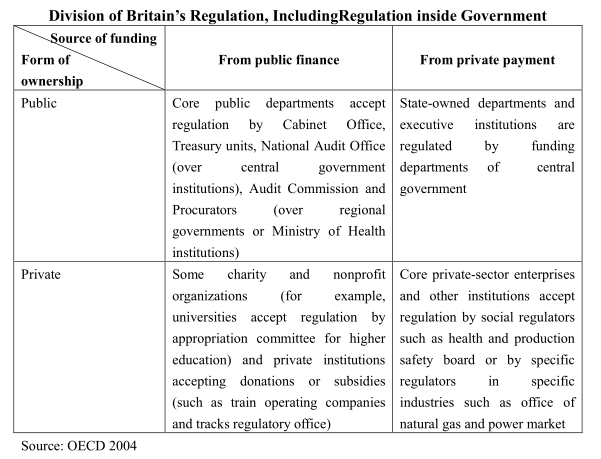
In terms of the objects controlled by regulation, public service regulation can be divided into regulation inside government or regulation within government and regulation of business.
…
If you need the full text, please leave a message on the website.