We have launched E-mail Alert service,subscribers can receive the latest catalogues free of charge

E-commerce: A Promoter for the Transformation and Upgrading of Chinese Economy
2015-07-03


By Li Guangqian & Shen Junjie, Research Team on "Strategies of E-commerce Economy for Promoting China's Economic Upgrading and Transformation", Information Center of DRC
Research Report NO. 13 2014 (Total 4521)
I. Accelerating the Restructuring of Domestic Demand
E-commerce drives forward the transformation of the Chinese economy by exerting its impacts in two aspects, namely stimulating domestic demand and changing the direction of investment.
In terms of stimulating domestic demand, e-commerce is boosting the rapid growth of demand for consumer goods across the country.
In recent years, the total retail sales of e-commerce have grown rapidly at a rate noticeably higher than that of the total retail sales of consumer goods (Figure 1). Meanwhile, the share of e-commerce sales in the total retail sales of consumer goods has been on the rise, reaching 6.3% in 2012 (Figure 2), higher than the 5% in the Unites States.

Fig. 1 Growth of Total Retail Sales of E-commerce and Consumer Goods
E-commerce enables people to go shopping without going to stores and select as many goods as they want without worrying about the time limit. As the cost of shopping falls considerably, people's willingness and demand on consumption would increase.
Regarding the direction of investment, e-commerce will lead the government and enterprises to invest more in information network, particularly the new generation of information technology, and to keep improving the environment for economic and social development. The foregoing analysis indicates that since information consumption and e-commerce overlap to a great extent, government investment in promoting information consumption is also intended to propel the development of e-commerce, which can be verified from the State Council's documents on promoting information consumption. More importantly, the demand for e-commerce applications will give a boost to the investment in promoting the use of information technology in traditional manufacturing and service industries. In addition, due to the competition between e-commerce platform enterprises, e-commerce service providers will continue to invest more in developing a modern logistics system and cloud computing technology. All these investments will contribute to the faster transformation and upgrading of the Chinese economy.
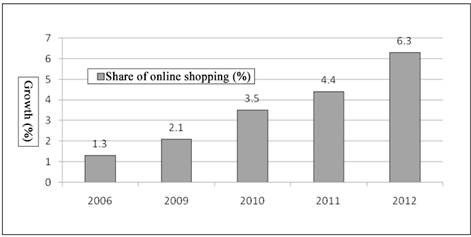
Fig. 2 Share of online shopping in the total retail sales of consumer goods, 2008-2012
Source: China Electronic Commerce Research Center; 2012 Online Retail Market Data Monitoring Report.
II. Facilitating Industrial and Corporate Restructuring
The influence of e-commerce on China's industrial restructuring is shown in the following aspects:
1. E-commerce services promote the growth of modern service industry in China.
As the ecology of e-commerce services (Figure 3) shows, goods delivery, e-payment, e-certification, IT service, data mining, online marketing, customer service outsourcing, and instant messaging all fall into the category of modern services as defined here. Even in the case of traditional courier service and goods delivery, the logistics systems established by both e-commerce platform enterprises and third-party logistics service providers are all based on business systems supported by information technology. All goods carry QR code or bar code and their location can be inquired and tracked in a real-time manner on e-commerce platforms. Moreover, payment can be made through POS machines or online in advance through Internet banks or third-party e-payment platforms. There is no doubt that these modern services will grow along with e-commerce and their share in the entire service industry will rise as well.

Fig. 3 Ecology of e-commerce services
2. E-commerce applications accelerate innovations in traditional industries.
E-commerce is bringing about changes at all stages of traditional manufacturing.
First, e-commerce spurs manufacturers worldwide to intensify R&D efforts. As e-commerce platforms bring products of one kind throughout the country and even the world onto the same stage, cost-performance ratio becomes an important factor for online shoppers to consider in making choices. Manufacturers need to follow the trends in both domestic and international markets in light of the development of e-commerce, and develop, design and manufacture products accordingly. In this way, they will be able to align their products with the changes in the international market.
Second, e-commerce promotes the application of information technology by enterprises, which underpins the growth of e-commerce as well. Over the years, enterprises have invested heavily in building the information system for internal management and the manufacturing process management system. Such efforts have improved their overall technical strength in manufacturing whereas the supply and demand relationship has not seen any noticeable improvements since they started to adopt information technology. Supply still fails to meet demand, and in some cases, enterprises fail to achieve better returns despite their heavy IT input, which is the so-called Solow Paradox ①. When the internal information system of an enterprise is connected with e-commerce platforms, its manufacturing output is further tied with the market, and the enterprise starts to be truly led by the market. In particular, with the help of tools for big data analysis provided by e-commerce platforms, the enterprise can customize its products according to market changes in a timely manner, which will drive its flexible manufacturing. As the "last kilometer" of IT application by enterprises, e-commerce will advance the process of promoting information technology among enterprises and help to address their overcapacity dilemma.
Third, e-commerce brings out better collaboration on the industry chain. E-commerce (especially B2B) will further improve the supply and demand relationship between enterprises in the upper and lower streams of the industry. They will work together in a more efficient way for the manufacturing of the ultimate products. In this way, responsibilities are better divided in the industry at large; the development of industrial clusters becomes faster; and resources are allocated more efficiently. This is the direction of e-commerce parks in China.
3. E-commerce optimizes industrial structure and improves the environment for industrial development.
E-commerce in China is now making a shift from B2B to B2C, and large enterprises are showing growing preference for using third-party platforms over running their own websites ②. Businesses of various sizes and capacities are put on a large online platform; small and medium-sized companies compete with large ones under equal conditions. In this way, traditional monopoly in some industries such as finance and insurance will be broken due to the further development of e-commerce. A case in point is Yu'e Bao's challenging the banking sector recently.
In brief, despite the rapid growth of China's e-commerce in recent years, the development is mainly about the fast evolution and formation of e-commerce services, while e-commerce applications are the foundation for the optimization and upgrading of e-commerce in the future. Therefore, future efforts to promote e-commerce should be concentrated in the following two aspects.
Large comprehensive manufacturers should apply such technologies as Internet of Things, cloud computing and big data, and come up with new ideas and paths of information technology promotion at both corporate and industry levels. The “Industrial Internet” introduced by GE is a model worth studying in this regard. The Industrial Internet offers us a vision for building a new mechanism for the division of labor and cooperation in the manufacturing sector in the information age. Its exclusive thinking, however, should not be adopted, and the integration with e-commerce platforms should be strengthened so as to bring enterprises closer to the market via such platforms.
As for small and medium-sized businesses, all sectors should work together to facilitate their transformation and upgrading through e-commerce so as to improve their capacity for technology innovations as well as China's overall competitiveness.
…
① The Solow Paradox was proposed in the 1980s, when the Internet was not widely applied yet, not to mention e-commerce.
② China's E-commerce 2012 by the Ministry of Commerce (MOFCOM).
The article was published in China Development Review, No. 2, 2014.
If you need the full text, please leave a message on the website.